




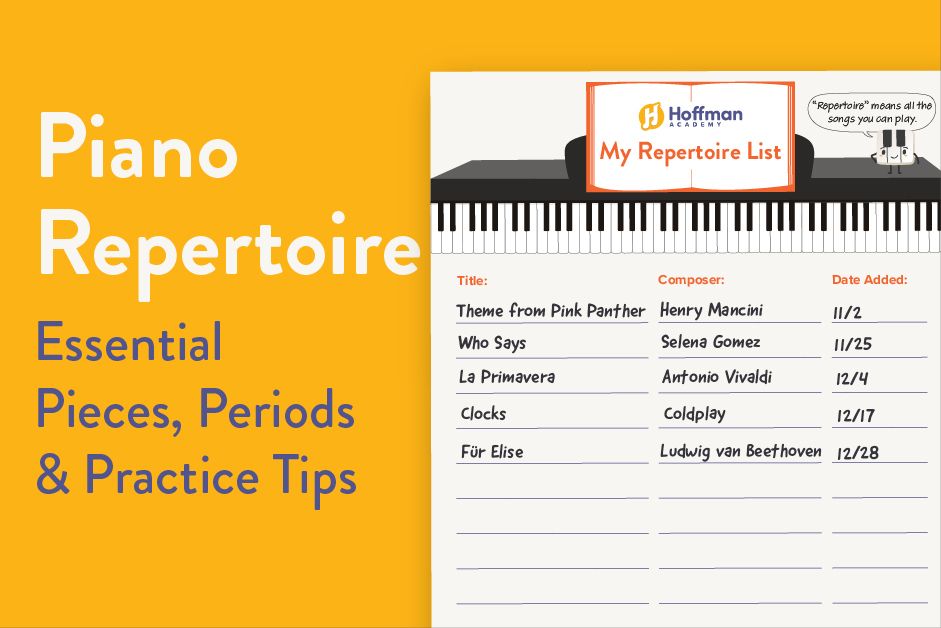
What is piano repertoire and why does it matter?
The term “piano repertoire” refers to the list of piano pieces that a particular pianist knows well and can perform confidently. From the time that you start learning piano, you can think about building a list of repertoire. In this article, you’ll learn how to build a repertoire, get suggestions for finding level-appropriate music, and more.
Want to learn the piano? Sign up with Hoffman Academy!
What is essential in choosing piano repertoire?
It’s essential to choose piano pieces that show off different facets of your personality, skills, pull from a variety of styles and historical eras, and have differing emotional qualities. In the following sections, we’ll discuss the different eras that you can choose from and give suggestions for pieces to build a strong repertoire list personalized for you.
How is piano repertoire categorized?
Classical piano repertoire is most often categorized by difficulty level as well as by style and era. In this article, we will focus on repertoire that aligns with Hoffman Academy levels. To learn more about Hoffman Academy levels and how they correspond to different leveling systems, check out our blog article Piano Levels Explained and Compared.
The main eras of classical piano music include:
- the Baroque Era (approx. 1580-1750)
- Characterized by contrapuntal writing, this era is well-known for composers such as Johann Sebastian Bach, Georg Friedrich Händel, Johann Pachelbel, and Antonio Vivaldi.
Prelude in C Minor (intermediate) – J.S. Bach:
- the Classical Era (approx. 1750-1820)
- The era that established many of the classical forms that we often encounter today. Composers at this time include Wolfgang Amadeus Mozart, Ludwig van Beethoven, and Joseph Haydn.
Scherzo from Piano Sonata No. 9 (intermediate) – Joseph Haydn:
- the Romantic Era (approx. 1800-1910)
- Possibly the most popular and lush era of western classical music, this era includes composers such as Johannes Brahms, Frédéric Chopin, Robert Schumann, Clara Schumann, Pyotr Tchaikovsky, and many more.
Elfin Dance (intermediate) – Edvard Grieg:
- the Modern/Contemporary Eras (also known as 20th Century Music)
- These are two eras that overlap and are very difficult to define. During this time period, there was an explosion of musical innovation which caused many differing styles to appear and develop. Composers during this time include Sergei Prokofiev, Dmitri Shostakovich, George Gershwin, Béla Bartók, film composers like John Williams, and so many more.
“The Mechanical Doll” (intermediate) – Dmitri Shostakovich:
Coinciding with the time periods of the Romantic and Modern/Contemporary eras, there are other unique styles which include (but are not limited to) the following:
- Impressionism (late 19th century-early 20th century)
- This style includes the composers Claude Debussy and Maurice Ravel. Their music is known for its watercolor-like sound that is created by using the sustain pedal and the composers’ unique harmonic language which includes extended chords such as 7ths, 9ths, and 13ths.
Arabesque in C-sharp Minor, L. 66 No. 1 – Claude Debussy:
- Expressionism (early 20th century)
- This style characterizes the strange and groundbreaking atonal music composed by Arnold Schoenberg, Alban Berg, and Anton von Webern.
Drei Klavierstücke, Op. 11 – Arnold Schoenberg:
- Serialism and Experimentalism (mid to late 20th century)
- Similar to expressionism, these styles are even more extreme and experimental. In these styles, composers like Pierre Boulez, Milton Babbit, Karlheinz Stockhausen, John Cage, and Morton Feldman focused on pushing the boundaries of music, but that means that this music is often considered difficult to listen to and is rarely recorded or performed for audiences.
“Rapide” from 12 Notations Pour Piano – Pierre Boulez:
- Neoclassicism (20th century)
- This style was popularized by composers like Igor Stravinsky, Sergei Prokofiev, and Paul Hindemith, who wanted to return to forms and conventions used during the Baroque and Classical Eras.
Piano Sonata in C Major, Op. 38 – Sergei Prokofiev:
- Minimalism (late 20th century)
- This style is well known for its repetitive nature and was popularized by composers such as Philip Glass, Steve Reich, Arvo Pärt, and John Adams.
Piano Phase for Two Pianos – Steve Reich:
- Film Music (20th century until today)
- This isn’t really a style by itself, but a collection of music composed for films which utilizes many different styles. Famous film composers include John Williams, Hans Zimmer, Bernard Hermann, and countless others.
“Main Theme” from Interstellar – Hans Zimmer:
More recent and popular styles also include jazz, rock/pop, and New Age music. Jazz piano composers include Oscar Peterson and Duke Ellington, New Age piano music includes composers such as Yiruma and Joe Hisaishi, and pop/rock music includes arrangements of songs by Taylor Swift, Billy Joel, Elton John, and many others.
How do you choose piano repertoire? What should a piano repertoire list include?
The piano repertoire that you choose often depends on the reason that you are choosing repertoire. If you are choosing general repertoire that you can perform at any recital or other performance, it’s important to choose music that varies in style, era, and mood. If you are choosing music for a recital with a particular theme, it’s important to choose a variety of music from different time periods/styles that fit into that theme.
What are recommendations of piano repertoire for beginners?
If it’s your first time putting together a list of piano repertoire, you’re a beginning student, and you don’t know how to start, Hoffman Academy has a lot of options for you to choose from. Our lessons include tons of songs for you to learn and add to your repertoire, but we also offer additional favorite classical pieces, film music, pop songs, folk songs, and more. You can find these additional pieces on the Popular Songs page of our website.
It’s important to have a Classical favorite or two in your repertoire list. On the Hoffman Academy website you can find early elementary tutorials of Ode to Joy, Für Elise, and, elementary tutorials of Für Elise (elementary) and In the Hall of the Mountain King (elementary), as well as other elementary level options, intermediate and advanced level tutorials, and more.
La Primavera (early elementary) – Antonio Vivaldi:
Adding Film music to your repertoire list is a way to liven up your repertoire list and play something that lots of people know. Our website includes popular choices such as the early elementary tutorial of John Williams’ famous Imperial March from Star Wars, elementary tutorials of the immortal Hedwig’s Theme from Harry Potter, the late elementary tutorial of the very popular Golden from K-pop Demon Hunters, and countless others.
Theme from Pink Panther (early elementary) – Henry Mancini:
Another way to shake up your repertoire list is by adding popular Pop songs to it, including elementary tutorials of Taylor Swift’s Shake It Off, Rachel Platten’s Fight Song, a late elementary tutorial of Coldplay’s Clocks, and many more.
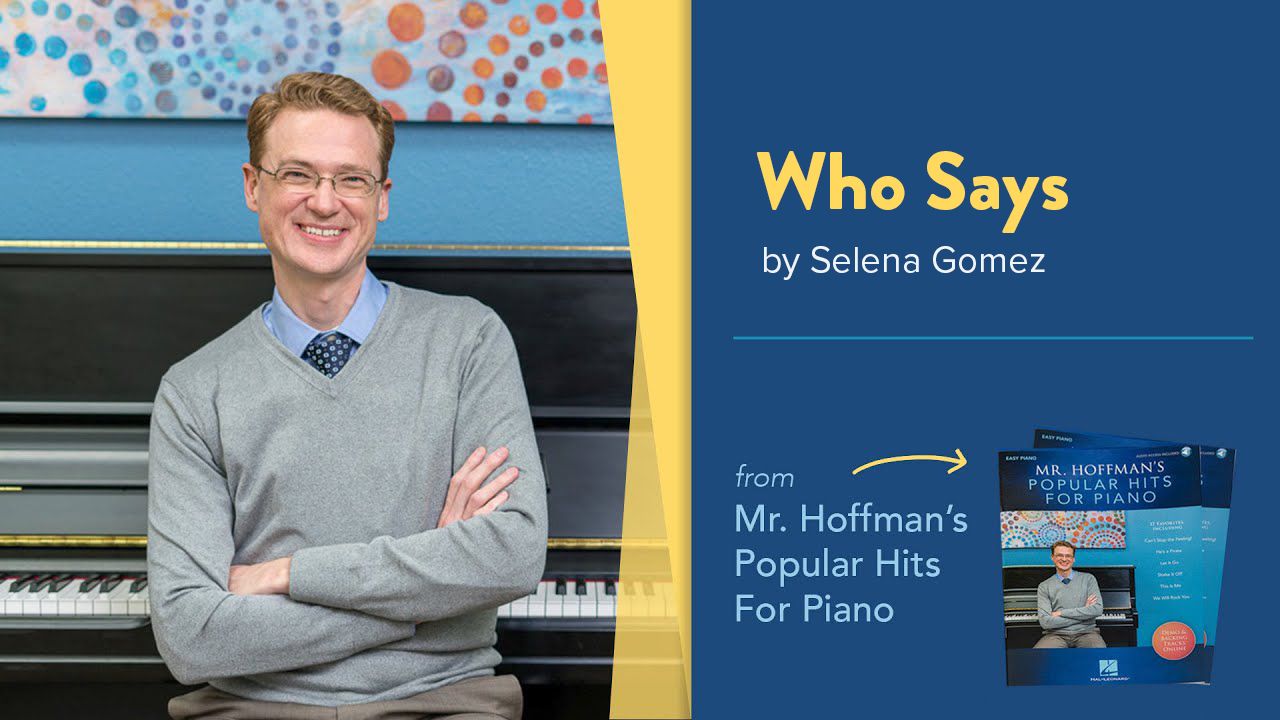
“Who Says” (elementary) – Selena Gomez:
Lastly, add a favorite Folk song to your list by including an early elementary version of Twinkle Twinkle Little Star, Amazing Grace, Chopsticks, or search the rest of our folk songs on the Popular Songs page of our website.
Aloha ‘Oe (early elementary):
What are some of the best piano repertoire books?
Some of the best piano repertoire books that you can find and order online include the Keith Snell Piano Series, Christopher Norton’s American Popular Piano Repertoire Series, and The Royal Conservatory’s Celebration Series. These book series include many varieties of pieces that you can build a repertoire list from.
Building a lifelong journey through piano repertoire
Building a diverse and engaging piano repertoire is a journey that expresses your personality, allows you to connect with and dive into music history, and showcases your skills. There are so many options from different classical eras, folk and pop songs, film scores, and more to keep you interested and refreshed as you learn and perform. It’s important to remember to select pieces that show off different emotions and appropriately challenge you. With the resources provided above, such as tutorials and materials on the Hoffman Academy website as well as repertoire collections, you are now ready to build your own repertoire list. Ultimately, your repertoire is more than just a list of musical pieces—it’s your personal musical story that grows and evolves as you do. We here at Hoffman Academy encourage you to keep exploring, continue learning, and most importantly, enjoying the wonderful world of piano music!