



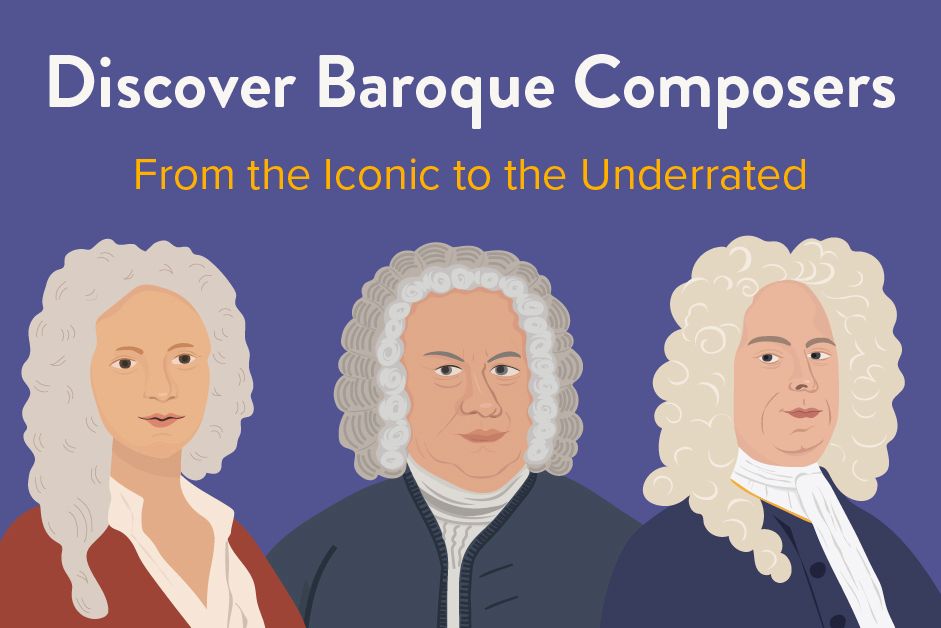
Baroque composers shaped a powerful era of music, leaving a legacy of famous names and lesser-known voices still worth exploring today
What is Baroque music?
The Baroque Era includes western classical music that was composed roughly between the years 1600 and 1750. The Baroque Era followed the Renaissance Era (approx. 1400-1600) and the Medieval Era (circa 500-1400) before that. The Renaissance Era was known for bending and breaking the musical laws that had confined musical creativity during the Medieval Era. In the Renaissance Era, composers introduced harmony (Medieval music is mostly a melody with no independent accompaniment), added independent instrumentation to vocal music, and separated music into sacred (music for the church) and secular (music for the people) forms.
During the Baroque Era, composers and musicians amped up their creativity, standardizing tuning conventions, creating new instruments, assembling larger ensembles (orchestras) to perform compositions, and creating new forms such as opera and oratorio. This era gave way to the next musical period, the Classical Era (circa 1730-1820), which is known for some of the most innovative and recognizable composers in history, such as Haydn, Mozart, and Beethoven. In this article we’ll take a look at the most important names of the Baroque Era and introduce some names that should be more well-known. Read on to learn more!
Learn Baroque music with Hoffman Academy! We have piano tutorials for some of the most popular works from Baroque composers. Discover your piano potential at Hoffman Academy with the world’s best piano learning system.
Who is considered the master of Baroque music?
The master of Baroque music was composer Johann Sebastian Bach, who lived from 1685 to 1750. Bach was an extremely prolific German composer who composed over 1,000 pieces of music during his lifetime, some smaller and some grand in scale. He is so important to the history of music that the name Bach is even well-known today by people who do not listen to classical music. His work often appears in movies and television. Examples of his work include the famously spooky and intimidating Toccata and Fugue in D Minor which is very popular around Halloween, his beautiful Christmas Oratorio, and the peaceful “Jesu, Joy of Man’s Desiring.” Below are some tutorial videos and sheet music to help you learn some of these famous pieces on piano. You can check out the Hoffman Academy store for even more Bach sheet music.
Tutorial videos:
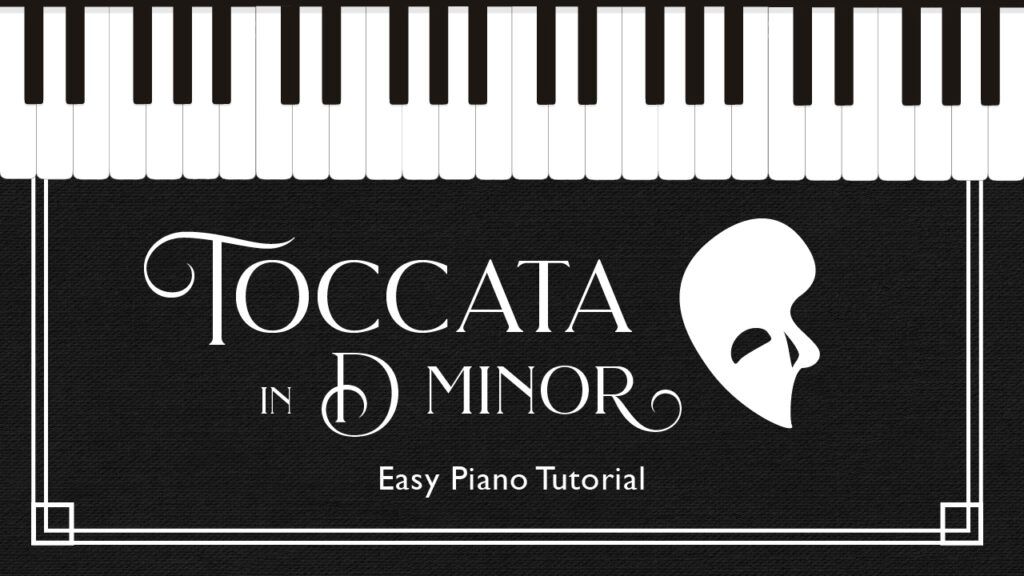
Toccata and Fugue in D Minor (elementary)
Toccata and Fugue in D Minor (intermediate)
Sheet music in store:
Toccata and Fugue in D Minor (elementary)
Toccata and Fugue in D Minor (intermediate)
Jesu, Joy of Man’s Desiring (early intermediate)
Who are the most famous composers of Baroque music?
An incredibly influential name in Baroque music is George Frideric Handel (or Georg Friedrich Händel in his native German). Handel was a German composer who lived from 1685 to 1759. He spent much of his life living and composing in Italy and later Britain, where in 1727 he became a naturalized citizen. He is famous for his many operas, oratorios, masses, keyboard works, concerti, and so much more. Many of these operas and oratorios are still performed today, especially The Messiah, which is often heard around Christmastime and Easter.
While Johann Pachelbel (1653-1706) is not well known for a large body of works, he is very well known for the Canon in D Major, also known as “Pachelbel’s Canon.” This composition contains a chord progression that has inspired countless songs, within which the progression has been partially or fully used. These songs include “Memories” by Maroon 5, “Starships” by Nick Minaj, “Don’t Look Back in Anger” by Oasis, “Basketcase” by Green Day, “Let It Be” by The Beatles, and many others.
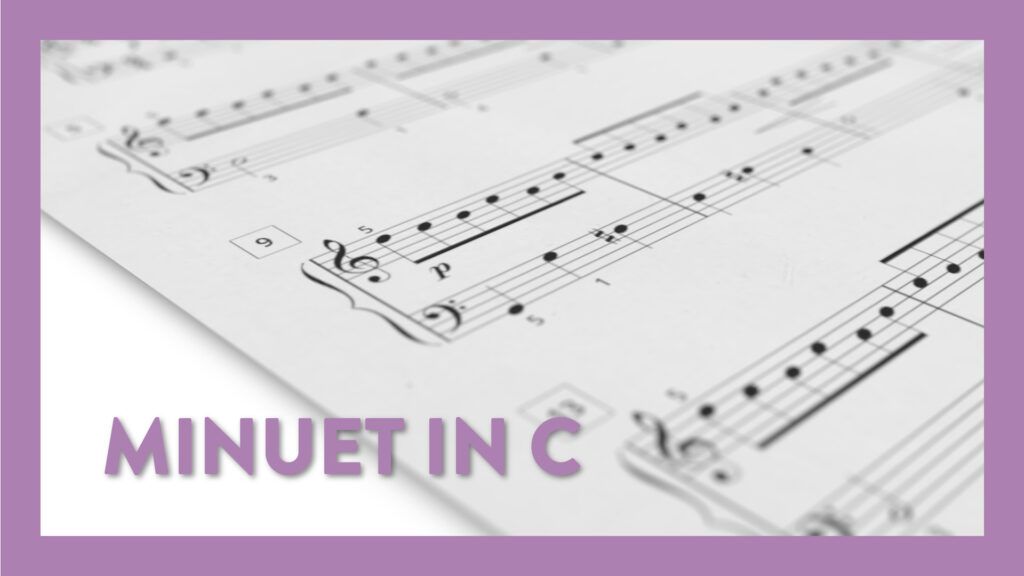
Jean-Philippe Rameau (1683-1764) was a French composer who replaced Jean-Baptiste Lully as the dominant opera composer in France. He was also one of the leading French composers of keyboard music, alongside François Couperin. One of his most famous keyboard compositions is a movement from his Suite in G Major for Harpsichord, RCT 6 entitled “La poule,” which translates to “the chicken” from French. This piece is written to make the instrument sound like a group of hens clucking and pecking! Listen here. Most of this composer’s music is quite advanced, but that doesn’t mean that you can’t learn to play something beautiful by Rameau. A Rameau piece for less advanced students is his Minuet in C Major. In the following video, Mr. Hoffman will guide you through learning this fun piece:
Antonio Vivaldi (1678-1741) was an Italian priest, virtuoso violinist, and composer who wrote over 50 operas, countless instrumental concertos, and today is best known for The Seasons. You can learn “Spring,” which is one of the best-known movements from this work, by watching the following video:
Video: La Primavera
Sheet music: La Primavera
Domenico Scarlatti (1685-1757) was an Italian composer well-known for his keyboard sonatas. You can learn some of Scarlatti’s sonatas from Mr Hoffman by watching his video on the Sonata in A Major, K. 323, the Sonata in G Minor, K. 35, and the Sonata in D Minor, K. 34.
Early Baroque composers
Some important early Baroque composers include Dutch organist and composer Jan Pieterszoon Sweelinck (1562-1621), Italian opera composer Claudio Monteverdi (1567-1643) who composed the earliest opera still regularly performed, Italian keyboard composer Girolamo Frescobaldi (1583-1643), and German composer Heinrich Schütz (1585-1672). Schütz is best known for his early oratorios, some of which are still commonly heard today.
In the following video you will hear an organ toccata composed by Sweelinck.
Important baroque composers who deserve more recognition
Unfortunately, there are many Baroque composers who deserve to be better known. Included are the fascinating female Italian composers Francesca Caccini (1587-1640s), Barbara Strozzi (1619-1677), and Isabella Leonarda (1620-1704). Caccini composed the oldest opera known to be composed by a woman. She was a very prolific composer, but sadly most of her music has been lost. Thankfully, her opera still exists and you can hear it by clicking here. Strozzi was a composer and singer who published over eight volumes of her own compositions during her lifetime and composed more secular music (music not meant for the church) than any other composer of the same era. Leonarda was both a nun and another very productive composer, turning out large amounts of sacred choral music (music meant for the church) and instrumental works such as concerti and sonatas.
Other important Baroque composers who deserve more recognition include French keyboardist-composer François Couperin (1668-1733), Dieterich Buxtehude (1637-1707), Georg Philipp Telemann (1681-1767), and Antonio Soler (1729-1783). Couperin composed vast amounts of works for the harpsichord (a predecessor of the piano). His most well-known piece is “Les Baricades Mistérieuses,” which you can listen to here. Danish composer Buxtehude served as a huge influence on the compositions of Johann Sebastian Bach. A commonly told story is that Bach walked from his home in Arnstadt to an organ concert in Lübeck just to hear Buxtehude perform. This is a 250 mile walk one-way that would have taken him four days. One of the most prolific (if not the most prolific) composers who has ever lived was German composer Telemann, from which 3,000 works still exist today. Soler was a Catalan-Spanish monk and composer best known for his keyboard works, specifically his sonatas. The following video is a recording of one of Soler’s sonatas.
Baroque composers continue to inspire with music that’s both timeless and full of character
The Baroque era was a time of transformation in Western classical music, in which innovations in harmony, instrumentation, and musical form changed the course of musical history and paved the way for the music of today. Within this expansive era that spanned from roughly 1600 to 1750, early Baroque pioneers like Monteverdi and Sweelinck created works that inspired future musical giants like Johann Sebastian Bach and George Frideric Handel to compose oratorios and other works that are still performed regularly today. Thousands of fascinating and timeless works were contributed by other Baroque composers such as Pachelbel, Rameau, Vivaldi, and Scarlatti, and compositions by composers who should be better-known, such as Isabella Leonarda and Barbara Strozzi, are waiting to be discovered and performed.