


Learn all about the life and legacy of Johann Sebastian Bach
In 1750, prolific composer Johann Sebastian Bach died in the German city of Leipzig. His long post there as music director was ended by cataract surgeries that blinded him. This father of twenty children, only nine of whom outlived him, had a career marked by contentious employment and even a month-long jail term for trying to change jobs. He was highly praised as a keyboard virtuoso, but would nevertheless not be well-known for his compositions until some eighty years after his death.
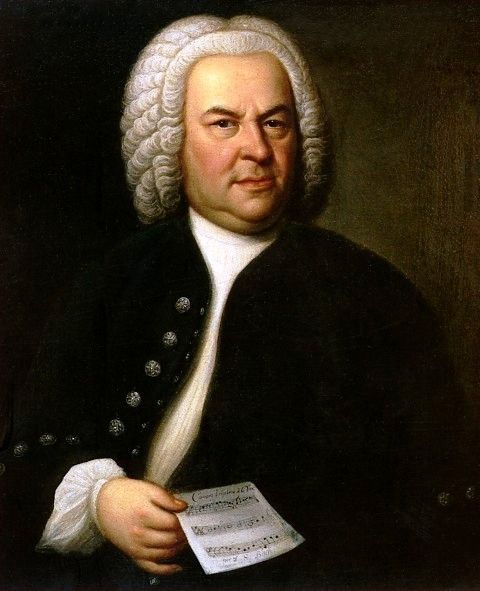
If there are turning points in the history of Western music, one could justly be centered on the career of Johann Sebastian Bach. Both the apex of centuries-long musical development and a harmonic pioneer, Bach was a conservative and progressive all in one. He was versatile in almost every musical genre of his time. Let’s tour the career and influence of this German composer whose life stood for genius and a tireless commitment to music.
You can browse sheet music by Johann Sebastian Bach in the Hoffman Academy store!
Johann Sebastian Bach’s career, children, and family life
Early childhood
Johann Sebastian Bach was born on March 21, 1685 in the town of Eisenach, where Martin Luther had come to translate the Bible into German over a century earlier. Lutheranism would, in fact, be the spiritual core of Bach’s music throughout his life. He was born into a talented musical family, including his court trumpeter father, Johann Ambrosius Bach, and uncles who were either chamber musicians or organists. Bach was the eighth child of Maria Elisabeth Lämmerhirt, who died when Bach was nine years old. He would also lose his father less than a year later.
Johann Ambrosius Bach

After his father’s death, Johann Sebastian Bach came to Ohrdruf to live with his brother, Johann Christoph, a church organist. The young Bach was given keyboard lessons, and was shown music from an international sampling of composers, including Pachelbel, Lully, and Frescobaldi. There is a legend that the young Johann Sebastian copied his brother’s music by moonlight, and that this led to blindness later in life. Although he did indeed lose his sight, the real cause would be far more appalling.
1703-1708
Bach’s career meandered through various German cities as he searched for better employment. In 1703, after graduating from St. Michael’s School in Lüneburg, he was made a court musician for the Duke of Weimar. Bach’s keyboard prowess was such that in six months he was appointed organist at the New Church in Arnstadt. Over the next four years he studied organ at the urging of Dieterich Buxtehude. Bach’s occasional absences from Arnstadt irritated his employer, a matter not improved by Bach’s frustration with the musicians he worked with. This led him to change jobs and secure an organist position at the Blasius Church in Mühlhausen in 1707.
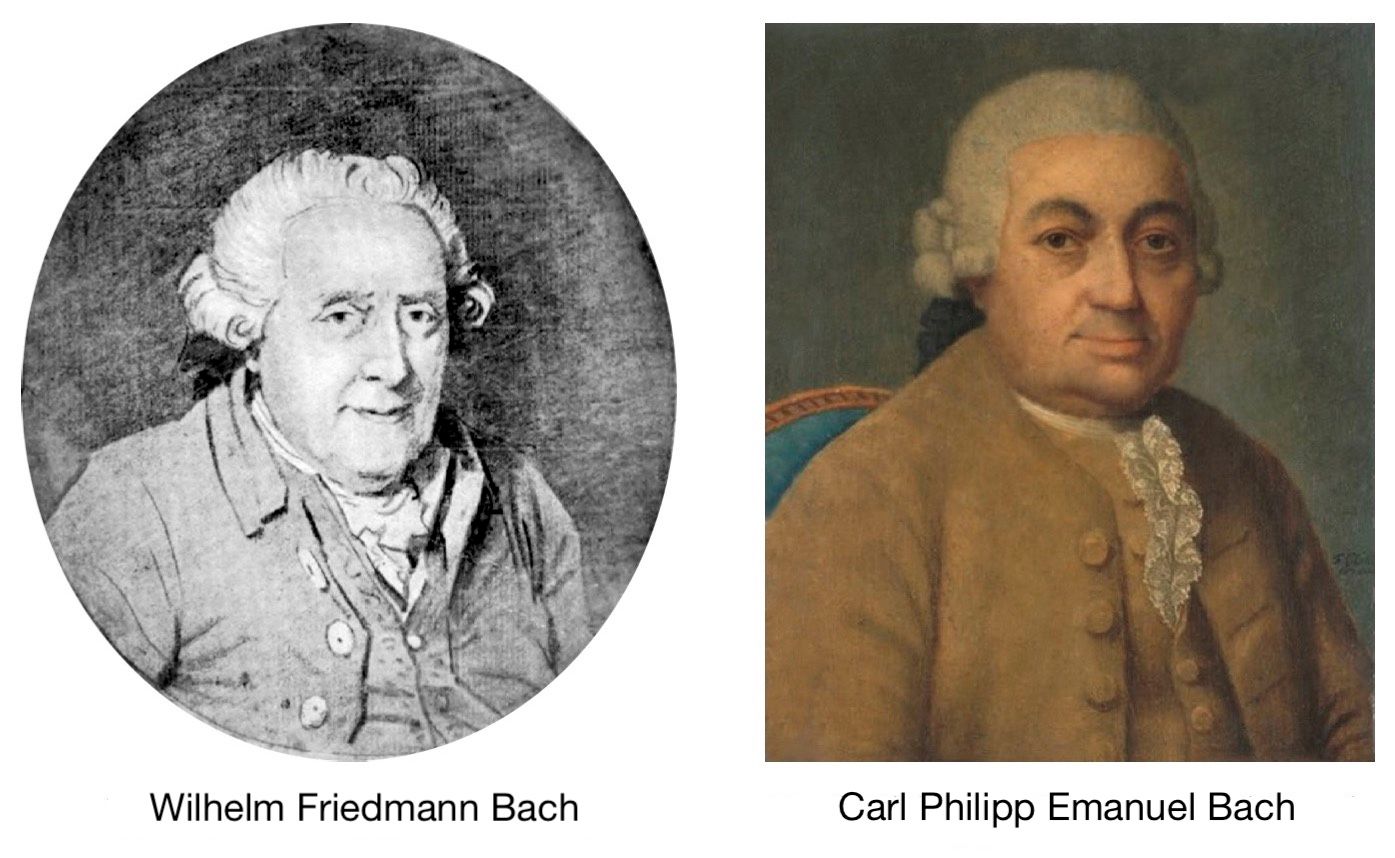
During his year in Mühlhausen, Bach married his second cousin, Maria Barbara Bach. They returned to Weimar in 1708, where Bach became the organist at the Duke’s court. He and his first wife would have seven children, with four living to adulthood. This was common in a time of high infant mortality. Two of Maria Barbara’s sons, Carl Philippe Emmanuel and Wilhelm Friedmann, became noteworthy composers themselves.
1708-1723
During his nine years at Weimar, Bach was able to compose steadily for the first time. He produced many keyboard works, including the preludes and fugues that would become the first book of the Well-Tempered Clavier. In 1714, he became the court music director and composed some of his early Lutheran cantatas. Weimar was a very fertile period for Bach, but increasing tensions with the Duke led to a painful career change. In 1717, Prince Leopold of Köthen hired Bach to be his Kapellmeister. It was a lucrative post that would not come easily to Bach, whose current employer at Weimar, Duke William Ernest, refused to accept his resignation. The fiasco culminated in Bach being jailed for nearly a month before the Duke reluctantly granted his release.
Prince Leopold was a Calvinist, whose church worship required only simple music. As a result, Bach’s six years at Köthen were devoid of church service music. He worked mostly on his cello and orchestral suites, violin sonatas and partitas, and other secular instrumental pieces. The famous six Brandenburg Concertos are from this period, today considered supreme examples of the Baroque concerto grosso.
The Brandenburg Concertos are so named because Bach may have tried to use them to get hired at the court of Christian Ludwig, Margrave of Brandenburg. This endeavor showed what most composers had to endure in Bach’s time. Here is an excerpt from the dedication page for these works:
“…as I noticed then that Your Highness took some pleasure in the little talents which Heaven has given me for music, and as in taking leave of Your Royal Highness, Your Highness deigned to honor me with the command to send Your Highness some pieces of my composition…”
Today we might laugh at this obsequious language, but it was nothing less than aristocratic protocol in Bach’s time. Composers were servants, and had to go begging for commissions or posts. Once secured, they had to do their fair share of ring-kissing, as the above dedication attests. It would be fifty years after Bach’s death before a robust middle class would support careers free of such forced patronage. Ultimately, for all of Bach’s efforts, his six Brandenburg Concertos were never performed by the Margrave, who likely considered their technical demands beyond the skill of his musicians.
Tragedy befell in 1720 when Maria Barbara died. The next year, Bach met and married the soprano Anna Magdalena Wilcke, who sang at the same court in Köthen where Bach worked. She continued her performing career during their marriage, and even sang at Prince Leopold’s funeral in 1729. She and Bach would have thirteen children together, and two of their sons would also have careers as composers: Johann Christian and Johann Christoph Friedrich.

1723-1750
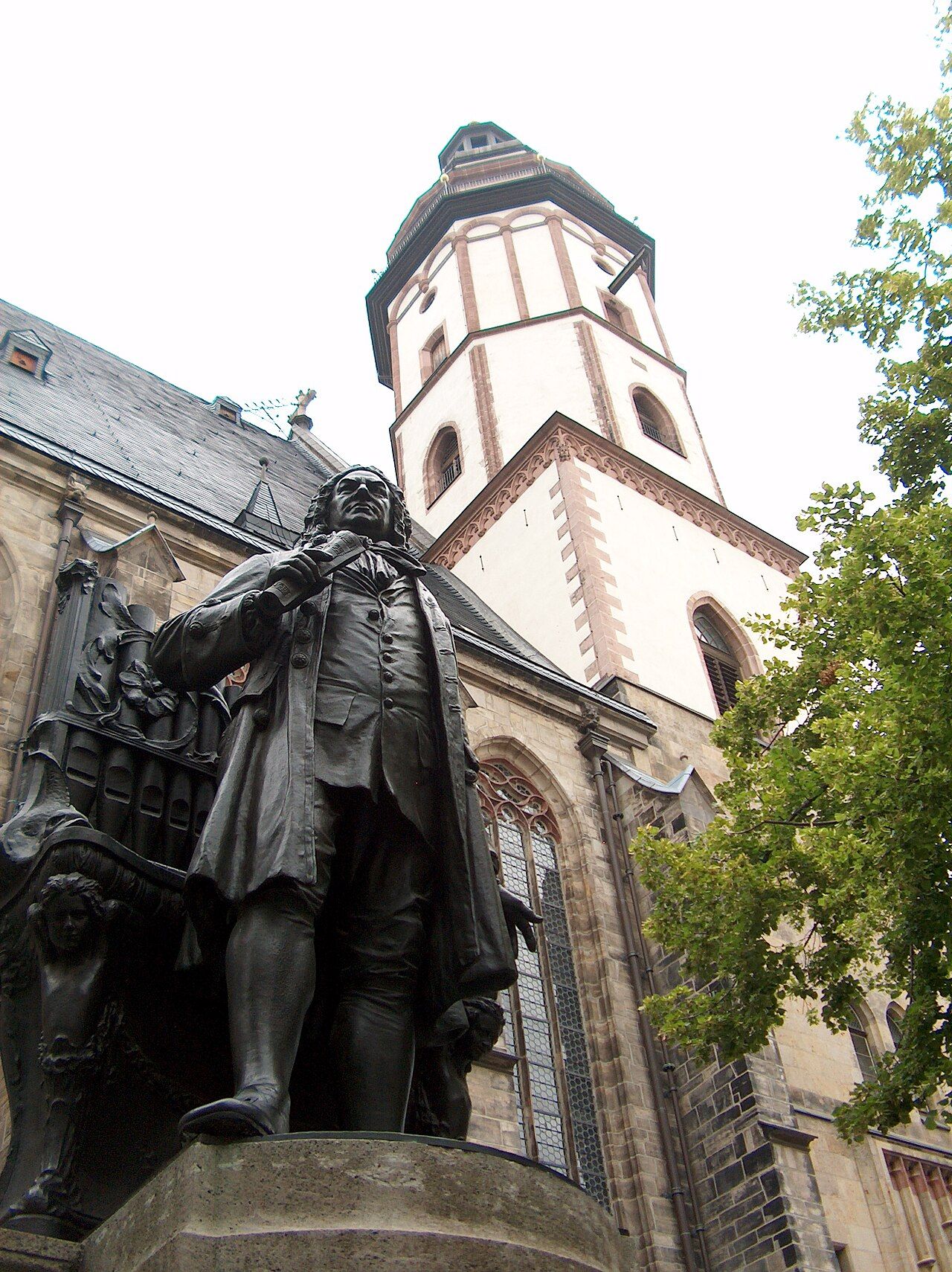
A year after marrying Anna Magdalena, Bach applied for the influential post of Thomaskantor, the music director for the St. Thomas Choir of Leipzig. Among his considerable duties was composing for no fewer than four Lutheran churches in Leipzig. Bach held this appointment for the rest of his life, and it was finally the blend of Lutheran worship and composing he’d sought. In his first six years at Leipzig he wrote a new cantata weekly, each a twenty to thirty minute piece for chorus and full orchestra. By 1729, he had over three hundred cantatas, enough for every Sunday service and feast day in the Lutheran calendar.
In the next twenty years, Bach composed the immense Mass in B minor, one of the greatest settings of the Catholic mass. He also wrote Book II of the Well-Tempered Clavier, for a total of 48 keyboard preludes and fugues. Then, in 1747, he met King Frederick The Great of Prussia, for whom he improvised a three-voice fugue on a theme the King had written. Bach then improvised a six-voice fugue on another theme, which developed into A Musical Offering. Equally impressive was Contrapunctus, a final set of fugues Bach never finished, and which today is known as The Art of Fugue.
A final travesty likely hastened Bach’s death. He had two cataract surgeries done by John Taylor, an English doctor now known to be a fraud. The operations left him blind, and may have led to infections that compounded his already poor health. Bach died on July 28, 1750, a victim of the same surgeon who would blind George Frederick Handel eight years later.
What is Johann Sebastian Bach most known for?
Complex polyphony
J.S. Bach was a consummate writer of polyphonic music, in which multiple voices and melodies are set against one another. He is today known as perhaps the most accomplished master of this style, and his music remains a staple of composition teaching to this day. Here is an excerpt from his Fugue in C-sharp Major from Book 1 of the Well-Tempered Clavier:

A new tuning system
Johann Sebastian Bach also played a large role in the change to equal temperament, a tuning that divided the octave into twelve equal half steps and allowed musicians to modulate to any key. Before this, with previous systems like Pythagorean and mean tuning, modulation was far more limited. His Well Tempered Clavier was more than an ingenious collection of preludes and fugues. Each one is in a different key, showcasing the versatile new tuning system.
Was Bach a conservative composer or a progressive one?
The answer is, both. It depends on which part of his style you’re looking at.
Bach’s preferred musical texture was polyphony; in that sense, he was utterly backward looking. It is no hyperbole to call his music the culmination of some five hundred years of development. From 12th Century organum through late Medieval motets, from Renaissance masses through Baroque fugal writing, Bach was perhaps more indebted to the past than any other composer.
On the other hand, what set Bach apart from his contemporaries was his obsessive use of chromaticism. This is a reliance on accidentals––notes that are foreign to any given key. While other Baroque composers, like Handel, Pachelbel, and Telemann, used plenty of chromaticism in their music, they did not share Bach’s indulgence. Here is a passage from the harpsichord cadenza in the first movement of his Brandenburg Concerto No. 5:

This highly chromatic writing opened harmonic doorways that allowed Bach to either create or codify much of the harmony that would be used well into the 19th Century. Modulation with secondary dominants and diminished chords, Neapolitan harmony, and the rudiments of augmented 6th chords are all to be found in his music. For all his stylistic obsolescence, he left a vast new harmonic territory for the next few generations of composers to explore.
Johann Sebastian Bach’s Most Famous Pieces:
Brandeburg Concerto No. 3
This was one of the six concerti grossi that Bach presented to the Margrave of Brandenburg in 1721. Enjoy the breathless final movement of this now famous masterpiece:
Brandenburg Concerto No. 3 BWV 1048, Third movement: Allegro, Voices of Music
Prelude and fugue No. 3 in C-sharp Major
This is typical of the complexity found in Book 1 of the Well-Tempered Clavier. With a key signature of seven sharps, Bach ventured into keys rarely used in his time:
Prelude & Fugue No. 3 in C-Sharp Major, BWV 848, WTC I; Marta Czech
Prelude no. 1 in C Major
This is the very first piece in Book 1 of the Well-Tempered Clavier. It’s a virtual master class in modulation, voice leading, and chromatic harmony, and proof that the new equal temperament permitted wide-ranging key changes. It’s also only intermediate in skill level, accessible to piano students with a few years of experience:
Prelude No. 1 in C Major from The Well Tempered Clavier Book 1
Cantata No. 80, “Ein feste Burg ist unser Gott”
Based on Martin Luther’s chorale A Mighty Fortress Is Our God, this is one of Bach’s most splendid fugual treatments of a Protestant hymn melody. Listen to the fugue subject at the beginning, set to the first hymn phrase “Ein feste Burg ist unser Gott.” When this phrase ends, it is set against the second hymn phrase “ein gute Wehr und Waffen” as a countersubject. The effect is simply glorious:
Cantata BWV 80 “Ein feste Burg ist unser Gott” (J.S. Bach Foundation)
Mass in B minor, Kyrie
At nearly two hours in length, this is one of the most imposing sacred choral pieces in Western music. This first section, the Kyrie, has a somber introduction, then builds as a massive fugue, first with orchestra, then with the chorus joining in:
MASS in B minor, BWV 232: I. KYRIE – Laurenscantorij – (Hohe Messe)
How much music did Johann Sebastian Bach compose?
Bach was prolific and masterful in every musical form of his time, except opera. He is famous for his powerful oratorios, including the St. Matthew and St. John Passions, hundreds of Lutheran cantatas and chorales, concerti grossi, orchestral and keyboard suites, sonatas and partitas for solo violin, and cello suites. In all, he composed over 1,100 pieces, and could arguably claim a more consistent degree of perfection than any other German composer.
Why did J.S. Bach’s music take so long to be recognized?
Unlike Handel, Bach never left the German states, crisscrossing from one German city to another throughout his career. From this map, you can see how restricted his travels were:

Also, given the waning popularity of his complex style, his music was not widely published outside of the German lands until the early 19th Century. One music critic, Johann Adolphe Scheibe, summed up the musical zeitgeist of the mid-1700s by criticizing Bach’s style. According to him, with all voices treated equally, there wasn’t a clear distinction between melody and accompaniment. In short, there was too much to listen to! By the time of his death, the new galant style was all the rage, with homophonic textures and short, tuneful phrases. Bach had been digging in his heels and composing in an “antique style” already years in its grave.
Johann Sebastian Bach did enjoy some fame in his lifetime, but as a virtuoso performer, not a composer. It took nearly 80 years after his death for his composing stature to come to light. Through the revival performances and teaching efforts of Felix Mendelssohn, Robert Schumann, and Johannes Brahms, Bach eventually joined the pantheon of the greatest composers in Western music. Brahms once said of J.S. Bach’s great Chaconne for violin: “On a single stave, for a small instrument, the man writes a whole world of the deepest thoughts and most powerful feelings.” Listen to Itzhak Pearlman play the Chaconne, and it’s impossible to disagree:
Partita for Solo Violin No. 2 in D Minor, BWV 1004: V. Chaconne