





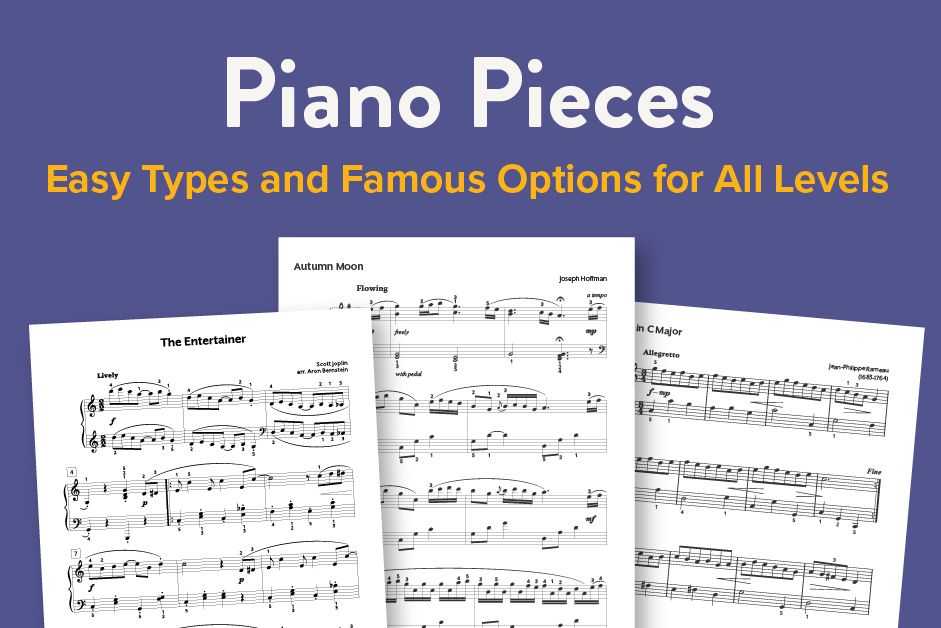
Learn about the different types of piano pieces!
There are many different types of piano pieces, some of which are based on dances (waltz, mazurka, and minuet), some that follow a specific artistic format (sonata and fugue), some that tell a musical story (intermezzo and fantasia), and others that are used to teach a specific skill (étude). Continue reading to see our extensive list of examples and their composers. You can also find sheet music and tutorials for many of the pieces on this list on our website.
Want to learn the piano? Sign up with Hoffman Academy!
What are the different types of piano pieces?
- Contemporary pop crossover pieces – These are piano works that combine pop and classical styles. They are often called “songs” because they sound like they could be sung along with, but a true song must have words to be called a song. Popular composers in this style include Yiruma, Joe Hisaishi, and David Lanz. A Hoffman piece in this style includes Joseph Hoffman’s composition “Autumn Moon.” Click on the image below to watch the video and learn this piece!
- Waltz – A dance-inspired piece in 3/4 time of Austrian origin. This style is used in classical music, jazz music, and other genres. Composers who wrote waltzes include Franz Schubert, Frédéric Chopin, Ferenc Lehár, Johann Strauss II, Dmitri Shostakovich, and many more.
- Waltz No. 2 – Dmitri Shostakovich
- Waltz in D-flat Major “Minuet Waltz”, Op. 64 No. 1 – Frédéric Chopin
- “The Beautiful Blue Danube” Waltz, Op. 314 – Johann Strauss II
- Minuet – A dance-inspired piece in 3/4 time of French origin. Claude Debussy, Christian Petzold, J.S. Bach, Ignacy Jan Paderewski, and others famously composed minuets for the piano.
- Mazurka – A lively dance-inspired piece in 3/4 time of Polish origin. Composers like Chopin, Alexander Borodin, and Karol Szymanowski are known for having composed mazurkas for the piano.
- Mazurka in F-sharp Minor, Op. 59 No. 3 – Frédéric Chopin
- Polonaise – Another lively dance-inspired piece in 3/4 time of Polish origin. Polonaises for the piano were composed by Chopin, Moritz Moszkowski, Edward MacDowell, and others.
- Polonaise in A-flat Major, Op. 53 – Frédéric Chopin
- Rag – A dance-inspired piece in 2/4 time of African-American origin. Some of the most famous composers of rags include Scott Joplin, James Scott, Joseph Lamb, and William Bolcom.
- Sonata – A multi-movement piece composed to a specific sonata-allegro form. Hundreds of sonatas have been composed in the last few hundred years, but some famous sonatas were composed by W.A. Mozart, Ludwig van Beethoven, Sergei Prokofiev, and Florence Price.
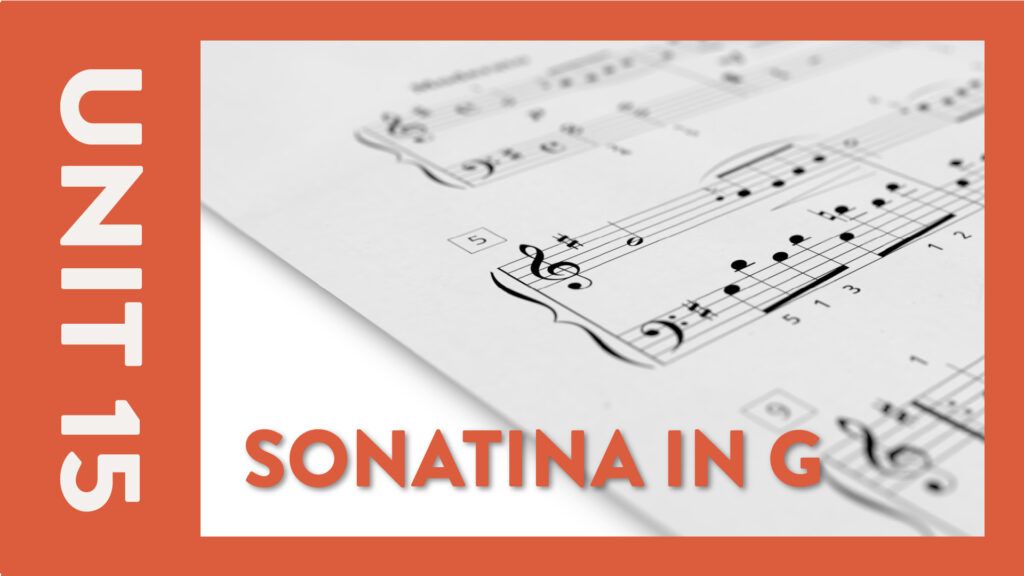
- Sonatina – A smaller version of the sonata that is often used to teach students about sonata-allegro form. Famous composers of sonatinas include Muzio Clementi, Friedrich Kuhlau, and Beethoven.
- Fugue – A contrapuntal piece that was made popular during the Baroque Era by composer J.S. Bach. His fugues were a great inspiration to other fugal composers, such as Beethoven, Johannes Brahms, and Shostakovich.
- Invention – Short contrapuntal pieces that are normally composed for two or three voices. The most famous inventions composed for piano were written by J.S. Bach.
-
- Two-Part Invention in A Minor, BWV 784 – J.S. Bach
- Theme and Variation – A piece of music that contains a theme and variations of that theme. Some famous themes and variations were composed by Mozart and Robert Schumann.
- Geistervariationen – Schumann
- Blues – A musical form that originated in the Deep South. Well-known composers of the blues for piano include Oscar Peterson, Duke Ellington, Valerie Capers, and Bill Evans.
- Rhapsody – A free form piece of music that is often virtuosic. The most recognizable rhapsodies were composed by George Gershwin, Franz Liszt, and Belá Bartók.
- Rhapsody in Blue – Gershwin
- Toccata – A lively virtuosic piece of music, sometimes played with orchestra. Some famous toccatas include those composed by J.S. Bach and Benjamin Britten.
- Concerto – The most popular type of virtuosic music, often played with an orchestra. Hundreds of concerti exist, but some of the most famous include those composed by Beethoven, Brahms, Pyotr Tchaikovsky, Sergei Rachmaninoff, and Charles-Valentin Alkan.
- Piano Concerto No. 1 in B-flat major, Op. 23 – Tchaikovsky
- Impromptu – A short improvisational piece of music. Some composers of impromptus include Chopin, Gabriel Fauré, Schubert, and Schumann.
Impromptu in A-flat major, Op. 90 No. 4 – Schubert:
- Fantasia – An extended improvisational piece of music. Mozart, Bach, Schumann, and many others have composed fantasias.
- Intermezzo – A short composition that expresses a specific emotion or idea, often accompanied by a descriptive title. Some of the most famous intermezzi were composed by Brahms and Schumann.
- Nocturne – A piece of music that is inspired by the nighttime. The most notable nocturnes were composed by John Field, Chopin, and Fauré.
Nocturne in C Minor – John Field:
- Ballade – A dramatic and lyrical piece, reminiscent of a sung ballad. Chopin and Brahms both composed ballades in their lifetimes.
- Scherzo – A fast and humorous composition, scherzi have been composed by J.S. Bach, Beethoven, Chopin, and many others.
- Prelude – A short piece composed in an improvisatory style. Some famous preludes were composed by Rachmaninoff, Chopin, and Debussy.
Prelude in C-sharp Minor, Op. 3 No. 2 – Rachmaninoff:
- Suite – A multi-movement collection of dances and narrative pieces. Suites have been composed by J.S. Bach, Debussy, Arnold Schoenberg, and many others.
- Étude – A piece of music written to teach a skill. Some of the most famous études were composed by Chopin, Rachmaninoff, Liszt, and Philip Glass.
“Revolutionary” Etude in C Minor, Op. 10 No. 12 – Chopin:
Famous piano pieces every player should know
There are hundreds of famous piano pieces to choose from. Here are some piano pieces that students at each level can learn, including links to tutorials and sheet music on the Hoffman Academy website.
Beginner Piano Pieces
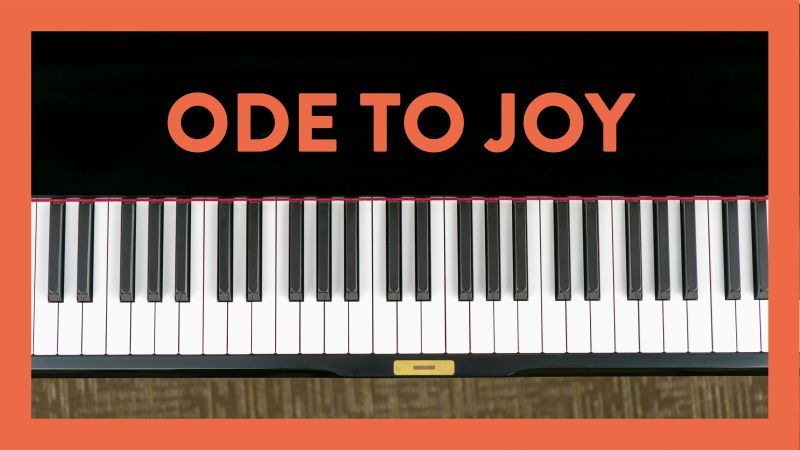
A very popular and fun beginning piece is “Ode to Joy,” which is the main melody from the final movement of Beethoven’s Ninth Symphony. Check out the tutorial below and click here to download the sheet music.
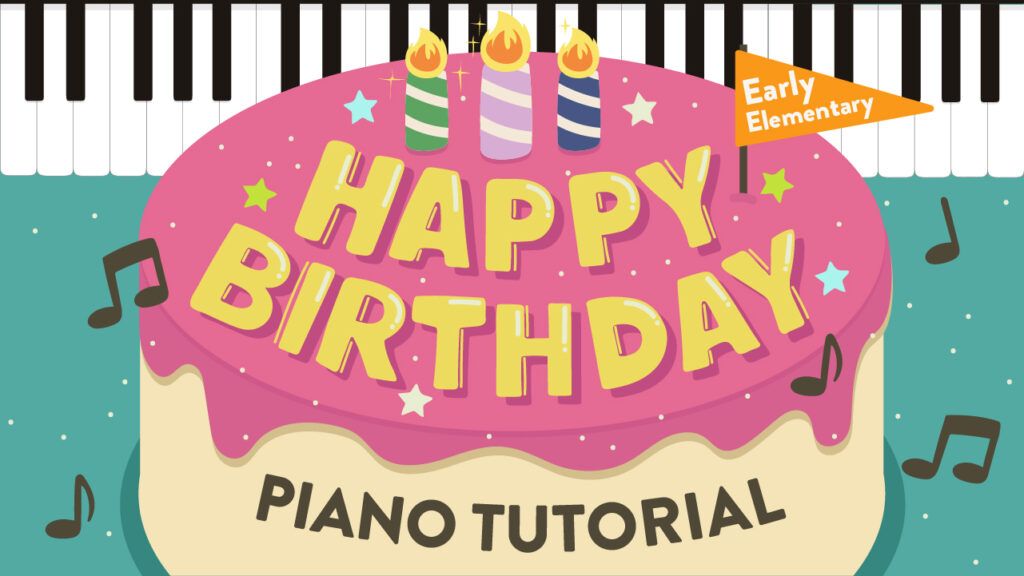
“Happy Birthday” is probably a song that you’ve heard at least once a year. With the following tutorial, you now can play this fun tune for your friends and family on their birthdays. Click here for the sheet music!
“Twinkle Twinkle Little Star” is another fun tune that everyone should have in their repertoire. Originally a French folk song, Mozart famously composed his own theme and variations based on this tune. Check out the following tutorial to learn it and download the sheet music here.
The following list provides a few more beginning piano pieces that are must-learns! This list is ordered from easiest tutorials to more challenging ones.
- from the Anna Magdalena Bach Notebook: Musette in D tutorial – sheet music download
- by Joseph Hoffman: Dragon Night tutorial – sheet music download
- by Ludwig van Beethoven: Für Elise tutorial – sheet music download
- by Ludwig Schytte: Melody for Left Hand tutorial – sheet music download
- by Joseph Hoffman: Tarantella tutorial – sheet music download
- by Alexander Reinagle: Promenade tutorial – sheet music download
- by Hoagy Carmichael: Heart and Soul tutorial
- by Vladimir Rebikov: The Bear tutorial – sheet music download
- by Jean-Philippe Rameau: Minuet in C Major tutorial – sheet music download
- by Joseph Hoffman: Amazing Day tutorial – sheet music download
Intermediate Piano Pieces
Two very exciting intermediate piano pieces include Friedrich Burgmüller’s “Arabesque” and “Ballade.” These pieces are performed at a fast tempo and demand that you show off your ability to create dynamic contrasts (change from soft to piano in a short amount of time), make clean staccatos and smooth legatos, and so much more. Watch the following tutorials to start learning!
The Mechanical Doll, a strange and interesting modern piece of music by Dmitri Shostakovich, challenges your ability to quickly change from one hand position on the piano to another. I recommend practicing this one slowly before trying it at full speed, but you will certainly feel accomplished once you’ve learned this fascinating work.
Here are a few more piano pieces that you should learn as an intermediate pianist. Again, these are ordered from the easiest to the most challenging.
- by Muzio Clementi: Sonatina in C Major tutorial – sheet music download
- by Robert Schumann: The Wild Horseman tutorial – sheet music download
- by Albert Ellmenreich: The Spinning Song tutorial – sheet music download
- by Scott Joplin: The Entertainer tutorial – sheet music download
- by C.P.E Bach: Solfeggietto tutorial – sheet music download
- by Ludwig van Beethoven: Rage Over a Lost Penny sheet music
- by J.S. Bach: Fifteen Two-Part Inventions sheet music
Advanced Piano Pieces
One of the most popular compositions ever written, Debussy’s “Clair de lune” is a gorgeous and lush representation of nighttime. You can learn more about this work on our blog by clicking here and you can also find the sheet music at this link.
Beethoven’s “Moonlight Sonata” is another popular piano piece that evokes the nighttime. Written in three movements, the third movement is a very challenging and fast-paced outpouring of emotion. I recommend learning movement one and two before moving on to movement three.
Here are a few more piano pieces that you should learn as an advanced pianist. Again, these are ordered from the easiest to the most challenging.
- by Ludwig van Beethoven: Pathetique Sonata, Mvt. 2 sheet music
- by W.A. Mozart: Fantasia in D Minor sheet music
- by J.S. Bach: Prelude in D Minor, BWV 851 sheet music
- by J.S. Bach: Fugue in C Major, BWV 846 sheet music
- by Frédéric Chopin: Nocturne in C-sharp Minor sheet music
- by Sergei Rachmaninoff: Prelude in G Minor sheet music
Where to find reliable scores, tutorials, or recordings that align with your level
To discover more video lessons and sheet music, check out Hoffman Academy’s website. Our video lessons are always free, but when you sign up for Premium Membership with Hoffman Academy, sheet music, audio tracks for practicing and listening, games, and so much more is included with your membership. Click here to learn more and sign up today!
Choosing piano pieces that inspire your growth
There is such a diverse range of styles and difficulty levels to choose from when choosing a piano piece – from simple, beginner-friendly works to complex compositions. Whether you’re interested in dance-inspired piano pieces like waltzes and mazurkas, or more intricate form-based works like fugues and sonatas, there are many options to suit all interests and levels. Here at Hoffman Academy, we offer reliable scores, tutorials, and recordings to suit your needs and offer guidance. We also want to remind you that selecting music that inspires you is key to fostering your confidence, motivation, and growth as a pianist.