





Here’s everything you need to know about piano keys—from layout and notes to memory tips and navigation
That long row of white and black piano keys can seem intimidating. We’ll demystify the 88 keys on the piano, providing resources to help you navigate sharps and flats. With tips for memorization, you won’t have to label your piano keys to play confidently. Our resources will help you find C and all the other notes you need to play your favorite songs.
Try Hoffman Academy Premium today for more piano key resources.
How many keys on a piano?
Acoustic pianos and digital pianos have 88 keys, with 52 white keys and 36 black keys. Although some specialized electronic keyboards have as few as 25 keys, the keys are arranged in the same patterns no matter what type of piano you have. The specialty grand piano by Bosendorfer has 97 keys – a full additional octave of lower tones!
What are the piano keys in order? What are the 12 notes of piano keys?
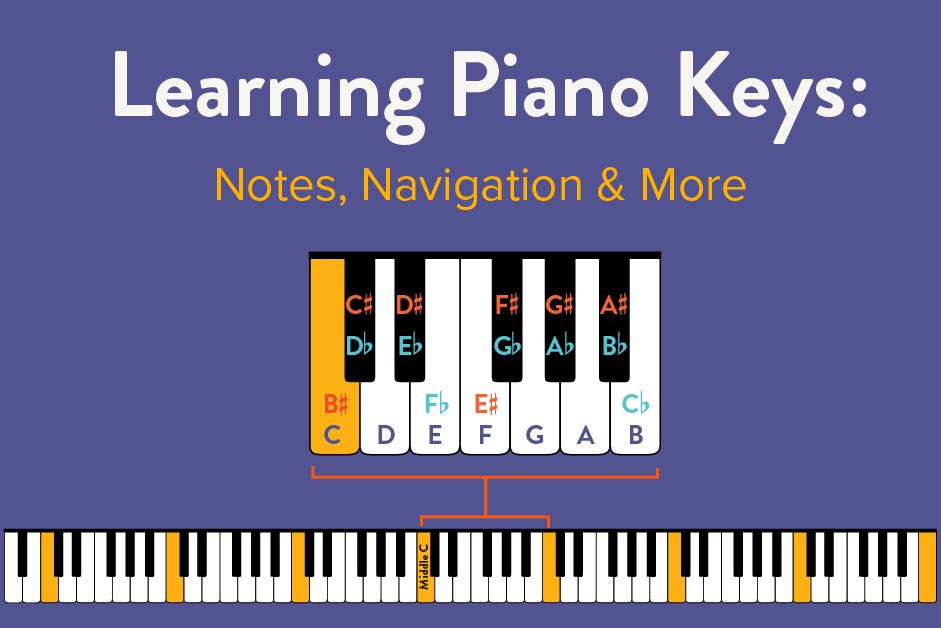
The white piano keys in order starting from C are C, D, E, F, G, A, B. These note names repeat in every octave of the piano. You can use the image below as a reference, or download and print it for free here.

Every black key has two names! These are called enharmonic spellings. Traveling up the keyboard the black keys are named C sharp (C♯), D sharp (D♯), F sharp (F♯), G sharp (G♯), and A sharp (A♯). Traveling down the keyboard, they are called B flat (B♭), A flat (A♭), G flat (G♭), E flat (E♭), and D flat (D♭). If you have your own keyboard at home, take your index finger and touch each one ascending and descending.
Some white keys have enharmonic spellings too. These white keys are next to another white key, with no black key in-between. C can also be called B♯, and B can also be called C♭. F can also be called E♯, and E can also be called F♭.
How to memorize the piano keys
Some people like to memorize the keys by putting labels or stickers on the keys. Instead, we recommend navigating the piano keys using stories and landmarks. It’s easier to remember – and doesn’t risk damaging your piano’s keyboard with adhesives.
First, get oriented on the piano keyboard by finding the groups of two and three black keys. The groups of two black keys are the dog house. Within the doghouse is the dog – our note D! The cat, our C note, stays in front of the doghouse and teases the dog. On the other side of the doghouse is the elephant, our note E
The three black keys make up Grandma’s house! The white key in front of the three black keys is F, for the front yard. Grandma’s room is in between the first two black keys. Then, there’s Auntie Annie – the note A. The final note next to the black keys is B, for the back yard.
Watch as we teach this method of remembering piano note names in this video:
How to navigate piano keys
The best way to navigate the piano keys is by practicing finding your landmarks. Have your student start by pointing to every cluster of two black keys on the piano. Then, have your student find the “D” key inside those two black keys. Next, have your student find each cluster of two black keys, and then identify “C” in front of those keys. For beginner students in this phase of keyboard navigation, our Piano Key Navigation (Early Elementary Version) bundle is a great way to practice.
For students further along in their piano journey, our Piano Key Navigation (Elementary Version) reinforces note finding on the piano. Designed for more advanced beginner students in units 5-8, this packet focuses on naming sharps and flats. It also includes information on enharmonic spellings for notes.
Types of pianos
Whether you’re playing on a grand piano or a keyboard, the arrangement and order of the keys is the same. Grand pianos and upright pianos are a type of acoustic piano, meaning that the sound comes from a hammer hitting the string. In contrast, digital pianos and keyboards use electronics and speakers to produce the sound when a key is pressed down. Digital pianos, upright pianos, and grand pianos all have 88 keys, while electric keyboards can have differing numbers of keys.
To learn more about acoustic, electric, and digital pianos, read our article on Different Types of Pianos.

How do you clean piano keys?
Your piano will thank you for a regular dusting with a microfiber cloth! Wipe the white and black keys towards you, and you’ll keep your piano looking like new.
To clean your piano keys more thoroughly, you’ll need a microfiber cloth dampened with soap and water and a dry microfiber cloth. Be sure to wring your soapy microfiber cloth out so that it is damp only – no liquids dripping on the keys! Using the same motion as for dusting, wipe the white and black keys towards you. Then, take your dry microfiber cloth and wipe towards you again. Don’t leave moisture on the keys as this can damage them. For more tips, read our article on Piano Care.
To disinfect the keys, check out the guides from Yamaha for Yamaha’s Disinfection Guide for Pianos. Since they have electronic parts, Yamaha also created a Disinfection Guide for Digital Pianos.
Background history on the piano
One of the piano’s ancestors is the hammered dulcimer, an instrument from the 11th century that spread from the Middle East to Europe. Next came the clavichord in the 14th century, followed in the next century by the harpsichord. Both the clavichord and the harpsichord had keyboards that operated levers to pluck the strings.
In 1700, Bartolomeo Cristofori decided he wanted a harpsichord that had better volume control. He created what he called the “clavicembalo col piano e forte,” which was eventually shortened to “piano.” His innovative design used hammers to hit the strings, and this is the way pianos still work to this day.
In the 18th century, the piano’s white and black keys were reversed. When Mozart was composing, he would have played on a keyboard where the natural keys were colored black and the sharps were white!
To learn more about the piano, check out our article on 10 Things To Know About The Piano.
Now you’re ready to explore the piano keys with confidence
Acoustic and digital pianos have 88 keys. With the resources above, you’ll become familiar with all the keys on the keyboard as you learn to play your favorite songs. We hope our piano keys navigation resources help you on your musical journey!