





What is the standard piano keyboard layout?
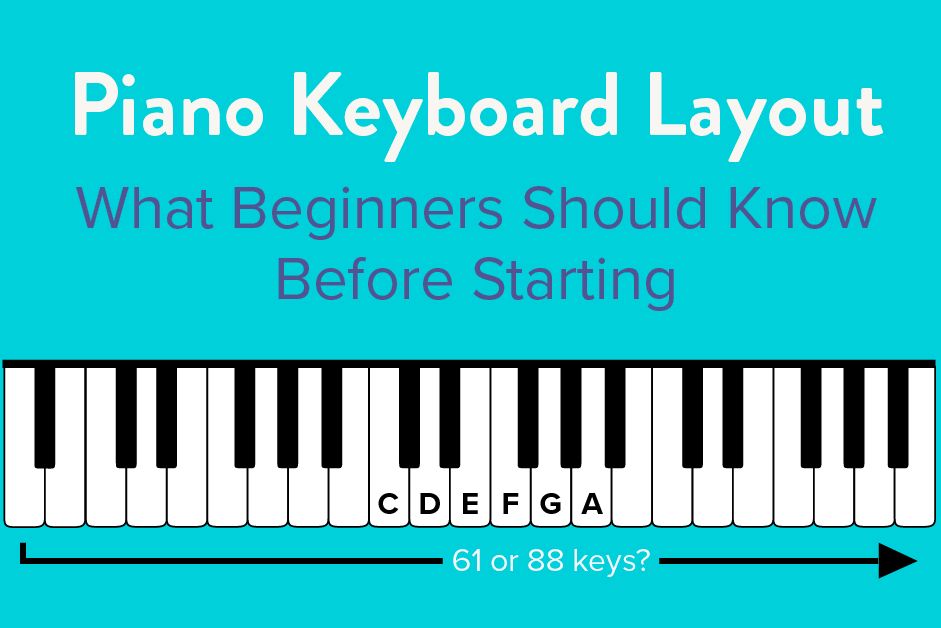
The standard full-size piano keyboard layout has 88-weighted keys which span seven octaves and include 52 white keys and 36 black keys. Some companies sell electronic keyboards with only 61 keys, citing portability and cost-effectiveness, but these smaller keyboards have limitations when playing music with a wide range of notes. Many of the smaller electronic keyboard models have unweighted keys, which makes playing with dynamics and proper technique very challenging. There are also extended piano keyboards with more than the standard 88 keys, but these are expensive and only needed in special circumstances. Read on to learn more about the piano keyboard and discover resources that will help you find a keyboard that will work for you!
Want to learn the piano? Sign up with Hoffman Academy!
Should a beginner use 61 or 88 keys?
This question is common for beginners as they search for an appropriate instrument. While looking for a first keyboard instrument, it’s important to keep the beginner’s level, goals, and interests in mind. What type of music is the student interested in? Is the music learning simply for enjoyment or is there a particular goal in mind? Of course, the student’s mind can always change in the future, but keep the more immediate future in mind first.
As a beginner who’s testing out their interest on the instrument, it’s okay to have a less expensive keyboard with only 61 keys. As the student progresses and learns more complex music with a wider range, it’s important to invest in a piano or electronic keyboard with a standard 88-keyed keyboard.
As you search for a piano or electronic keyboard, I recommend checking out our article on Choosing a Piano or Keyboard and Best Digital Pianos. In these articles, Hoffman Academy piano teachers have provided their recommendations for the best and most cost effective instruments.
How are the piano keys arranged? How do you navigate the piano keyboard?
The standard keyboard layout has 88 keys. The 52 white keys play the notes A-B-C-D-E-F-G in alphabetical order. The alphabetical names of the keys repeat seven times within seven different octaves from the lowest notes of the keyboard (the left side) to the highest notes on the keyboard (the right side).
36 black keys separate the white keys by creating patterns of two black keys and three black keys. Every black key has two names: a sharp name and a flat name. Their names come from the white keys that surround them. For its sharp name, the black key takes the name of the white key to its left and adds the word “sharp.” For the flat name, the black key takes the name of the white key to its right and adds the word “flat.” In the groups of two black keys, you have two keys: C sharp/D flat on the left and D sharp/E flat on the right. In the group of three black keys, you have F sharp/G flat on the left, G sharp/A flat in the middle, and A sharp/B flat on the right.
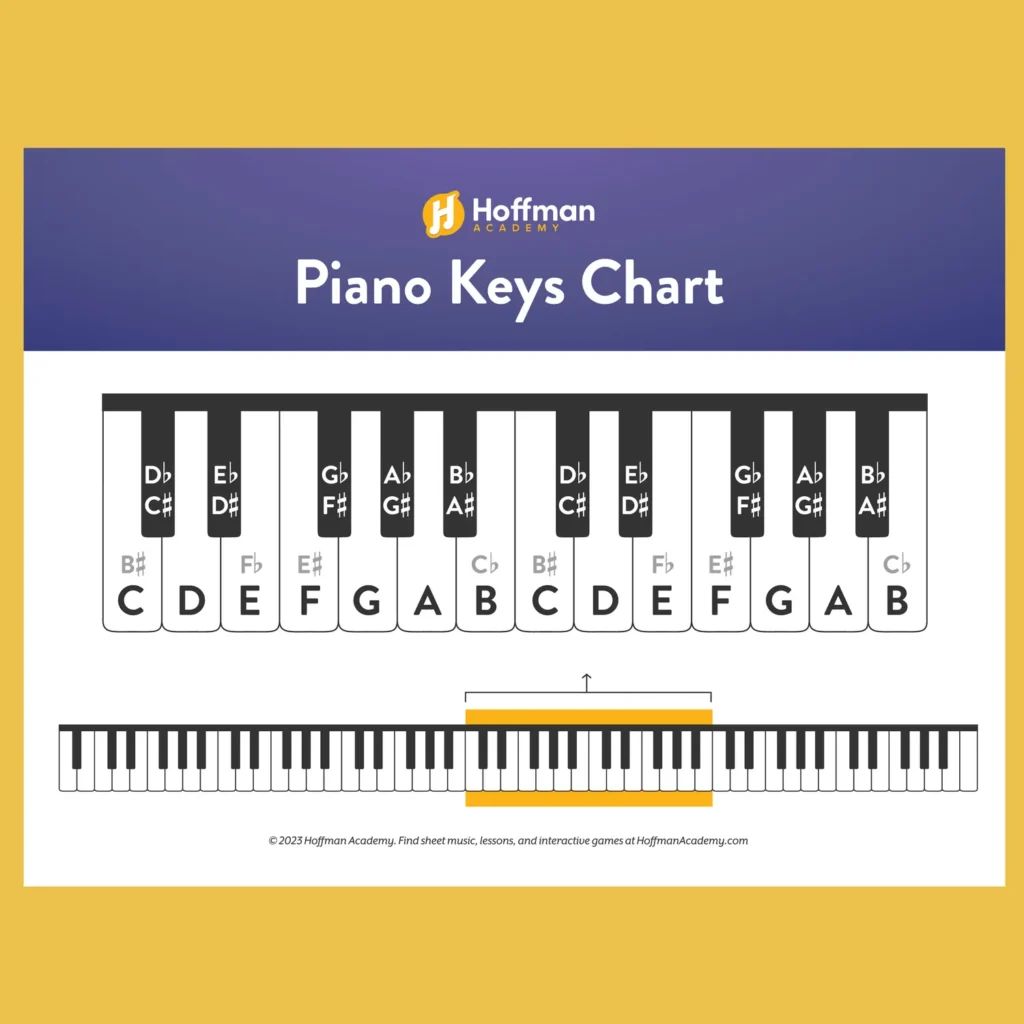
Notice that there are no black keys between B & C and E & F. You might be asking: “Does this mean that B and E don’t have sharps and C and F don’t have flats?” Since there are no black keys where the sharp should be, C is also called B sharp and F is also E sharp. The same is true for C flat and F flat, which are B and E respectively.
For more help with the white and black keys, check out our Piano Keys Notes Guide and our blog article How Many Black Keys On a Piano.
How can a player identify where the note C is on the piano?
A player can find the note C on a piano keyboard by locating a group of two black keys. Between the two black keys is the white key D. To the left of D is the white key C. For more help, check out our Piano Keyboard Notes Chart and our Piano Key Navigation Bundle. They’re free downloads and can even be displayed above your piano for help at home!

How do you pick a piano keyboard?
Here are some more blog articles that can help you pick the best piano for you and your students’ needs! These articles include suggestions for where to shop, what to look for, and how to save money while buying a good-quality instrument.
- Best Starter Pianos
- Five Best Digital Pianos Under $1,000
- How Much Does a Piano Cost?
- How to Shop for a Piano
- Where to Buy a Piano
Getting comfortable with the piano keyboard layout
In order to get comfortable playing music and getting creative with the piano, understanding the keyboard layout is essential for all piano students. Investing in a piano or electronic keyboard that fits the students’ needs is equally important and will set the students up for success. At Hoffman Academy, we are committed to supporting a positive and enriching music-learning experience; which is why our dedicated piano teachers have developed a variety of resources, including blog articles, printables, and videos, to guide and prepare students every step of the way. Learn more and sign up for Hoffman Academy!