


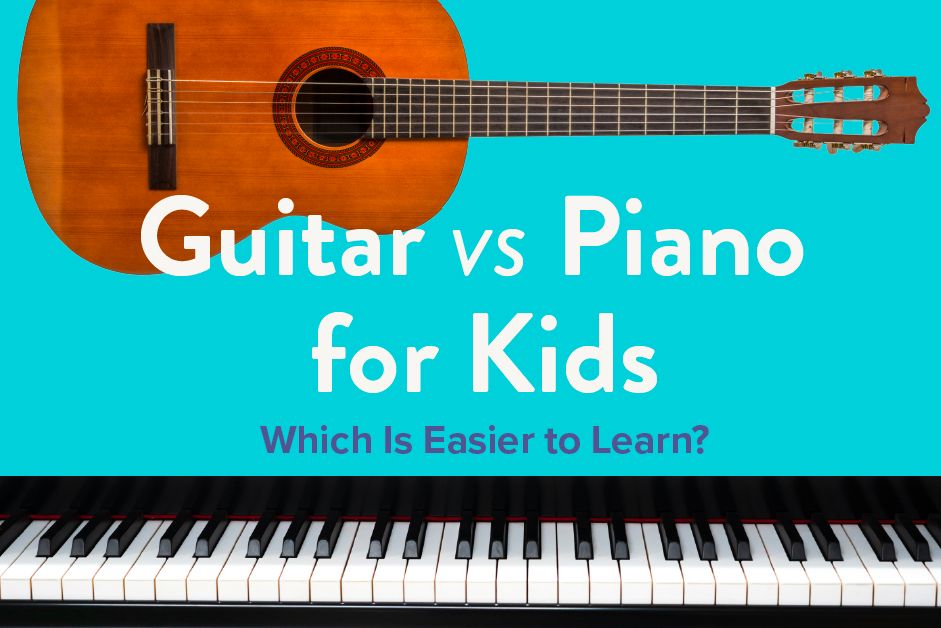
For a young beginner, piano is easier to learn than the guitar. A piano keyboard is much simpler to use than a guitar’s strings and fretboard. This makes the piano a natural choice over the guitar for a first instrument for ages 6 to 8 years old. While a 6-year-old can learn to play a child-sized guitar or ukulele, it’s easier for children to start guitar at age 9 or 10 when their hands are larger and stronger.
I’ve loved learning to play both the piano and the guitar, and I hope you’ll gain some insight as I discuss their unique musical qualities.
Want to learn piano in a fun and intuitive way that will help prepare you to learn any other instrument you choose? Try Hoffman Academy today!
Is piano or guitar easier to learn?
The piano is easier to learn than the guitar because of the way the two instruments are played. Press down on a piano key and a note sounds. A guitar string has to be held firmly against the fretboard with one hand and picked, plucked, or strummed by the other hand in order to produce a note. Also, the piano has a simple, easy-to-understand keyboard where notes are laid out in order from lowest to highest. This layout visually illustrates the relationships of notes in a scale. Playing scales on guitar strings is not as straightforward. Because each guitar string plays a different set of notes, a guitarist has to adjust both the string they are playing and their left-hand position on the fretboard to create scales and melodic patterns.
While playing musical scales and melodic patterns is much simpler on the piano, playing chords and accompanying a singer is more instinctive on the guitar.

What is the learning curve between piano and guitar?
A piano has a more gradual learning curve at the beginning as compared to the guitar. Here are the main reasons:
- Piano keys are easy to play. Simply press a key and the note sounds. Before playing the guitar, a guitar student needs to learn how to hold the strings firmly against the fretboard with one hand while strumming them with the other.
- A piano keyboard is laid out in a simple, straightforward way with notes arranged from lowest to highest. The simple relationships of piano keys make it easy to learn and apply fingering patterns to all 24 major and minor scales in Western music. In contrast, each guitar string can produce a different set of notes, and there is no visual indication as to where the sharps or flats are in any key.
- Piano students don’t have to learn how to hold their instrument. The piano stands on its own. A guitar student needs to learn how to hold their instrument properly. Young children will have a difficult time holding and playing an adult-sized guitar, so if they do want to learn the guitar it’s a good idea to get them a smaller guitar or even have them start on an ukulele.
- A piano student will not need to learn how to tune a piano, but guitar students will need to tune their guitar frequently. It’s a good idea to check and adjust the tuning every time a guitar is pulled out for playing.
Depending on a student’s goals, learning to play new songs on the guitar may eventually become easier and more motivating than learning piano. Once a guitar student has learned to play a basic set of chords they can accompany almost any song simply by memorizing the chord progression. With a few strumming or picking patterns they can create a variety of accompaniment textures and enjoy playing while they and their friends sing along. A guitar is also a light weight instrument that can be carried and enjoyed almost anywhere.
For a student who wishes to continue studying the piano, it can become a more challenging instrument to learn. The piano has a wider range of possible notes than a guitar, and it’s easier to play several notes at once. Pianos are versatile instruments that are equally at home in a concert hall, a jazz club, or a rock band. There are also significantly more pieces of music written for piano than guitar. That being said, learning to play classical guitar, with both melody and chords plucked on the strings, is a very complex skill. Both the piano and the guitar offer advanced techniques that can take a long time to master. No matter which instrument a student chooses, it will require years of consistent practice to reach a high level of playing.
What is the physical feel of playing piano vs guitar?
Playing the piano feels more symmetrical than playing the guitar. A pianist sits near the keyboard and uses both hands to press down on the smooth keys. A pianist can press a key with either hand, varying the strength of their touch to affect the sound of the note.
To play a guitar, the instrument sits on your lap or hangs on a strap over your shoulder. The fretboard controls the pitch of the note while the other hand plucks or strums the strings to create the rhythm, dynamics, and articulation. One hand is used to press the strings against the fretboard. The strings feel almost sharp to the touch, and this can be painful until callouses are built up on the fingertips. The other hand plays the strings. You can use your fingers and thumb, your fingernails, or a guitar pick to play.

How does the layout of piano compare to guitar?
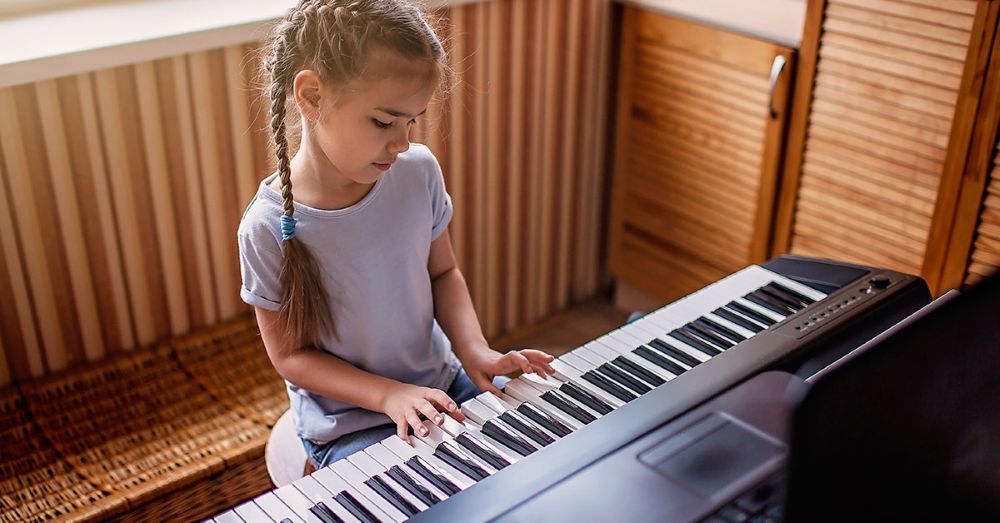
A piano has 88 keys laid out in a row with the lowest note on the left and the highest note on the right. In each octave there are 7 white keys. There are also two groups of black keys in each octave, a group of two and a group of three. As you move from left to right across all white and black keys, each piano key produces a note that is one half step higher than the note before it. This is one of the most straightforward and simple layouts of any musical instrument.
Like many other stringed instruments, the guitar has a number of strings tuned to different pitches. A guitar player holds the guitar with the fretboard in the left hand and the strings facing away from them. A standard six-string guitar typically has its lowest string on the top. From lowest string on the top to highest string on the bottom, the strings are tuned to E, A, D, G, B, and E.
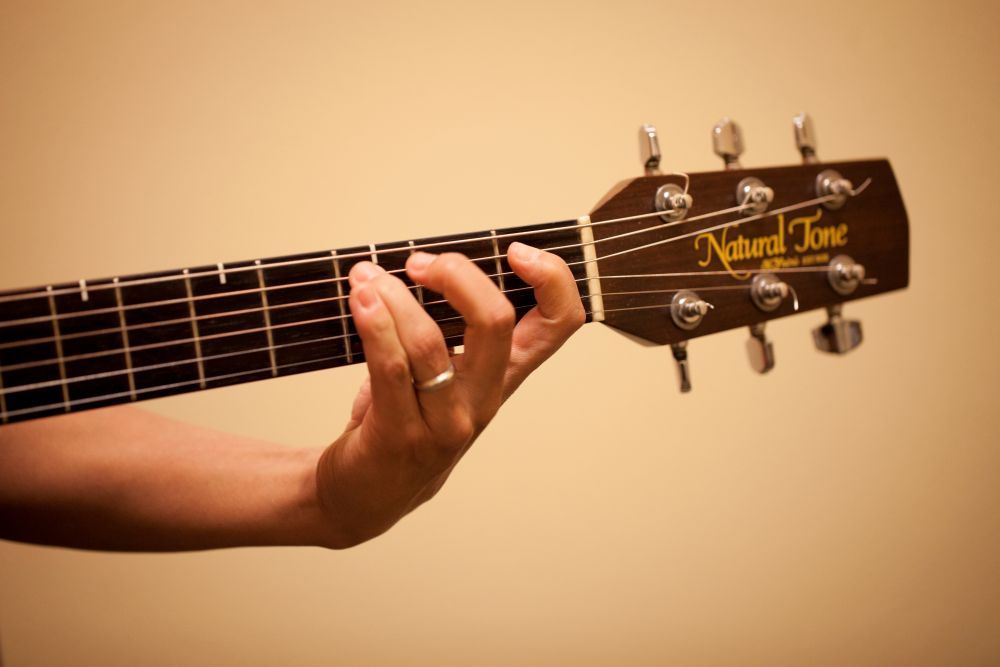
Each fret on the fretboard represents a half step on the string. Pressing down on a string between frets will cause that string to play a higher note than the note played by the open string. To play a scale, a guitar player typically plays a few notes on one string, then moves to the next string for the next set of notes. This keeps their hand from having to move very far along the fretboard.
Which is better for learning music theory, piano or guitar?
The piano is an excellent instrument for learning all aspects of music theory thanks to its well-laid-out keyboard and the ease of playing melody, harmony, and accompaniment. As primarily an accompaniment instrument, the guitar can be more limited, but its focus on chords can help musicians develop a deep understanding of chord progressions.
Is guitar or piano better for your brain?
Both guitar and piano are wonderful instruments for brain development. The piano may offer slightly more benefits at higher levels of playing because of the number and complexity of advanced piano pieces that there are to learn. Piano sheet music is also more challenging to read because it requires students to learn the Grand Staff. Music for piano spans a wider range of notes than music for guitar and often features melody, harmony, and accompaniment played all at once.
The guitar does require more fine motor skill development than the piano. It also lends itself well to playing by ear and improvisation. Each instrument has its own set of skills for musicians to learn, and each will help develop memory, focus, brain connectivity, executive function, neuroplasticity, and long-term brain health.

Which instrument is better for reading sheet music?
The piano has an advantage over the guitar when it comes to learning to read sheet music. Piano music is among the most complex sheet music to learn to read, second only to pipe organ music and orchestral scores. The full range of a piano’s 88 keys are notated on a grand staff, which is made up of two staves written in different clefs: treble and bass. A pianist learns to read both treble clef and bass clef simultaneously, and also learns to play up to 10 notes at a time. Once a musician has learned to play the piano, they can easily learn to read music for most other instruments.
Reading music for the guitar is comparatively simple, with music written on a single staff in treble clef or in tablature. To go from guitar sheet music to piano sheet music would require learning the bass clef. Sometimes guitar music can be written as guitar tabs, which indicate which fret on which string to press. This is an easier way to read guitar music, but can’t be transferred to other instruments.
[Image of guitar tablature with notes]
Which instrument gives a stronger foundation for learning other instruments later?
The piano provides the strongest foundation for learning other instruments, especially in the areas of music theory and music reading. The literature for piano is rich and varied, the instrument is versatile, and students who play the piano learn both accompaniment and melody. No matter what instrument they choose to play next, their piano skills will transfer well.

Is it harder to switch from guitar to piano than piano to guitar?
For most music students it will be easier to pick up the guitar after having learned the piano than to pick up the piano after having learned the guitar. Both instruments will require a music student to learn new skills. Going from piano to guitar will require a student to learn chord symbols, which aren’t used as often in piano notation. They’ll also need to develop the finger strength and calluses to handle the guitar fretboard. Going from guitar to piano will require a student to learn to read the bass clef alongside the treble clef and to independently play notes and rhythms with both hands.
Can my child learn both piano and guitar?
Learning both guitar and piano can give your child the best of both worlds. However, because starting a new instrument is especially challenging, it would be a good idea to focus on one or the other at first.
I began learning the piano as a child then added the guitar as a second instrument when I was a young teenager. As I continued my piano lessons, the guitar opened up for me a deeper understanding of chord progressions. It seemed magical that I could use a few hand shapes on the guitar fretboard to accompany almost any song. I also enjoyed the ability to carry my instrument wherever I went. The guitar gave me more opportunities to share music with my friends in social settings as they listened or sang along with me.
Later, when I began learning the harp, I appreciated both the music reading skills I’d learned on the piano and the understanding of chords I’d gained from the guitar.
Piano vs guitar: the verdict for beginners
The most important factor in choosing an instrument for a beginning musician is their own interests. While at the beginning level the piano is easier to play than a guitar and offers a more solid foundation from which to learn other instruments, a young student who wants to start with the guitar can find success if they’re given an instrument designed for smaller hands and bodies. For older beginners, starting with either the piano or guitar is a matter of personal choice. Both of these instruments will bring a rich and unique musical experience into your life.
Learn piano with the world’s best music learning system! Try Hoffman Academy today.