


All About the Aeolian Mode in Music
The Aeolian Mode includes the same notes as the natural minor scale, lowering the third, sixth, and seventh scale degrees from a major scale. Those lowered scale degrees create a sad or contemplative mode that is used in all types of music. Aeolian tonicizes on a minor i chord and is one of the four musical modes with a minor third in the tonic.
The word Aeolian referred to people who lived on the island Aeolis in the Mediterranean. In the Classical era of Greece, Greek musicians named scales after regions of Greece and other nearby countries. Since music moves with people as they travel, the Greek scales spread all across Europe alongside other Ancient Greek knowledge. By the mid-1500s, a music theorist gave the name Aeolian (sometimes called Hypodorian during the Renaissance) to the white key scale that starts on A. Now, when you play the white keys of the piano starting on A, or create any minor scale, you are exploring Aeolian.
Ready to learn piano and master the musical modes with Hoffman Academy? Try Premium today to access 400+ videos and hundreds of music theory sheets that will enhance your musical journey!
What is the formula for the Aeolian mode?
Aeolian is built with the following formula of steps: whole step, half step, whole step, whole step, half step, and whole step, whole step.
You can play the Aeolian mode on the piano by starting on A and playing all the white keys.

What are the characteristics of the Aeolian mode?
Aeolian mode shares the characteristics of the natural minor scale. The flattened third, sixth, and seventh degrees of the scale create minor chords that we tend to hear as sad. The home base chord of Aeolian is a minor i chord, which is created by the minor third between the root and the third scale degree.
Pieces using this mode are the same as pieces in natural minor, but not every piece in a minor scale is Aeolian.
What does Aeolian mode sound like?
The pattern of whole and half steps creates a characteristic melancholy sound. The shared relationship of the notes with natural minor means that Aeolian and natural minor sound the same. For Western classical musicians, minor scales and Aeolian connect to introspection and sadness. “The Wild Horses” below, from Unit 2, introduces natural minor and showcases the sound of this mode.

How is the Aeolian mode used in music?
Aeolian imbues music with a sense of sorrow. The lowered third, sixth, and seventh scale degrees of Aeolian create the intervals of natural minor. In Aeolian, the tonic chord is a minor i chord, which contributes to the melancholy feeling.
Unlike in some minor songs, where a musician will borrow a major V chord from the parallel major key, pieces in Aeolian use only the notes of the scale. Modal songs do not borrow from a related key. Because songs in Aeolian use only the notes of the mode, this means that songs in this mode have a distinct minor v chord. Without the raised 7th degree, this weaker v chord does not have as strong a drive toward resolution.
Although in Ancient Greece songs would use only the notes of their respective modes, today we can borrow, mixing and matching to make our music our own. Pop and classical musicians might begin in a minor key, but they often borrow notes from the parallel major scale to create moments of major harmony. Borrowing the raised seventh scale degree from major creates a major V chord, which functions as a dominant chord. The melody pulls strongly toward the tonic chord and resolution.
How do you play the Aeolian mode on piano?
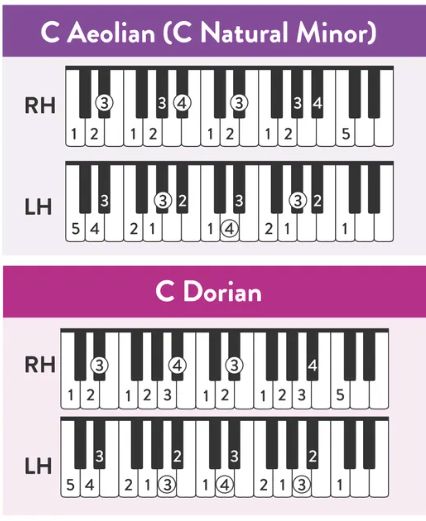
You can play the Aeolian mode on the piano by playing all white keys starting with A. To play this mode in any other key, build the natural minor scale. Starting with the related major key, lower the 3rd, 6th, and 7th scale degrees of a major scale to create music in Aeolian. Moving C Ionian (C, D, E, F, G, A, B) to C Aeolian is as simple as changing the E, A, and B to flats (C, D, E♭, F, G, A♭, B♭).
What is the difference between Aeolian and Dorian modes?
Aeolian and Dorian modes differ in their interval structures and overall sound. Musicians classify modes into major and minor groups. The “minor” modes include Dorian, Aeolian, and Locrian. The Dorian mode includes a raised sixth scale degree from the natural minor scale. Many pop songs switch between the natural minor (or Aeolian mode) and Dorian mode because the inclusion of “la” from the major scale lets musicians incorporate a major IV.
What are chords of the Aeolian mode?
Chords in Aeolian have the same relationships as the chords of natural minor. Since the mode does not borrow other notes from other scales, the chords follow this pattern:
- minor i chord
- diminished ii chord
- major III chord
- minor iv chord
- minor v chord
- major VI chord
- major VII chord.
You can read more about building chords from a minor scale in this article on piano chords of C minor.
What are some songs that use Aeolian mode?
Many songs use Aeolian to create a sense of sadness. The iconic pop song “Hello” by Adele takes advantage of the minor v chord and relentless quiet of the mode. “Zombie” by the Irish rock band The Cranberries also uses Aeolian. The chord progression of i → VI → III → i uses the notes of Aeolian and an unusual progression to capture the futility of the Troubles.
To start learning songs in Aeolian, the Hoffman Academy lesson for “The Wild Horses” features this natural minor scale.
While the natural minor scale uses the same note relationships as Aeolian, not all songs in minor use the Aeolian mode. Sometimes composers deviate, raising the sixth and seventh scale degree as in melodic minor.
Why Aeolian remains essential for musicians
Aeolian offers a distinct palette of notes for creating sad and contemplative harmonies. Learning this mode teaches musicians the notes of the natural minor scale. Unlocking natural minor scales in every key with Aeolian offers a whole world of songs written with minor keys.
Master all the modes with our Music Mode Charts!