


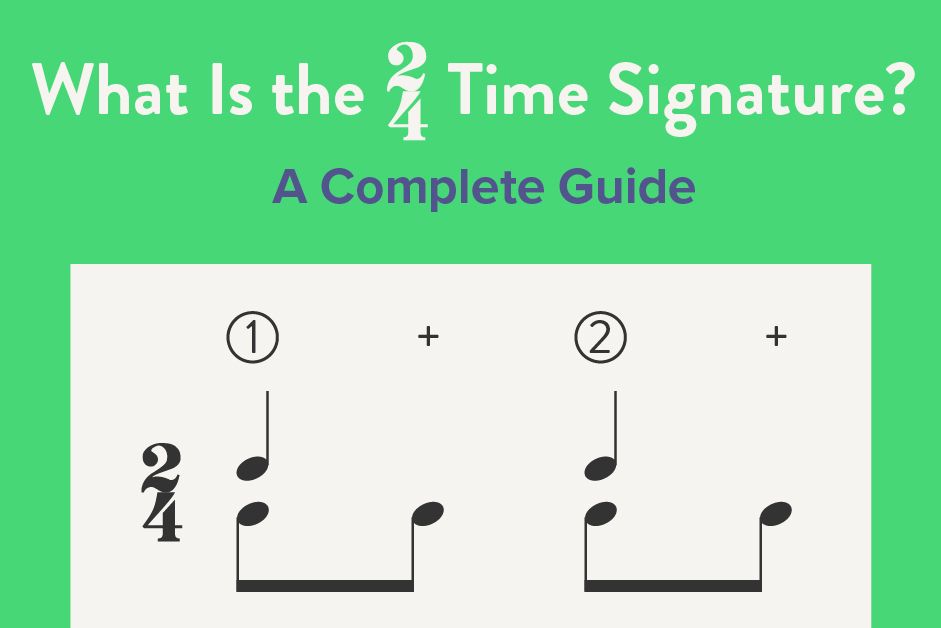
2/4 is one of the most common time signatures calling for duple meter, a two-beat pattern. Listen to marching band music or ragtime and you can’t help tapping your feet to this pattern:
In fact, 2/4 time is often called “march time” because the alternation of strong downbeat and weak second beat perfectly captures the rhythm of walking. You’ll also find 2/4 in polkas, ballets, and bossa nova songs. Come have a look at this versatile time signature that crosses many genres.
Improve your rhythm with Hoffman Academy Premium. We have over 400 free lessons, plus many fun rhythm resources available in our store.
What is the 2/4 time signature? How many beats are in a measure of 2/4 time?
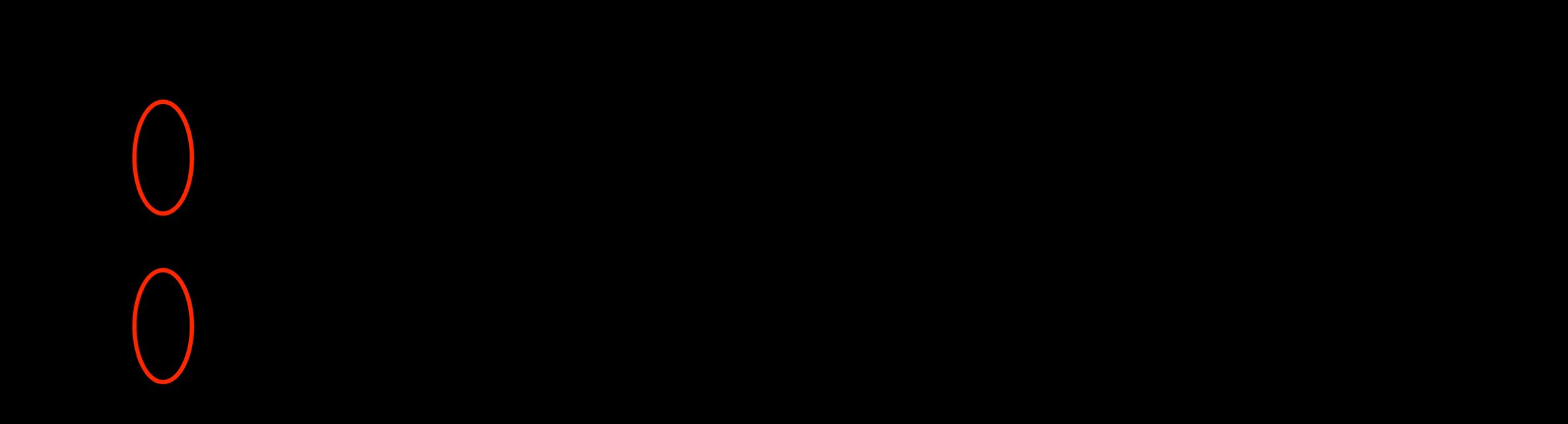
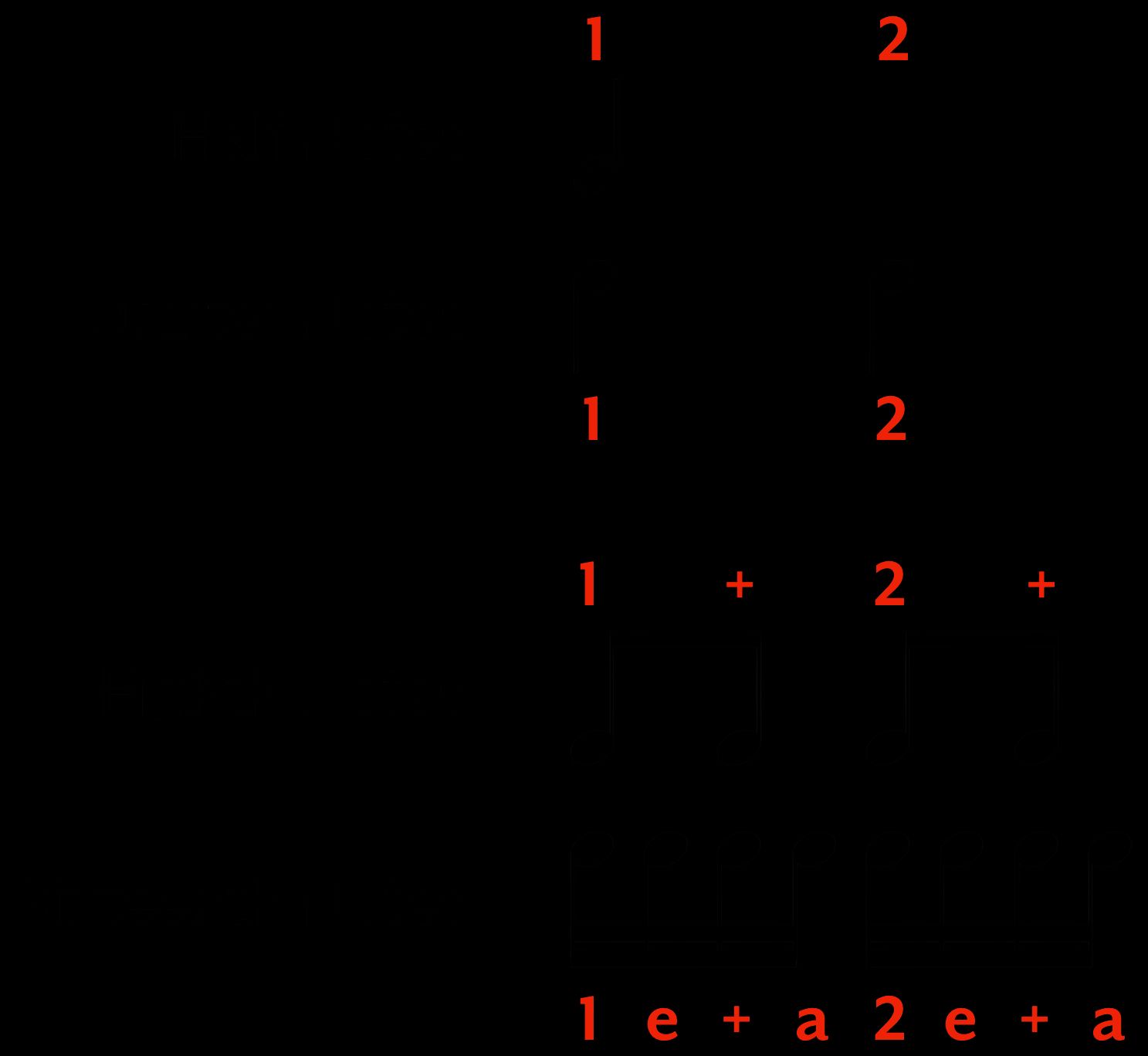
2/4 is an example of a simple duple time signature. Music is divided into repeating patterns of beats, called measures. In a simple meter time signature, the top number refers to the number of beats per measure: two in the case of 2/4 time. The bottom number indicates the beat unit: the note value that lasts for one beat. A “4” on the bottom means that the quarter note is the beat unit. So a measure of 2/4 time will have two quarter note beats:
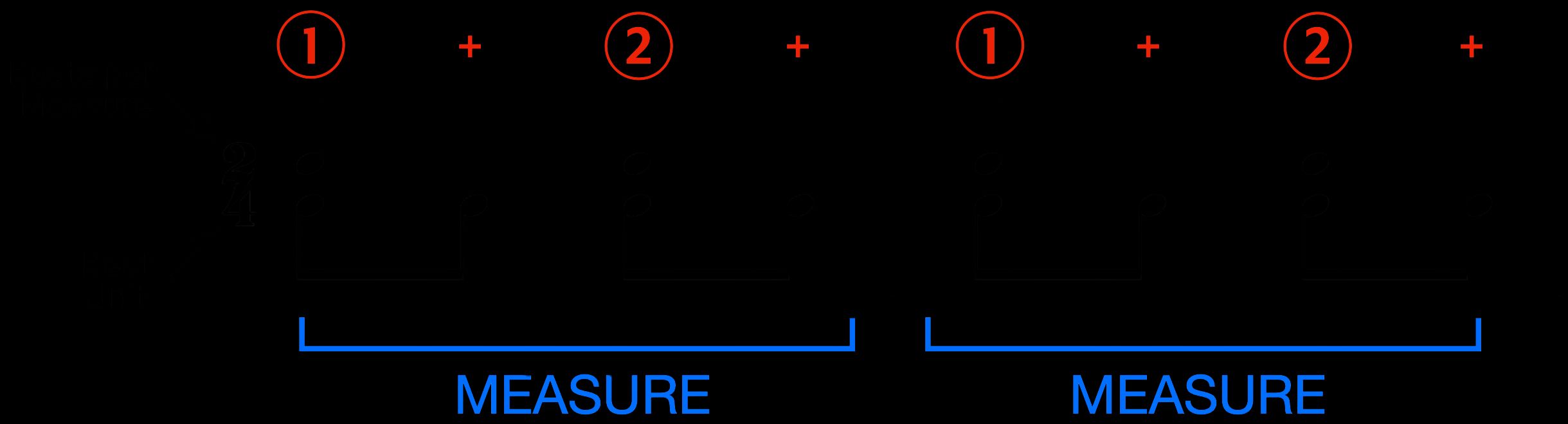
As with all simple meter time signatures, the beat is initially divided in two. Each quarter note beat is split into two eighth notes, which can then be further subdivided:
How do you count in 2/4 time? What note values are used?
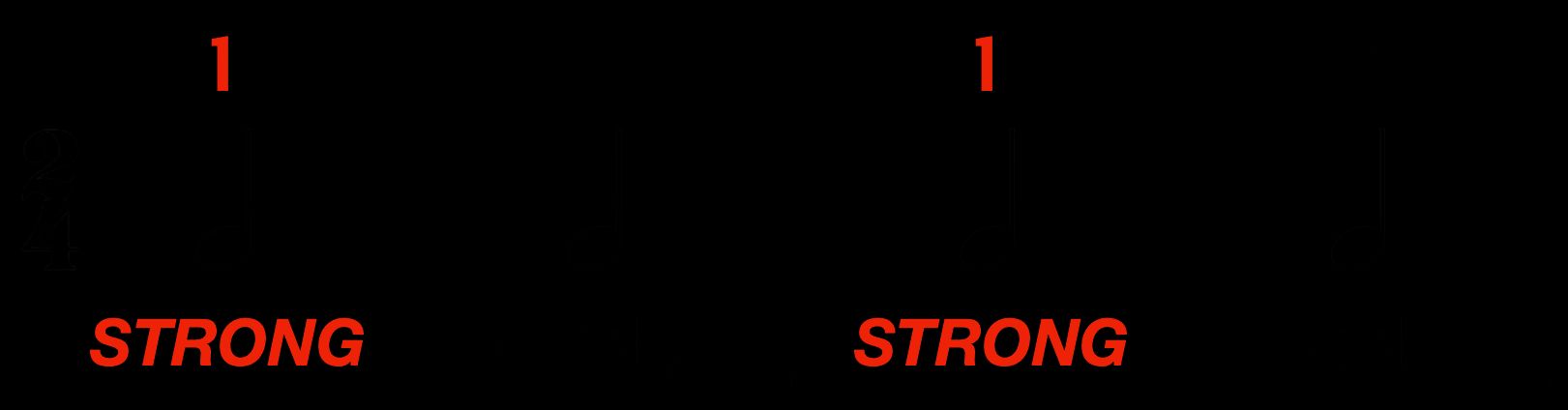
With two beats per measure, 2/4 time is easy to count. Simply count “ONE – two.” Remember the STRONG – weak alternation between beats 1 and 2. Clap your hands with an emphasis on the first beat, then more gently on the second:
If you want a single sustained note, the longest note you can fit into each measure is a half note, which is held for two beats. Notice that whole notes are not possible in 2/4 time for the simple reason that they can’t fit inside a measure with only two beats. Whole notes take up four quarter note beats, and so can only appear in measures of 4/4 time.
For shorter note values than quarter notes, we’ll first divide each beat into two eighth notes. When clapping these, you’ll want to say “ONE – and – two – and.” Once again, make the first beat the strongest, the second beat weaker, and save the weakest emphasis for the “ands” between each beat. Notice that there are four eighth notes possible in a single 2/4 measure.
Finally, to subdivide the eighth notes into sixteenth notes, clap twice as fast as you did for the eighth notes. This results in four sixteenth notes per beat, for a total of eight per measure. To count sixteenth notes, say “ONE – e – and – a – two – e – and – a.” Continue to keep the emphasis only on the main beats while you clap.
When practicing any type of rhythm or meter, be sure to count aloud while clapping. This ensures that you can truly hear and feel each beat, division, and subdivision. Don’t whisper. Say the counting syllables with emphasis and intensity. The more you externalize beats and rhythms, the more you’ll internalize them.
Is 2/4 the same as 4/4? How do you know if a song is in 2/4 or 4/4 time?
2/4 and 4/4 both have the same quarter note pulse, but they are completely different kinds of simple meter. 2/4 is duple meter, with a two-beat pattern. It has the characteristic STRONG – weak feel of walking or marching. On the other hand, 4/4 is quadruple meter, with a four-beat pattern. A measure of 4/4 is twice as long as a 2/4 measure, and spreads the beats out into a longer rhythmic cycle: STRONG – weak – (strong) – weak:
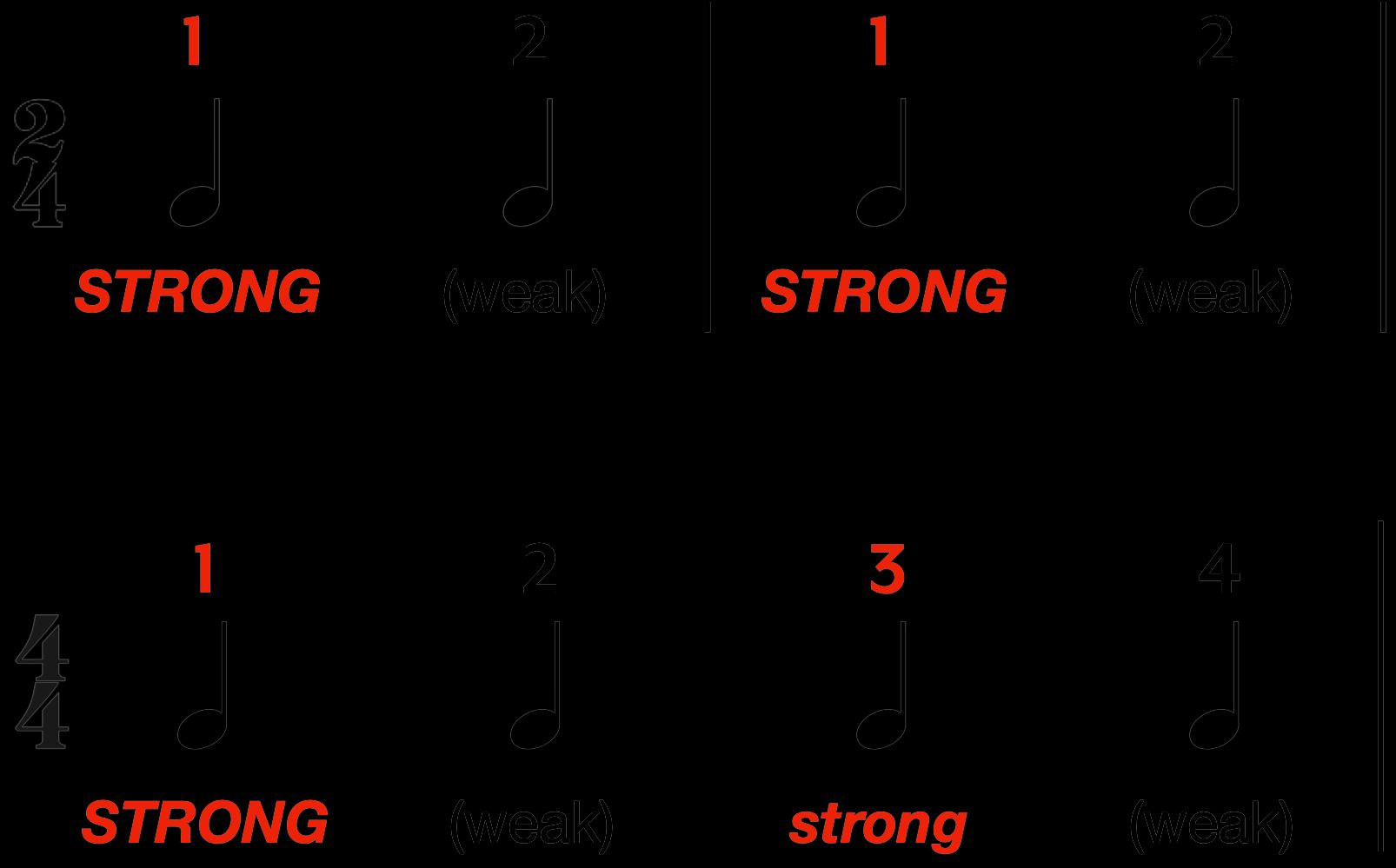
While the third beat in 4/4 time is strong, it’s noticeably weaker than beat 1 (the downbeat). This is the best way to distinguish between 4/4 and 2/4. Listen for that third beat–if it’s weaker than the first, you’re probably in 4/4 time, but if it’s just as strong as the first beat, it’s likely the downbeat of the next measure in 2/4. In the audio below, you’ll hear two measures of 4/4 followed by two measures of 2/4:
What are some examples of the 2/4 time signature in music?
Here are some popular genres where you’ll often see the 2/4 time signature.
Marching band music
Although 2/2 time is the most typical meter for marching band pieces, it is only distinguishable from 2/4 on paper. Given the same tempo, both meters sound identical, and so the famous marches of John Philip Sousa could easily be notated in 2/4 time. His 1889 march The Thunderer is a perfect example of simple duple meter.
Ragtime
Scott Joplin’s enduring ragtime pieces are generally notated in 2/4. Even with their characteristic syncopation, the marching-band duple feel is evident throughout, as in The Entertainer from 1902.
Polka
2/4 is almost always the time signature for the Polka. Originally a 19th Century Bohemian dance, the Polka’s charm and “half-jump” step made it popular throughout Europe, Scandinavia, and South America. Bedřich Smetana transformed it from a folk dance into a nationalist Czech genre. His Three Poetic Polkas, Op. 8 bring lyricism, nostalgia, and a seriousness to the style.
Ballet and folk music
Many ballet numbers are written in 2/4 because this time signature facilitates quick footwork. Russian composer Pyotr Ilyich Tchaikovsky used it for the “Dance of the Reed Flutes” in The Nutcracker. In fact, a great deal of Russian folk music uses the stamping rhythms of 2/4, such as the 1860 song Kalinka by Ivan Larionov.
Bossa nova
Although often notated in 4/4 time, Brazilian bossa nova music is typically felt in two. This means that only the first and third beats in a 4/4 measure will receive emphasis, making the music sound more like 2/2 or 2/4. Antônio Carlos Jobim’s The Girl from Ipanema is probably the best known example.
Start using the 2/4 time signature today
To get experience playing in 2/4, try some piano music with this time signature. The Hoffman Academy store has nearly 200 pieces in 2/4 across all skill levels. If you’re a beginner, our lesson library will give you a thorough rundown on meters like 2/4. Just as this time signature fits into so many musical genres, Hoffman Academy has something to offer for everyone!