


Are there tabs for piano? Yes, and here’s what you need to know about them
Piano tablature, also known as piano “tab” or “tabs,” is a text-friendly way to notate music. Traditional music notation requires special software, such as Sibelius, to create a musical staff and put notes, rests, sharps, flats, and other musical symbols on it. Piano tabs can be created with any text editor, like Google Docs or Microsoft Word. The rules for encoding music with tabs are simpler, so it’s easier for beginners to understand and read piano tabs than to read traditional staff notation.
Piano tabs do have some drawbacks as compared to traditional music notation. They work best for melodies and simple accompaniments. Using piano tabs, it’s difficult or impossible to notate close harmonies, syncopated rhythms, and other musical elements that are found in more advanced piano pieces.
How to read and play with piano tabs
There are several different ways to create piano tabs. Perhaps the simplest is to write out the lyrics of a song and place the chord symbols above the words. For example, the first two lines of “Mary Had A Little Lamb” in the key of C would look like this:
C
Mary had a little lamb
G7 C
Little lamb, little lamb
The performer would be expected to play the tune by ear on the piano, and the chord symbols would be a guide to playing an accompaniment in the left hand. If you want to know how to play any piano chord, check out our FREE Ultimate Piano Chord Chart and our article on how to read and play piano chords.
Piano tabs might also include letter names for the melody line along with chords. Bar lines are indicated by a vertical line. Here is a piano tab for the first two lines of “Mary Had a Little Lamb” that includes melody and chords:
C | | G | C |
E D C D | E E E _ | D D D _ | E G G _ |
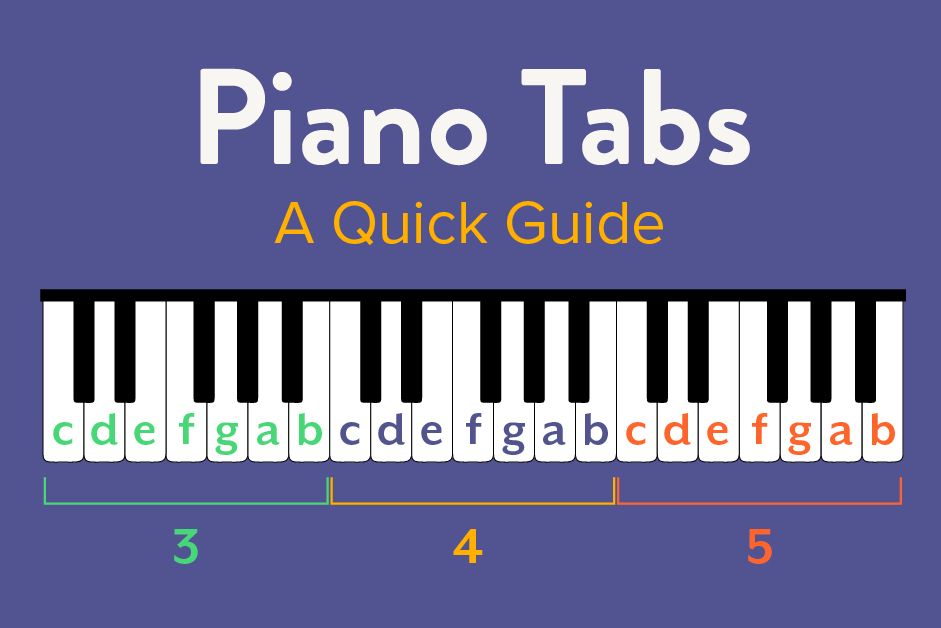
More sophisticated piano tabs divide the keyboard into octaves, from C to C. This kind of piano tab resembles a guitar tab, for which each dotted horizontal line represents a guitar string and numbers on the line represent which fret should be held as the string is played. On the piano tab, each octave is represented by a horizontal line and labeled with a number, with 1 being the lowest C to C octave on the piano. The example below spans three octaves from low C to high C:
5 | – – – – – – – – – – – – – – – –
4 | – – – – – – – – – – – – – – – –
3 | – – – – – – – – – – – – – – – –

Notes on the tab are indicated by letter names or sometimes numbers. When using letters, a lower case letter indicates a natural while an uppercase letter indicates a sharp. Again, bar lines are indicated by a vertical line. Here is the opening line of “Für Elise” using this piano tabs method:
5 | – e – D – | e – D – e – – – d – c – – | – – – – – – – – -|
4 | – – – – – | – – – – – – b – – – – – – | a – – c – e – a – |
5 | – – – – – – – – – | c – –
4 | b – – e – G – b – | – – –
Notice that there is not much indication of what the rhythm is in this tab. If you haven’t heard “Für Elise” before, you wouldn’t be able to play it accurately. To make up for this, some piano tabs count the rhythm below the lines.
5 | – – – – – – – – e – D – | e – D – e – – – d – c – | – – – – – – – – – – – – |
4 | – – – – – – – – – – – – | – – – – – – b – – – – – | a – – – – – c – e – a – |
| 1 – – – 2 – – – 3 – – – | 1 – – – 2 – – – 3 – – – | 1 – – – 2 – – – 3 – – – |
5 | – – – – – – – – – – – – | c – – –
4 | b – – – – – e – G – b – | – – – –
| 1 – – – 2 – – – 3 – – – | 1 – – –
Indicating rhythms in tabs isn’t always necessary because most people who read and use tabs are already familiar with the song they are playing and know the rhythm. They simply need a guide as to what notes to play on the keyboard.
How to learn piano without the use of piano tabs
While piano tabs are a quick and easy way to find the right notes on the keyboard for a familiar song you want to play, it can be hard to learn a song you’ve never heard before using piano tabs. Learning to read music on a full score will give you the ability to learn and play a much wider variety of pieces and songs. When written on the grand staff, piano sheet music shows the notes, the rhythms, and often includes markings for tempo, mood, dynamics, and articulation. Almost everything you need to know is there on the page.
Learning to read piano music on a full staff can seem intimidating, but the Hoffman Academy music learning system is designed to guide you through it step-by-step. Our first lessons introduce you to playing by ear and learning simple songs by rote, in other words by memorization. Once those familiar songs are in your mind, we show you how they would be written on the staff. This is similar to the natural way children first learn to speak and understand language.
Children become comfortable with the sound of language before they are shown how to read and write. In the same way, as you continue to learn more complex pieces, we introduce sight reading, or playing unfamiliar music that you’ve never heard before. By starting with a simple one-line staff and progressing gradually to the full grand staff, our method helps you build sight reading skills with confidence and without frustration.
What should a piano beginner learn first?
The first thing to know about the piano is that the keyboard is laid out with low notes on the left, high notes on the right, and each note is one half step higher than the note to its left. A piano keyboard has white keys and black keys. Most white keys have black notes between them, but some do not. Notice that the black notes come in sets of twos and threes. Take some time to become familiar with the layout of the piano. Try some notes and see how they sound.
For a fun and easy first song, learn “Hot Cross Buns” with Mr. Hoffman:

What are other resources for learning that aren’t piano tabs?
Our Hoffman Academy store offers dozens of pieces of FREE sheet music that you can download and either print or display on a tablet while you play. Our early elementary pieces include fingering charts to show you exactly where to place your hands on the keyboard. As you become familiar with the musical staff, you’ll find that playing with sheet music isn’t any harder than playing with piano tabs.
Do you have a piano piece you’ve always wanted to play? We can help you reach that goal by giving you the foundational skills to play any piece of piano music. Our carefully crafted Hoffman Method will guide you step-by-step to becoming a well-rounded and confident musician. All of our video lessons are available to watch for free, but to get the most complete learning experience we recommend Hoffman Academy Premium, which gives you access to our method books, all the sheet music, worksheets, and music learning activities in our store, plus online music learning games and more!