





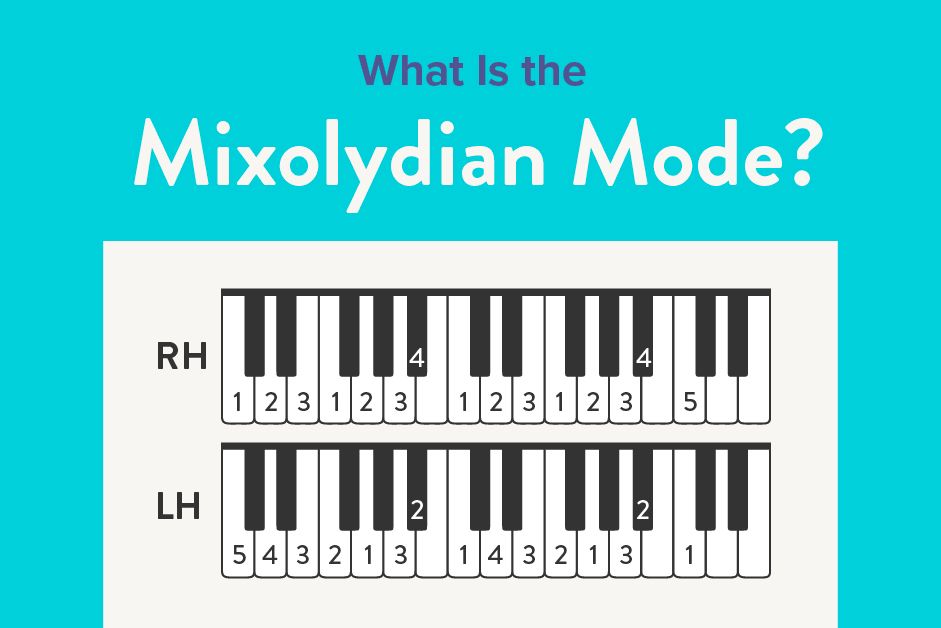
The Mixolydian mode is a major scale with a flattened seventh degree. It’s the fifth mode in the Ancient Greek system of modes. Some Classics scholars attribute its creation to the famed Grecian poet and musician Sappho.
Composers have been writing in this mode for thousands of years. It’s often heard in traditional folk melodies and fiddle tunes such as “Old Joe Clark.” In modern times, the Mixolydian mode’s special pairing of a major scale with the borrowed flat seventh scale degree makes this mode an enduring and evocative choice for pop and rock musicians.
In this article, we’ll outline the scale degrees and intervals that make up this mode. Then, we’ll discuss examples of the Mixolydian mode in music and share how to play the most common Mixolydian chord progression on piano. To learn all the modes, download our free Modes Packet linked below.
What feeling does the Mixolydian mode evoke?
Mixolydian mode lends its pensive flat seventh scale degree to many of our favorite pop and rock songs. If you’ve jammed out to the opening riff of “Sweet Child Of Mine” or enjoyed the vague sadness of “Bitter Sweet Symphony,” you’ve appreciated the cloud-with-a-silver-lining quality of Mixolydian. By blending the flat 7th scale degree of the blues scale with the optimism of a major third, this mode offers a bit of darkness and grit to the sunshine of the major scale.
Why use the Mixolydian mode?
If you are composing a song that is primarily upbeat with a touch of raw emotion, Mixolydian might be a great choice for you! It appeals to our ears because of its strong association with the major scale and bright sound, but the special flat seventh degree lends it the minor and more sad quality of the blues scale. This mode is also a common choice in pop and rock music and underpins the commonly-heard Mixolydian chord progression of I – ♭VII – IV.
What are examples of the Mixolydian mode in music?
With a close connection to the blues scale, this mode can be found in numerous rock, pop, and jazz songs. The distinctive outro “na na na na” of “Hey Jude” by the Beatles is an iconic example of the gritty flare the flattened seventh degree lends Mixolydian mode.
The Mixolydian Chord Progression
The Mixolydian Chord Progression encountered most commonly in pop and rock songs is the I – ♭VII – IV progression. Our first chord in the progression is the major I chord, or tonic chord. What gives Mixolydian its bluesy flavor is the flat seventh chord, ♭VII. The chord progression closes with a major IV before rotating back to I.
In “Clocks” by Coldplay, the piano part incorporates the I chord, the flat vii arpeggiated for two measures, and then the major IV chord. You can learn to play this Mixolydian classic in our Clocks piano tutorial.

Lorde also uses this distinctive progression in her song “Royals.” This chart topper’s chorus is in D Mixolydian. Lorde’s surly line “we don’t care” lands on the flat seventh degree, the C natural, in this chord progression.
How do you play the Mixolydian mode on piano?
A great place to start with playing in this mode is to play the white key version of this scale. Because the Mixolydian scale is built on the fifth scale degree of the major mode, you can easily learn the white key version starting at G. To play your first Mixolydian mode scale, find the key G on the piano and play all the white keys. From G, you’ll play A, B, C, D, E, F, and G again.
To learn the Mixolydian scale using solfege, you would say “do, re, mi, fa, so, la, te, do.” In solfege, the flattened seventh degree of the major scale changes from “ti” to “te.” Using solfege is one way to transpose a different key into Mixolydian by lowering the seventh scale degree. For example, if you are playing in C major and want to play in C Mixolydian, you’d lower the seventh scale degree B to B♭.

As you practice adding chords in this mode, keep in mind the lowered seventh scale degree changes the quality of some chords. For example, in this mode, the V chord is a minor chord because of the lowered seventh. Similarly, the VII chord is a major chord because the root is lowered by a half step.
Why is Mixolydian so popular?
Mixolydian is popular because it incorporates elements of the familiar major scale and blends that with a lowered seventh scale degree. The whole step between the seventh scale degree and the tonic of the mode lends a distant feeling to melodies using this mode. Since Mixolydian preserves the major 3rd and many other elements of the major scale, it combines the cheery quality of major with the introspective quality we associate with the lowered leading tone in blues and some minor scales.
How can you tell if a song is in Mixolydian?
Here are two ways to tell if a song is in Mixolydian mode:
- Listen for the iconic I – ♭VII – IV chord progression. The full step down from the root of the first chord to the second creates an unusual, unexpected sound. From “Sweet Child Of Mine” to “Bitter Sweet Symphony,” you can hear that distinctive step into a more distant place.
- Check the sheet music for a flat or natural sign.
Next steps for exploring the Mixolydian mode on piano
To explore more songs in Mixolydian mode on piano, take the time to listen to pop and rock songs for that unique lowered second chord in the progression. You can also master Mixolydian by challenging yourself to write your own piece. Take that common I -♭VII- IV chord progression, add a melody, and see if Mixolydian speaks to you.