





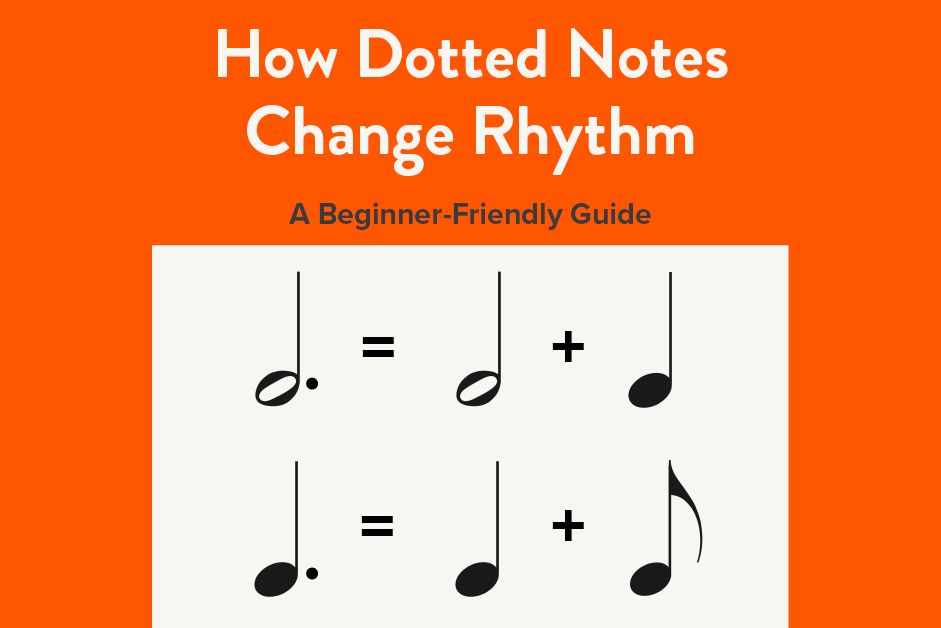
Dotted notes and dotted rhythms add variety and movement to music by changing how long a note is held
In musical notation, a dot lengthens the note by 1.5 times, adding half the value of the original note to its duration. If that sounds confusing to you, you’re not alone! We’re here to help with clear examples of how to count dotted notes and dotted rests in music.
In our guide to dotted rhythms, you’ll see examples of dotted notes written out in music notation, alongside examples of ties and syncopations. We’ll also share how dotted notes function differently in simple and complex meter. You’ll even learn a bit about double dotting, or the French dot, and its historical usage.
Ready to level up your music theory knowledge? Give Hoffman Academy a try today!
What are examples of dotted notes?
Composers use dotted notes in order to make notes last one-and-a-half times longer. You’ll see dotted notes in marches, where a dotted quarter followed by an eighth note provides a jaunty feel, or in ¾ time waltzes, where a dotted half note lasts for the length of an entire three-beat measure. An easy way to remember this is that a dotted note lasts for three of the next smaller note value; for example, a dotted quarter note lasts for three eighth notes.
Another common place you might see dotted notes are works written in compound meter. In time signatures like 6/8 and 9/8, the big main beat unit–the “pulse” of the song–is the dotted quarter note. Each beat unit is made up of a group of three eighth notes. You can visualize this in the Guide to Compound Meter, where you’ll see the connection between the dotted quarter note and the groups of three eighth notes in compound meter.
Dotted eighth note
A dotted eighth note lasts for three sixteenth notes. In simple meter time signatures like 2/4, a dotted eighth note lasts for three quarters of a beat.

Dotted quarter note
A dotted quarter note lasts for three eighth notes. In simple meter time signatures like 2/4, a dotted quarter note lasts for one beat and the half of the next. In compound meter time signatures like 6/8, a dotted quarter note lasts for a single beat.

Dotted half note
A dotted half note lasts for three quarter notes. Dotted half notes last for an entire measure in the simple triple meter 3/4 and compound duple meter 6/8.

Dotted whole note
A dotted whole note lasts for three half notes. If you are playing in time signatures like 3/2 or 12/8, you might see a dotted whole note, which lasts an entire measure.

What are types of dotted rhythms?
Dotted rhythms feel ‘different’ in simple meter time signatures compared to compound meter time signatures. While a dotted quarter note is always made up of three eighth notes, the type of meter changes the feeling of the rhythm. This is because simple meter divides each beat into two notes, and compound meter divides each beat into three.
So, in 6/8 time, the dotted quarter note lasts for a full beat, and divides into three eighth notes. A full measure of 6/8, containing two dotted quarter notes, is often counted as “ONE-and-a-TWO-and-a.” In comparison, a dotted quarter note in 2/4 time lasts for longer than one beat. It takes up the first beat (the first two eighth notes) and half of the next beat (the first eighth note of the second beat). The remaining eighth note of the second beat is on the “and” after beat 2. A full measure of 2/4 will be counted as “ONE-and-TWO-and,” with the dotted quarter note lasting for “ONE-and-TWO.”

Together, the dotted quarter and eighth notes in simple meter can feel similar to a swing rhythm, where eighth notes are played unevenly. In jazz music, you will often be directed to “swing” the eighth notes by making the first eighth note in each group sound longer than the second. This has the effect of making simple meter, like 2/4, feel more like compound meter, like 6/8:

How do you count dotted rhythms?
Dotted rhythms require spoken syllables that help divide up the beats. The rhythm syllables you use will depend on what kind of time signature you have. This is because a dotted quarter note in simple meter functions differently from a dotted quarter note in compound meter. If you’re in simple meter, your dotted quarter note will be counted as “ONE-and-TWO.” If there is an eighth note immediately following the dotted quarter, it will occur on the “and” after beat 2. If you want to keep track of where you are in the measure, use the beat number that the dotted quarter note begins on as your starting count. A dotted quarter that falls on beat three would then be counted “THREE-and-FOUR,” and the eighth note that follows it would fall on “and” after beat 4:

However, in compound meter, the same three-eighth note value would be counted “ONE-and-a” because in compound meter the beats are broken down into groups of three instead of two, as you can see in the chart below:
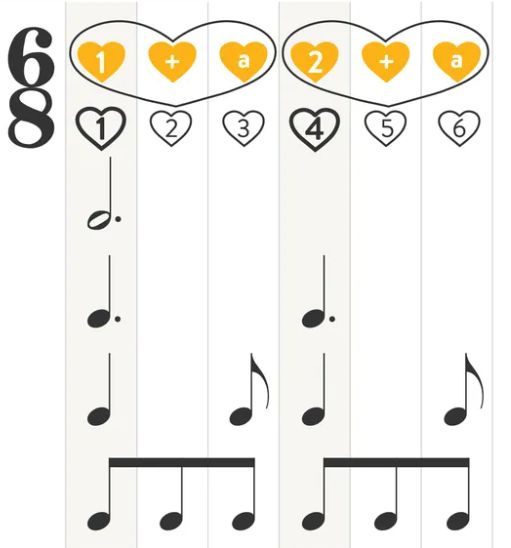
Even though the time signature says 6/8, the real beat unit is the dotted quarter note. So 6/8 is really the same thing as 2/4, with two main beats in the each measure, but with each beat divided into three eighth notes, instead of two.
What do two dots next to a note mean?
Two dots next to the note increases the note length by 75% of its value. If you prefer a fractional representation, it increases the note value by ¾ of its original duration instead of ½. In musical terms, take any note, add on half of its value, and then add on another quarter of its value. A double dotted quarter note lasts for a quarter note plus an eighth note and an additional sixteenth note. This makes it nearly as long as a half note, just one sixteenth note shorter:

The effect of double dotted notes is a faster, more strident rhythm than what you get with single dotting. You’ll frequently see double dotted eighth notes in Baroque piano music. Take an ordinary eighth note, add on a sixteenth note, then add an additional thirty-second note:

So a double dotted eighth note nearly takes up a full beat. All that’s left in the beat is one final thirty-second note, and we get an intensified march rhythm:

Double dotting lends music an extra bit of sass! This type of rhythmic figure was common in 18th century French courtly compositions. In the opening of the Beethoven Sonata Op. 111 in C Minor from the Early Romantic era, you can hear how the double dotting lends the music a sense of aggressiveness and weight.
Is a dotted rhythm syncopated?
Dotted rhythms can create syncopation. In syncopation, the accent of the beat moves to an unstressed beat. That movement of the accent to an unstressed beat, or even to the middle of a beat, as with a displaced eighth note, creates a fun, funky vibe! A dotted quarter note followed by an eighth note on the downbeat of a 4/4 measure does not create a syncopation because the accents stay on the strong beats.
In the video below, you’ll learn how to count syncopated rhythms in 4/4 time. Watch as Mr. Hoffman demonstrates syncopations and different ways to write them. You’ll see how the use of rests, eighth notes on an off-beat, or ties can create syncopations, along with dotted quarter notes.
What does a dot next to a rest mean?
A dot next to a rest means that the rest lasts 1 1/2 times as long as the un-dotted rest. As with dotted notes, dotted rests increase the value of the rest by adding half the duration of the original rest. To build dotted rests, look to the next smallest rest value and add one. A dotted quarter rest lasts for three eighth rests, in the same way the dotted quarter note equals three eighth notes.
You can use the process above to count more dotted rests. A dotted half rest lasts for three quarter rests, and a dotted whole rest lasts for three half rests. For more on reading rests, we have a free, downloadable reference guide to rests and an article on how to count rests.
What is the French style dotted rhythm?
A French style dotted rhythm is a double dotted rhythm. Common in Baroque and Classical era scores, this is also known as the inegale style, from the French word “unequal.” As with the double dotted rhythm above, this rhythm lasts for seven counts of the next smallest value, extending the note’s length for three-quarters of its value. This rhythmic figure was associated with royalty and the court of Louis XIV, the Sun King.
How do you play dotted rhythms?
To play dotted rhythms accurately, start by checking your time signature. We recommend counting and clapping your rhythms first.
Some pitfalls of dotted rhythms include rushing, especially with dotted quarter note rhythms in simple meters like 2/4 or 3/4. One trick to help this is count-singing while you play. Count and sing the eighth notes (or have your metronome play the eighth note subdivision with you) while you play the dotted quarter rhythm, being sure to hold the note for the duration of three eighth notes.
Always start slowly and count carefully as you’re learning a new rhythm. Gradually increase your speed as you get more comfortable with the rhythm. Soon playing dotted rhythms will feel as natural as playing the straight rhythms you already know.
How to find a dotted rhythm in a song?
In addition to looking for the dotted notes as written above, you can find a dotted rhythm in a song by actively listening. Dotted rhythms can have a distinctive skipping feeling, or an unequal ‘lilt’ to them.
What is the difference between a dotted note and a tie?
A dotted note and a tie can each make a note last longer, but they are different types of notation. Ties connect two notes of the same pitch to create a longer rhythm. This type of notation can be tied over a bar line to make a note last even longer than a measure. To practice tying notes together to make them last longer, try our Ties Musical Resource.
Math offers another way to think about the difference between a dotted note and a tied note. The “rhythm math” of a dotted note is always the same; it lasts for an extra half of its length and it will always be contained within a measure. A dotted quarter note will always last for three eighth notes, and be somewhere within a measure. In contrast, ties can connect notes across barlines. Ties can also link two notes of different quantities, for example connecting a quarter note to a half note.

Understanding dotted notes and rhythms helps you read and play music with greater accuracy and expression
Dotted notes and rests can add variety and excitement to the rhythm of a song. Depending on the style of the music, they can make the rhythm feel more light and lilting, fun and jazzy, or march-like and majestic. Now that you know more about dotted notes and rhythms, we hope you enjoy listening for them in your favorite music and that you’ll also feel more comfortable playing them!