





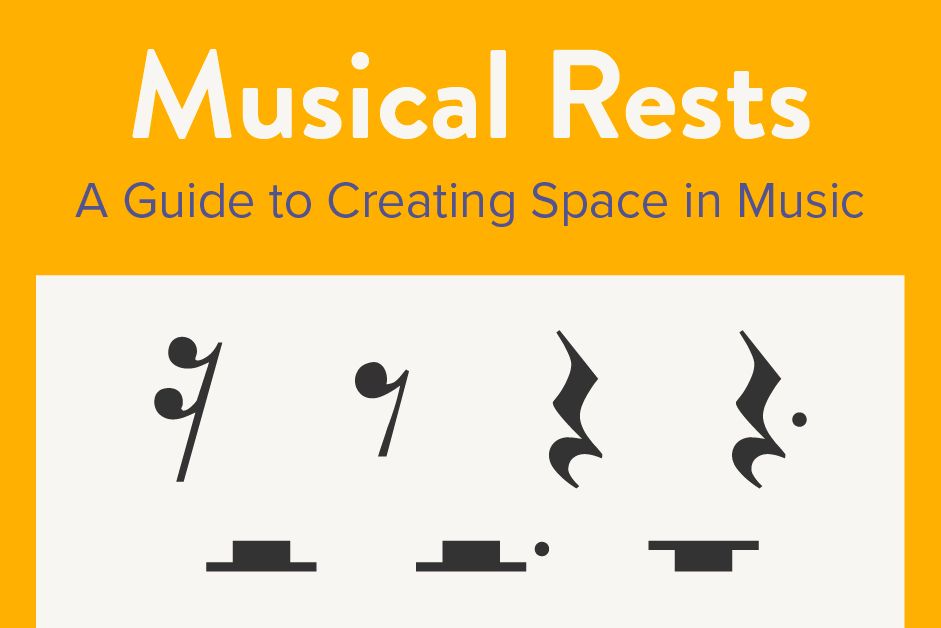
What are musical rests? Symbols that show where silence belongs within a piece of music. Learn all about them below:
Musical rests are silent moments within a song. Similar to the way commas and periods offer a place to pause when reading aloud, rests create natural pauses in music phrasing. Without these silent moments, music might feel like a constant hum, similar to the unceasing drone of an engine or a hive of bees.
Rests in music are measured by their duration and notated with symbols, similar to the notation for music notes. These silent beats stay in the meter of the piece and help keep the pattern of strong and weak beats. The beat goes on, even when there is silence!
To help you understand rests in music, we’ve included a guide to the symbols for musical rests and hints for memorizing their notation below. You’ll also find a discussion of common errors pianists may make with rests, from rushing them to skipping them, and some suggestions for making your rests as accurate as the notes you play!
Ready for more musical theory and technique lessons? Try Hoffman Academy today!
What is another name for rest in music?
Another name for a musical rest might be a pause or silence. Musical rests notated in sheet music usually share the names of the note value with the same duration. Therefore, a quarter note’s counterpart is a quarter rest. Another name for silences in music describes the pauses that make a dramatic break. Caesuras and G.P.s, or general pauses, describe long pauses in music where the beat disappears and there is a moment of silence.
What are the different types of music rests?
In sheet music, the durations of music rests correspond to note values. Our Guide to Rests chart pictured below shows the most frequently written rests next to their note counterparts. You’ll also see a graph that shows how much time a rest takes over the course of a common time measure.

When naming musical rests, the rest shares the name of the note of the same duration. A sixteenth rest is equivalent to a sixteenth note and an eighth rest is equivalent to an eighth note. You can learn more about eighth rests and eighth notes in the rhythm challenge video below!

There are also quarter rests, which last for one beat and are the same value as quarter notes. Two beats of rest are indicated by a half rest. For three beats of rest, a dotted half rest matches a dotted half note, and a whole rest lasts for four beats of rest.
What are some tips for learning music rests?
We recommend starting with the Guide to Rests in Music chart above as you practice reading musical rests in sheet music. To memorize the symbols for music rests, we recommend creating flashcards. Our Musical Notes Guide | Names, Symbols & Time Values is another resource to help you read notes and rests in the correct rhythms.
Once you’ve figured out the rhythms of the rests and notes in your song, it’s time to practice playing them! We find it helpful to practice the rests in the context of the piece with a metronome. Using a metronome can help you feel a steady pulse in sections of music where notes and rests alternate. Metronomes also make it easier to count a steady beat in longer duration rests, like whole rests.
How do music rests affect the rhythm of a piece?
Music rests are notated as part of the rhythm of a piece. As mentioned above, if you see a quarter rest, it lasts for one quarter note value. Rests in music fit into the meter of a song. If a piece has three beats in a measure, with two quarter notes followed by a quarter rest, the measure still takes three beats. The same way that a comma tells us to take a breath in a sentence without ending the sentence, a rest acts like punctuation for the musical phrase. Rests fit into the tempo of the song and are a part of the music.
One common pitfall for pianists includes hurrying through a rest to get back to playing as soon as possible, which can speed up the tempo of the piece. Musical rests help us breathe and stay in a steady tempo. If you find yourself rushing when you play a piece of music (I find this can often happen in fast songs, and especially in triple meter), take a deep breath and pull out your metronome. Be sure to play each group of notes and each rest along with the beat of the metronome. It helps to start slow for this exercise!
It can be as hard to sit in the silence of the rest as it is to play a note! Some young pianists might be tempted to even skip a rest to get to the end of the piece faster. However, the composer put that rest there for a reason, and it’s important to observe every rest to preserve natural phrasing. A piece with no pauses, like a run-on sentence with no punctuation, would be very difficult to read!
What are other pauses in music called?
A common term for pauses in music which you might see in choral or instrumental music is the term tacet, which comes from the Italian word for silence. A tacet marking might last for a whole piece or movement, and it indicates that the instrument does not play. Another term for a rest is a caesura, from Latin meaning to cease making noise. This marking, which looks like railroad tracks, signals a type of dramatic break. At a caesura, the piece comes “out of time” for a moment, similar to a silent fermata. A G.P., or General Pause, is another special type of rest, usually between movements.
Bringing it all together: How musical rests shape every song
To summarize, music rests notate moments of silence within music. Musical rests generally remain in the tempo of the piece, with one exception being the caesura and G.P. mentioned above. The silent spaces of rests are so important that an avant garde composer, John Cage, wrote an entire work called 4’33” where the pianist is tacet, or silent, for the entire duration of the piece. That’s a meditation on the role of silence in music.