





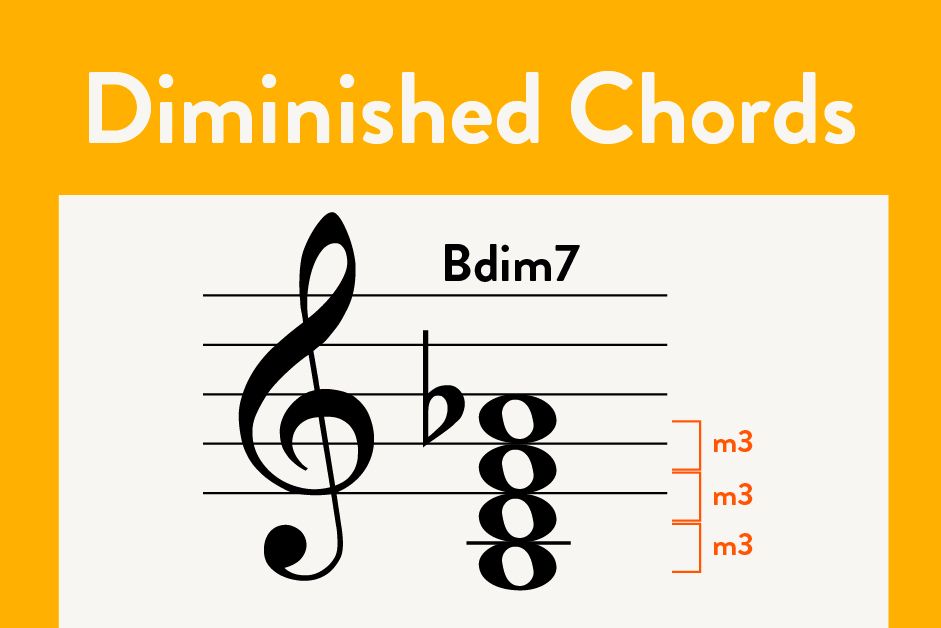
Learn all about playing diminished chords on piano
If you’re looking for the ultimate expression of confusion or anger in music, it’s the diminished chord. Here’s a passage from one of Beethoven’s stormiest piano sonatas, the Appassionata in F minor, Op. 57:
This diminished seventh chord sounds tense and unresolved, as if it inhabits a strange sonic world between established keys. In fact, we’ll discover that diminished triads and seventh chords also have special properties, making them excellent portals for changing from one key to another.
What does the musical term diminished mean?
An interval is the distance, or difference in pitch, between two tones. To diminish an interval is simply to make it smaller. Take a perfect fifth, for example C up to G, and make it a half step smaller. You can either lower the G to G flat or raise the C to C sharp. Both result in a diminished fifth:

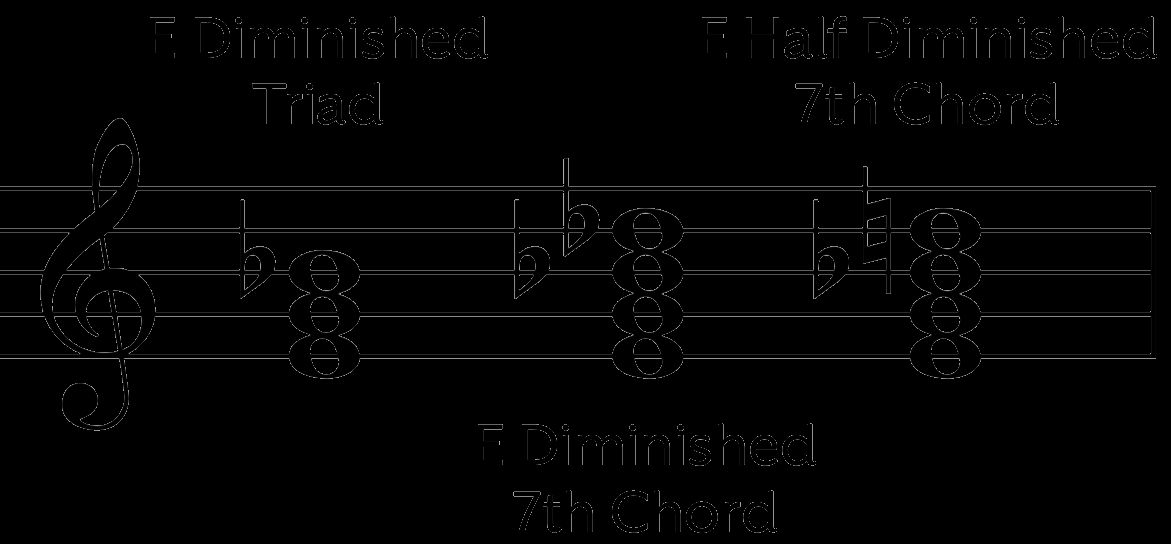
There are three types of chords containing diminished intervals that also use the name diminished: the diminished triad, the diminished seventh chord, and the half diminished seventh chord. Because of their unique tension, they have been a dramatic staple in compositions since the Baroque Era (the 17th and early 18th Centuries).
What emotions do diminished chords evoke?
Diminished harmony is an iconic expression of anguish, confusion, and ambiguity in music. Unlike major and minor triads, which are outlined by the consonant and stable perfect fifth, diminished chords do not contain this interval. They instead use the dissonant diminished fifth, also known as a tritone. This gives the chords an unsettled and nervous quality that allows them to evade any sense of restful key area.
The opening of Beethoven’s Piano Sonata No. 8, Op. 13, the “Pathétique,” gives a good example of the tension diminished chords create, and the release of that tension when they resolve.
In the Fantasia in D minor, Op. 116, No. 7 by Johannes Brahms, most of the frantic arpeggios you’re hearing are diminished seventh chords. The tension does not convincingly resolve until the titanic final D major chords, which seem to win a pyrrhic victory after a long struggle.
You’ll find a kindred episode in the cadenza from the first movement of J.S. Bach’s Brandenburg Concerto No. 5. You can hear chains of diminished seventh chords as arpeggios, first descending, then rising. This is Bach at his most fiery, and the repeated diminished seventh chords lend themselves perfectly to this tumultuous passage.
What is a diminished triad?
Diminished triads are easy to build! They’re made from just one kind of interval: the minor 3rd, which consists of three half steps. Choose any key on the piano, move up three half steps, then another three, and your chord is finished. Below is an E diminished triad. Start on E, go up a minor third to G, and another minor third up to B flat. Notice that the overall interval between the root (the bottom note) and the fifth on top is once again a diminished fifth:
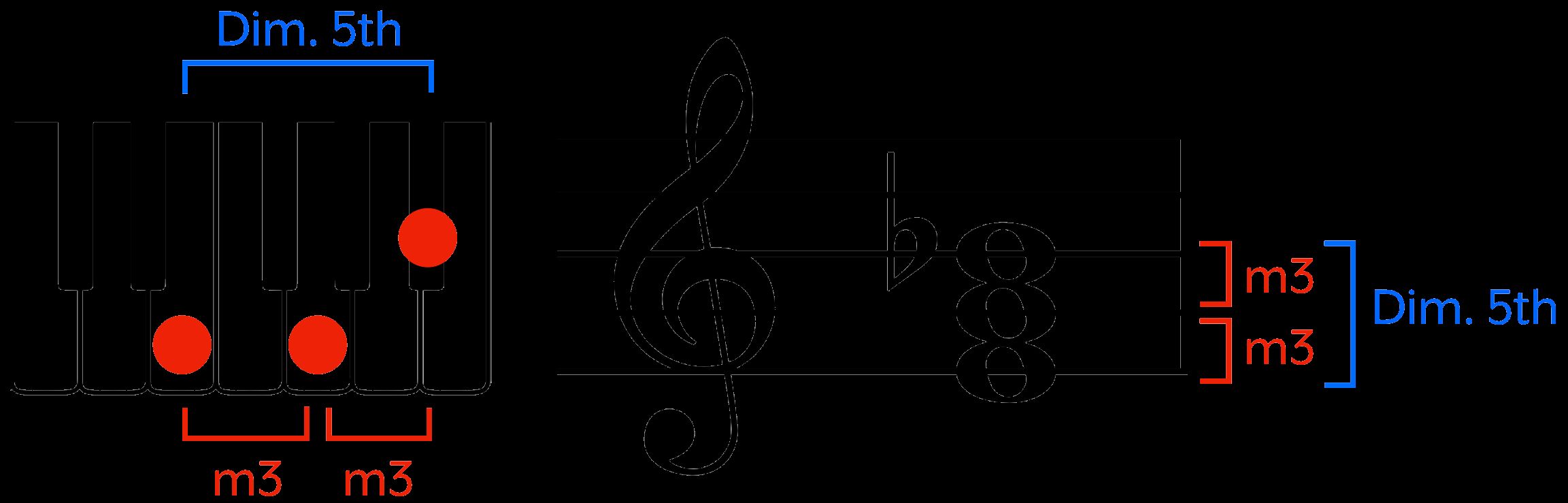
An even faster way to build a diminished triad is to take any minor chord and lower its fifth by a half step. If we start with a C minor triad, simply lower G a half step to G flat, and we get a C diminished triad:

One of the most common uses of a diminished triad is as a substitute for the V7 chord in the authentic cadence. While the V7 to I chord progression makes for a stronger cadence, composers often choose the vii diminished chord when they want a more slippery and less resolute return to I:

Notice the music symbol for a diminished chord: a small circle as a superscript (º).
What is a diminished 7th chord?
To create a diminished 7th chord, simply add one more minor third on top of a diminished triad. The four notes are now, from the bottom up, the root, third, fifth, and seventh:
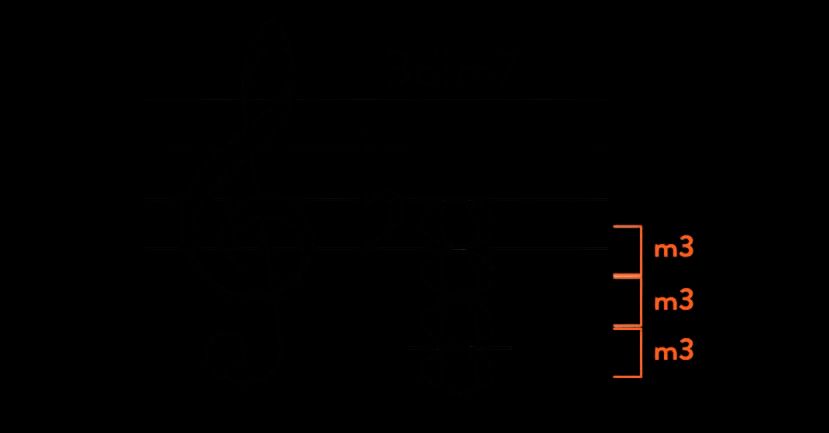
Notice once again that the chord consists of only one interval, the minor third. In fact, if we went up three more half steps from the seventh, we’d end up back at B, repeating the root. No matter how many times we invert this chord, we get only minor thirds over and over. This intervallic symmetry allows each of the four notes to be the root of its own diminished 7th chord, and makes the chord a useful tool for modulation. It has the special ability to move to four different keys. There are two ways it can do this.
Method 1
On the piano keyboards below, you can see how the same four keys can form either a G-sharp, B, D, or E-sharp diminished 7th chord.
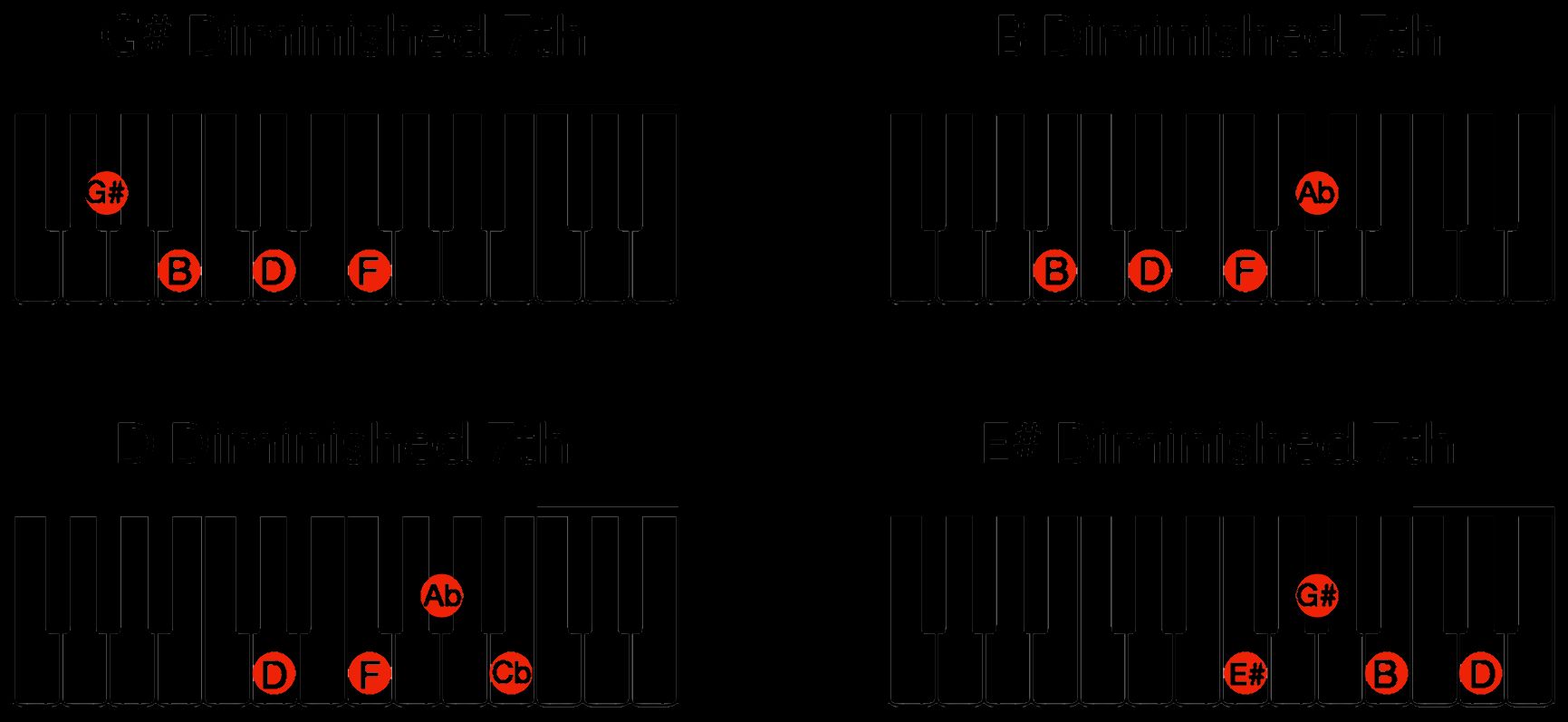
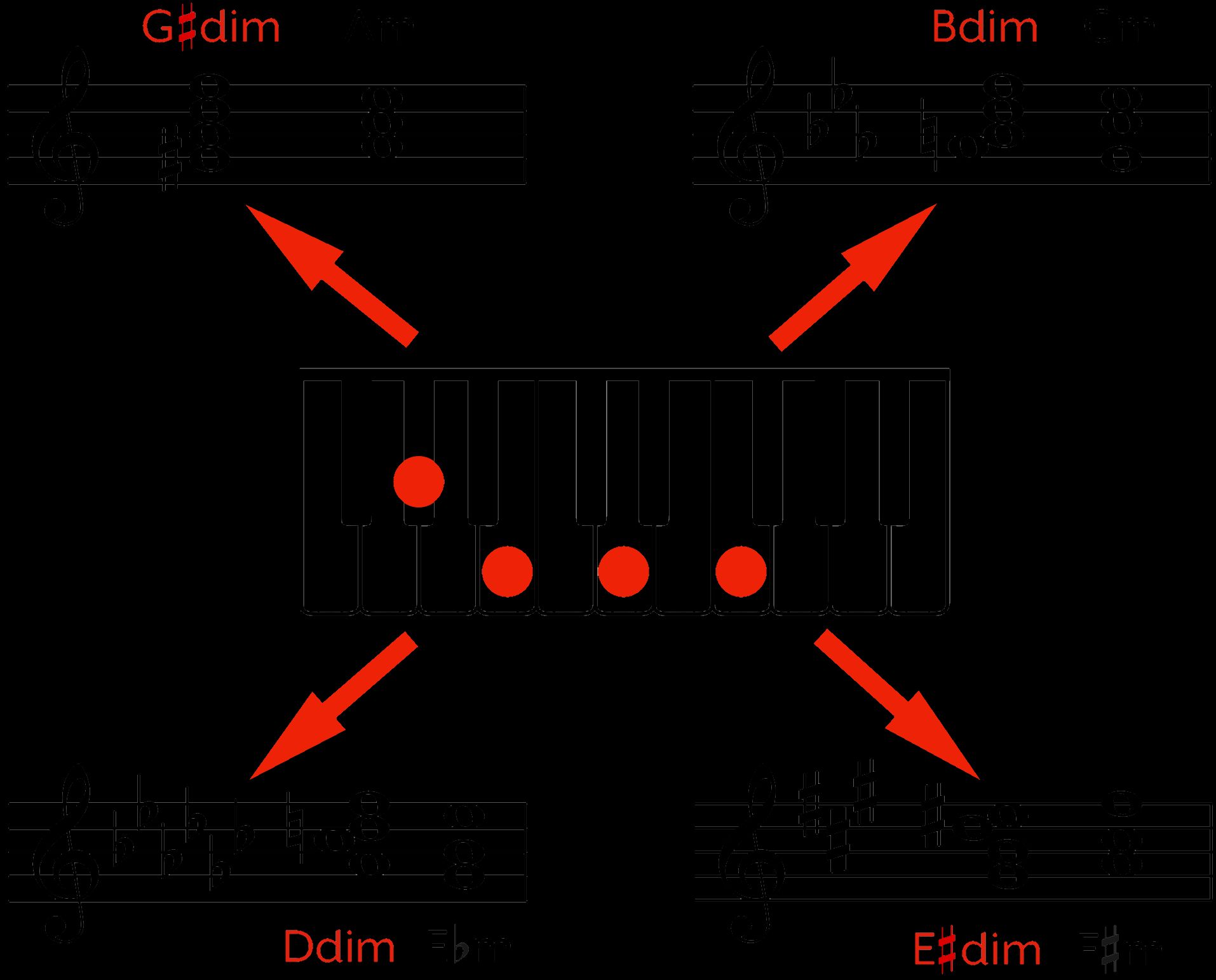
Just like diminished triads, the diminished 7th chord often functions as vii in any key. In the illustration below, we can spell a single diminished 7th four ways, making it the vii diminished chord in four different keys:
- The G-sharp diminished 7th chord (G# – B – D – F) will take us to the key of A minor.
- Respell the G sharp as A flat and we get a B diminished 7th chord (B – D – F sharp – A flat), which modulates to the key of C minor.
- Respell the B as C flat and that leaves us with a D diminished 7th chord (D – F – A flat – C flat), resolving to the key of E-flat minor.
- Finally, respell the F as E sharp and we have an E-sharp diminished 7th chord (E sharp – G sharp – B – D), which takes us to the key of F-sharp minor.
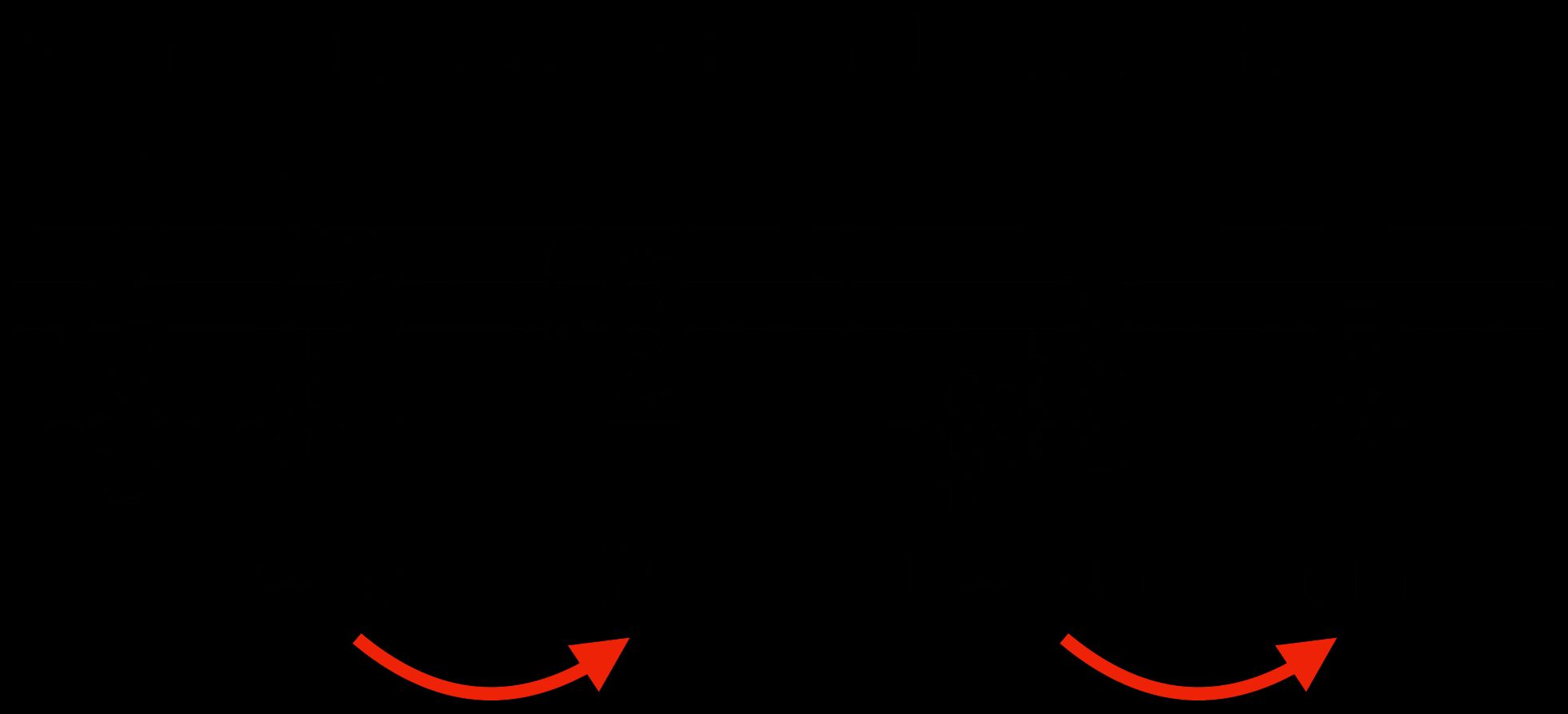
Beethoven often used this respelling of the same diminished seventh chord to modulate. Below, the first movement of his Piano Sonata No. 8, Op. 13 shows him using an F-sharp diminished seventh as the vii chord in the key of G minor. But right after that he respells the same chord as a D-sharp diminished seventh, which now makes it the vii chord in the new key of E minor:
Method 2
The other way to use a diminished seventh chord as a crossroads into four different keys is to simply lower any note in the chord a half step. This turns it into the V7 chord of a new key.
In a B diminished seventh chord, lower the B to B flat and you get the V7 chord in the key of E-flat major:

Or, instead, if you lower the D to D flat, that gives you the V7 chord in the key of G-flat major:

Lower the F to E and that takes you to the key of A major:

Finally, lower the A flat to G, and it’s home free to the key of C major:

Franz Schubert uses this technique to make a diminished seventh chord modulate to a very distant key. In his String Quartet in A minor, D. 804, we have a G-sharp diminished seventh chord, which should be the vii dim7 of the tonic key, A minor. But Schubert lowers the B a half step to B flat, respells the G sharp as A flat, and this turns the chord into V7 in the completely unexpected key of E-flat major:

What is a half diminished 7th chord?
Perhaps the most famous opening to any opera is the first chord of Wagner’s Tristan und Isolde. Listen to the woodwinds play it, just after the yearning cello line.
It’s quite different from the diminished seventh chord, which is really a diminished triad with a diminished seventh on top. However, If we instead add a minor seventh above a diminished triad, we get one of the most plaintive chords you’re likely to hear: the half diminished seventh chord:
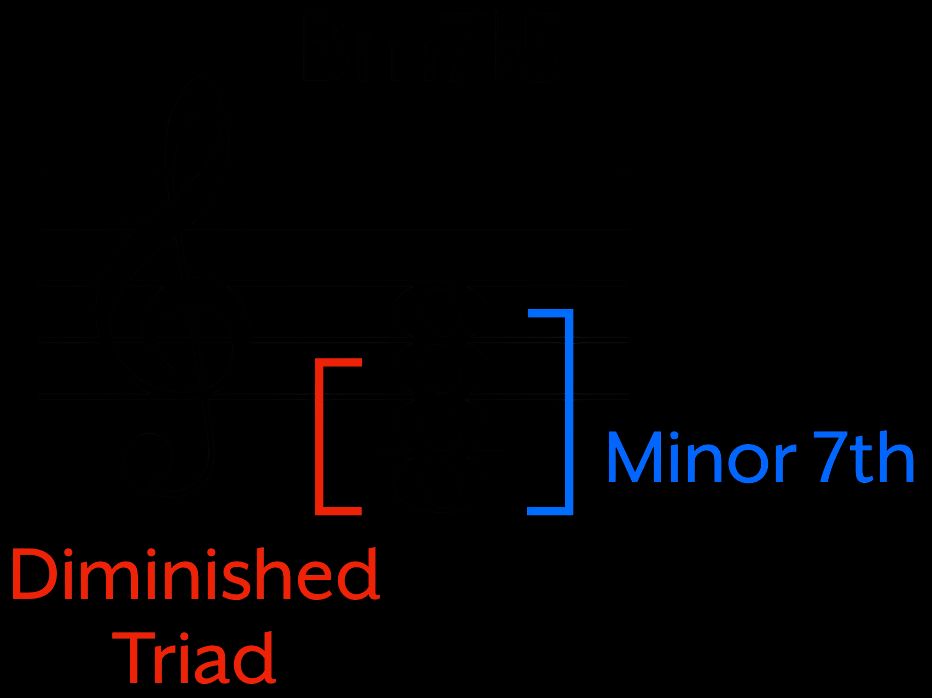
Although this famous “Tristan Chord” can be interpreted in several ways, its first appearance is enharmonic with a half-diminished seventh. The music symbol for this chord is a circle with a slash through it: ø. The half diminished seventh is most often seen in classical music as the ii7 chord in a minor key, and makes for a mournful approach to V:
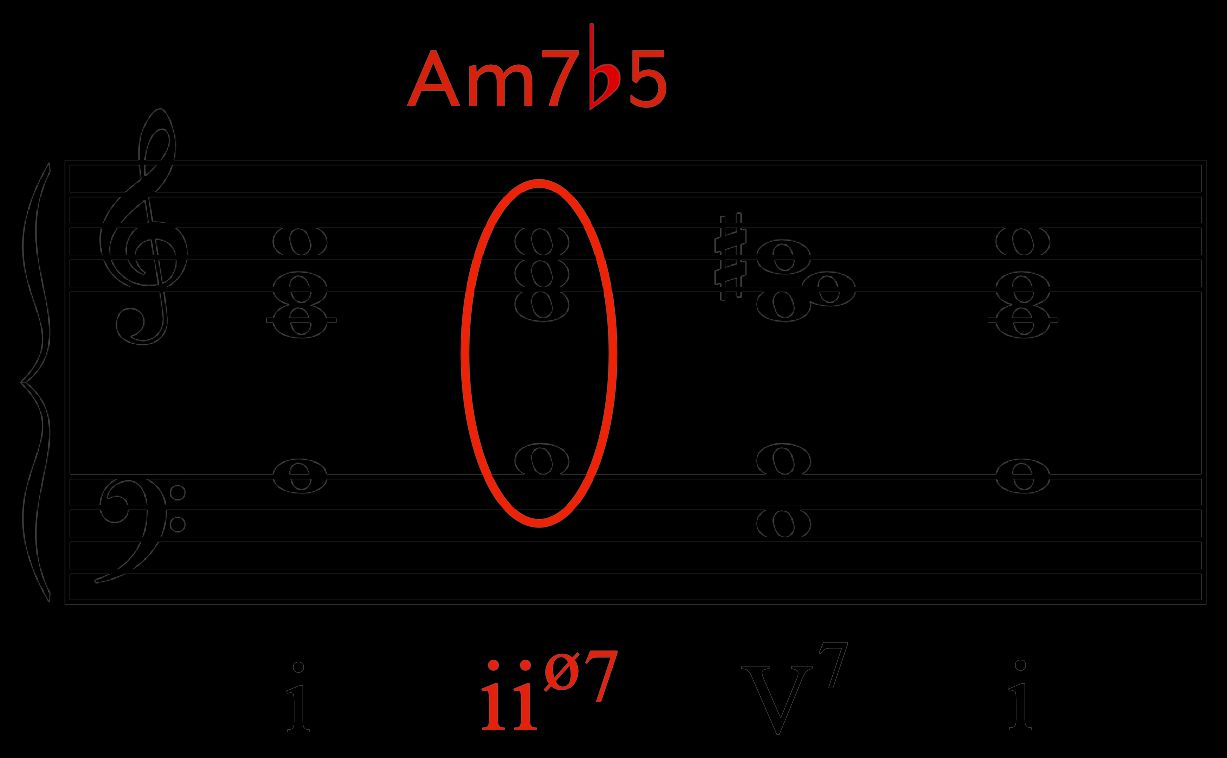
However, it also frequently appears in pop music and jazz, where it’s known as a minor seventh flat five chord. The Beatles used it in Penny Lane; listen for the lyrics “and all the people that come and go,” and also “and the banker never wears a mac.”
Are there rules for diminished seventh chords?
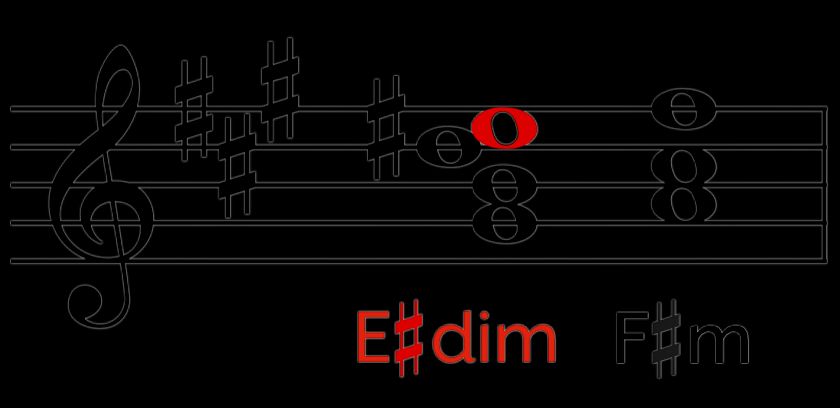
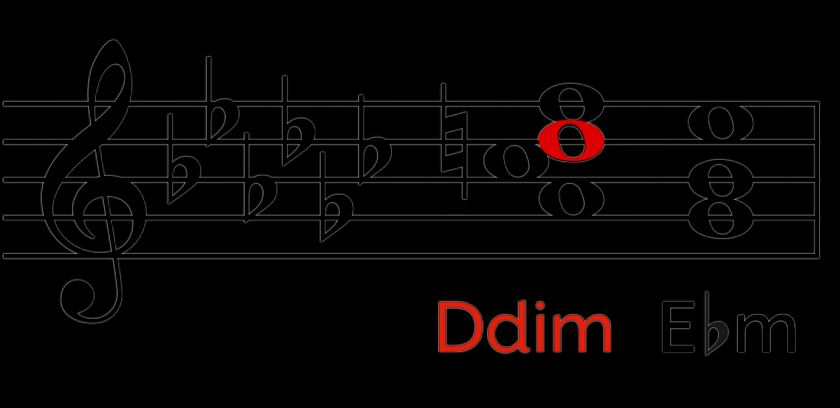
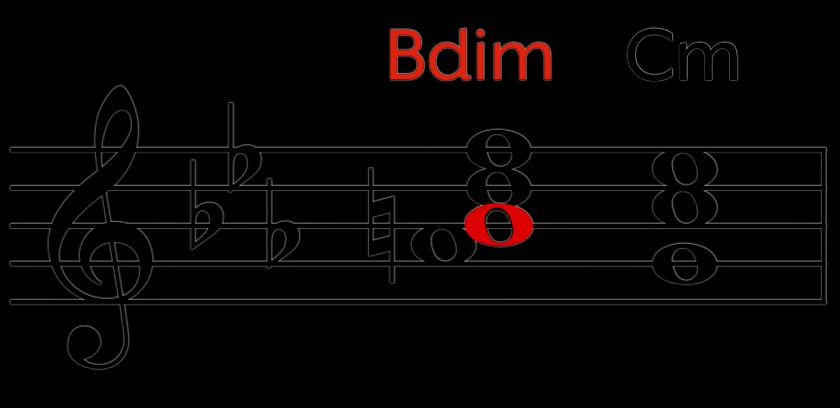
Because of its symmetry, it can be difficult to know if the diminished seventh chord is in root position or an inversion. But there’s a trick to it: if you see an inversion of this chord, one of its thirds will be spelled as an augmented second. Look for the top note in that augmented second, and that’s the root of your chord. This will also help you determine which key the chord should modulate to.
In first inversion, the augmented 2nd will be on top. So E sharp is the root of this diminished seventh chord, making it viiº7 in the key of F-sharp minor:
In second inversion, you’ll see the augmented 2nd in the middle. The root is D, and this diminished seventh chord is viiº7 in E-flat minor:
Finally, in third inversion, the augmented 2nd appears on the bottom. B is the root, and that makes this chord viiº7 in C minor.
Keep exploring diminished chords to strengthen your piano skills
Diminished chords, like all others, are part of a rich harmonic palette that brings color, emotion, tension, and release to music. Your familiarity with different kinds of triads and seventh chords will help you improve your musicianship on many fronts. Sight reading, improvising, composing, and discerning musical structure are just a few of the skills you can hone with a solid background in chords. So if you already have a few chords under your belt, don’t stop. There are so many more awaiting you!