


Suspended chords provide the dissonance and tension needed to drive music along and add tone color. Listen to the final chord of the keyboard intro to Van Halen’s Jump:

All of the chords in the right hand part are simple triads except for the very last one, a Gsus4. This is one of the most common suspended chords in pop music, and you can hear the dissonance that sets suspended chords apart from triads. Suspended chords can resolve their dissonance–and release tension–or they can maintain tension by leaving the dissonance unresolved. Either way, centuries of music have been enlivened by the use of suspended chords, and in this article we’ll learn how to build and play them on the piano.
Explore the world of music theory and so much more! Visit the Hoffman Academy Blog.
What is a suspended chord?
Suspended chords have a different arrangement of intervals from ordinary triads. While both suspended chords and triads are outlined by a perfect fifth, major and minor chords divide that fifth into a pair of thirds. These thirds are consonant intervals, and they’re the reason major and minor chords sound restful. Instead of being made with two third intervals, a suspended chord is made with seconds and fourths, creating dissonance:

Suspended chords originated in counterpoint writing, in which a tone is held over from the previous harmony, resolving late and causing dissonance. In two-voice counterpoint, we start with a consonant interval, such as a third. Then, one voice moves against the other, creating a dissonance, which the other voice “fixes” by resolving afterward:
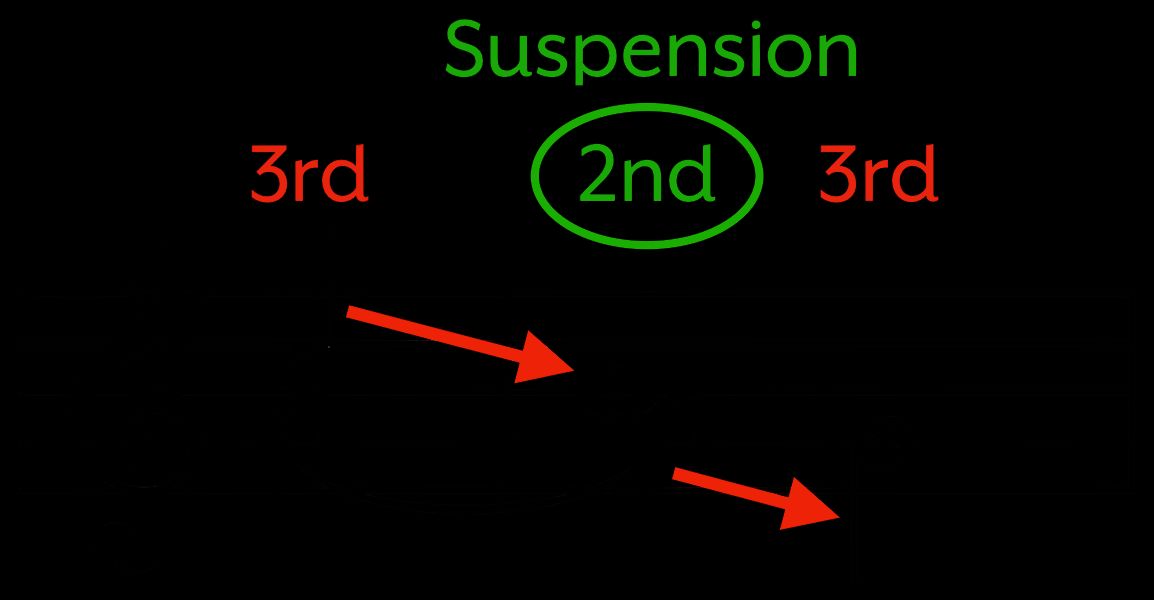
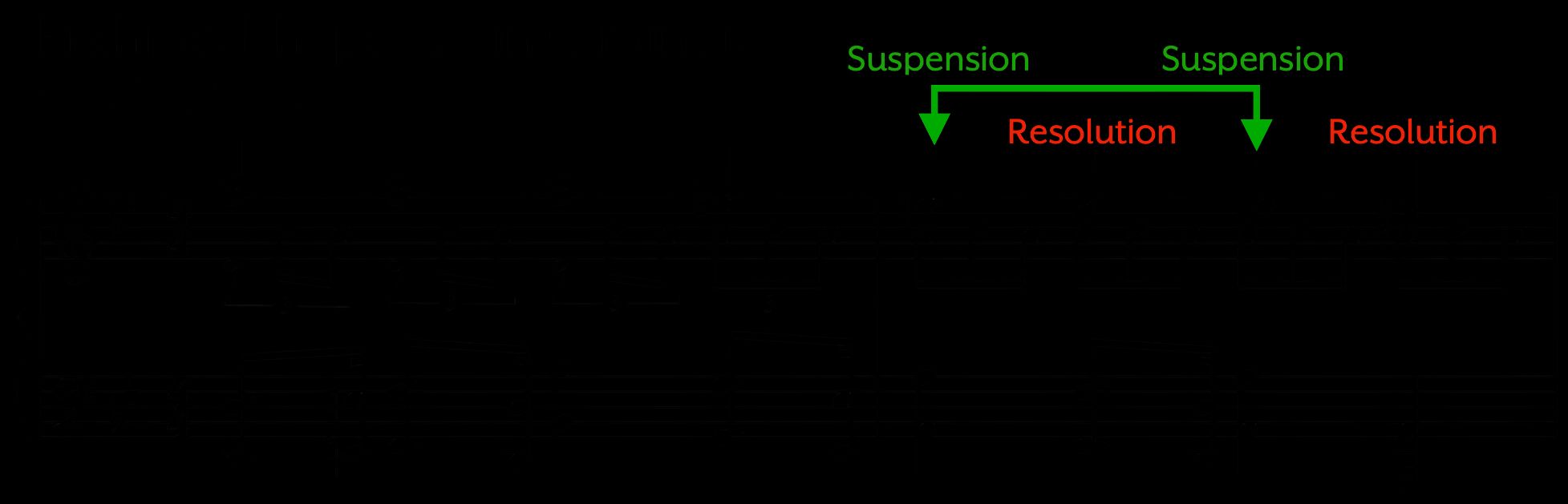
You can see a chain of suspensions at work in Brahms’s Rhapsody in G minor. The right hand’s dissonant seconds resolve to consonant thirds over the nervous accompaniment and left hand bass melody:
What are the types of suspended chords?
Sus2 and sus4 chords
The most simple suspended chords are the sus2 and sus4. They’re nearly the same as triads, but with their thirds replaced by either a second or a fourth. A Csus4 chord has a perfect fourth above the root, which has a strong tendency to resolve down to either a major or minor third:

On the other hand, the dissonant second in a Csus2 chord gives the root note, C, a tendency to resolve down a half step, creating a G major triad (the V chord in the key of C major):

7sus4 chords
Like triads, seventh chords can also be modified to include suspensions. The most common type is the 7sus4, a dominant seventh chord with its third replaced by a fourth. A C7sus4 is identical to a simple C7 chord, but with F replacing E above the root. The result is a chord that can substitute for the V7 in any key, without the harsh tritone dissonance of an ordinary dominant seventh chord. Listen to both a C7 and a C7sus4 resolve to the I chord in the key of F major:

Carole King’s I Feel the Earth Move has several 7sus4 chords. Listen for the harmony at the end of the phrase “mellow as the month of May.” This B♭7sus4 makes a pleasing alternative to the usual V7 chord.
9sus4 chords
If we stack an extra third on top of a 7sus4, we get another common suspended chord, the 9sus4. Very common in jazz, it has the same tones as a normal dominant 9th chord, again except for the suspended fourth above the root. A C9sus4 has the notes C-F-G-B♭-D, and can also substitute for the ordinary V7 in the key of F major:

The 9sus4 can also be notated as an eleventh chord. If we move the suspended fourth up an octave, the notes become C-G-B♭-D-F. This is the same as a C11 missing its third:

For this reason, 9sus4 chords can be interchanged with eleventh chords in jazz.
What is the formula for a suspended chord?
You can create a sus2 or sus4 chord simply by removing the third of any major or minor triad and replacing it with a major second or a perfect fourth above the root:

In root position, then, a suspended chord will have one of these two formulas: root-2nd-5th or root-4th-5th. These chords are called, respectively, sus2 and sus4 chords. An Fsus2, for example, has the pitches F, G, and C, while an Fsus4 contains F, B-flat, and C:

Sus2 chords also invert into sus4 chords, and vice versa. This means that the Fsus2 chord above becomes a Csus4 if we flip the top C down an octave. Also, we can turn the Fsus4 into a B♭sus2 by flipping the bottom F up an octave. So a sus2 chord inverts down to a sus4, and a sus4 inverts up to a sus2:

To build a 7sus4, simply add a minor seventh to a sus4 chord. Then add a major ninth and you have the 9sus4:

When do you use suspended chords?
Suspended chords are used to either intensify the motion into the next chord or to create an unresolved feeling.
Forward momentum
A hallmark of Western tonal music is its almost constant sense of movement from one harmony to the next. The dissonance of suspended chords amplifies their urge to resolve somewhere, and you can feel the release and sense of arrival when this resolution occurs. At the end of J.S. Bach’s Toccata and Fugue in D minor, the powerful suspensions drive the music to a compelling finish.
Unreleased tension
In modern music, especially pop and jazz, suspended chords do not always resolve. In other words, the dissonance is often used for its own sake, to add color and interest to the harmony. Edie Brickell’s What I Am is based almost entirely on unresolved suspended chords:

How to play suspended chords on piano
Sus2 and sus4 chords are easy for any pianist to play. Play any triad on your right hand, say, D major. The usual fingers are 1-3-5 on D, F-sharp, and A. Then remove the third, F-sharp, and replace it with either your second finger on E or your fourth finger on G. The Dsus2 chord will then have fingers 1-2-5 on D, E, and A, while the Dsus4 chord has fingers 1-4-5 on D, G, and A.
If you want to resolve the Dsus4 chord, simply play the D major triad afterward and hear that fourth (G) return to the third (F-sharp). To resolve the Dsus2 chord, you can likewise follow it with the D major triad to hear how the E wants to resolve up to the F-sharp:

The D sus2 chord, however, might also resolve to an A major triad. After the sus2, move your thumb down from D to C-sharp. Now you have fingers 1-2-5 on C-sharp, E, and A. So if we’re in the key of D major, turning the I chord–a D major triad–into a Dsus2 intensifies the need to resolve to the V chord, A major:

Why do suspended chords sound so good?
While triads lend restfulness to any piece, suspended chords bring in vital tension and momentum. Their unstable seconds, fourths, and sevenths push the music forward with a tendency to resolve to more consonant intervals. The dissonance is by no means unpleasant; in fact, the anticipation caused by suspended chords makes their resolution all the more fulfilling. And if they do not resolve, their tone quality remains expectant, as if we’re holding our breath.
What are examples of piano songs that use suspended chords?
Oranges and Lemons is one of the earliest piano songs in the Hoffman Method, where you’ll learn to play sus4 chords on the left hand. Learn how to play this song:

Melody For Left Hand by Cornelius Gurlitt is an easy piano piece with repeated D7sus4 chords in the right hand in measure 7. In the next measure the suspended chords resolve to an ordinary D7 chord. You can also learn how to play this piece with Mr. Hoffman:
Another piece by Gurlitt is the Etude in D minor, Op. 82, No. 65. The left hand melody ambles beneath frequent suspended chords in the right hand.
Domenico Scarlatti’s Sonata in G minor, K. 35 has an extended chain of 2-3 suspensions in the right hand, from measures 12-15. This is a good example of the polyphonic writing where suspended chords originated.
The “Raindrop Prelude” by Chopin, Op. 28, No. 15 has a series of sus2 and sus4 chords in the right hand. See measures 60 through 63.
Billy Joel’s And So It Goes features a piano part filled with suspensions. The dissonances add heartbreak that perfectly underscores the song’s intimacy and pathos.
The piano part in Coldplay’s The Scientist has a common i – VI – III – VII progression, but the VII chord is a Csus2 that remains unresolved, and simply leads back to the i chord.
Add suspended chords to your piano playing
Even with songs you’ve already learned, it’s easy to substitute a few suspended chords for enjoyment. Lavender’s Blue is the first song in Unit 4 of the Hoffman Method, and once you’ve learned to play it with the standard I, IV, and V7 chords, you can alter some of the notes to create sus2 and sus4 chords. With just a few suspensions you’ll transform the harmony, making each chord sound all the more anxious to drive ahead to the next:

To learn more about building and playing all kinds of piano chords, read our article “Piano Chords for Beginners: How to Read & Play Chords” and you can also download our FREE Ultimate Piano Chord Chart, a colorful guide that puts all piano chords at your fingertips!