


Understanding piano movement: Two distinct meanings explained
Isn’t it interesting that one term can have multiple meanings? “Piano movement” has two distinct meanings: it can mean physical movement at the piano, or it can refer to a smaller section of a larger piece. If you’re still confused, that’s okay! We will explain both of these meanings in this article.
For more piano resources, tips, and exclusive content, don’t forget to sign up for our Premium membership today and take your piano playing to the next level!
Factors affecting piano movement
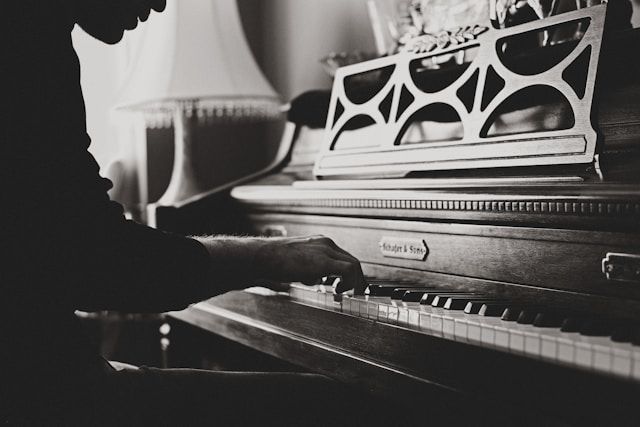
Learning proper piano-playing technique is a major part of piano lessons, and learning how to “move” at the piano is key to playing with proper technique. Factors that affect piano movement include how relaxed your body is, if you are breathing in and out, and if you are sitting tall and with good posture. We’ll learn more about these points in the following paragraphs.
To get started on your journey to learning excellent piano movement and technique, check out our blog articles Piano Exercises for Beginners and The Benefits of Hanon Exercises for Piano Players in which we provide you with exercises and tips on the best things to practice.
Piano movement techniques
Here are a couple videos where you can hear some piano professionals provide tips on the key elements of piano technique:
This first video that demonstrates the importance of good technique and physical movement is Beautiful Physical Gestures with Dr. Helen Marlais, in which she teaches the “Drip Drop Roll Motion.” Dr. Marlais is a pianist, author, and professor who teaches at Grand Valley State University in Allendale, Michigan.
A great quote from Dr. Marlais is “The quality of motion has a direct correlation with the sound that is produced.” I’ve heard this from my own piano teachers and it means that every move you make will result in a specific sound. So, when playing a single note, it’s important to think about:
- How you approach the key: Are you playing with strong and arched fingers or with flat fingers, are you moving quickly or slowly, and is your body stiff or staying relaxed?
- How you play the key: Are you slapping or hitting the keys or are you playing the keys with the right amount of force?
- How you leave the key: Are you jerking away from the key or shaping the end of the note?
To do the “Drip, Drop, Roll Motion” (at 4:52)
- Place your hand on the keyboard and then lift it as if a string is attached to your wrist. Your wrist should be the highest part of your hand and everything else (your fingers, hand, and arm) should dangle as if “dripping.”
- Now, “drop” your third finger slowly into a key (let’s use E). Let gravity do the work! After the drop, your arm will be parallel to the floor. Make sure to check for any tension in your wrist and arm before moving on. If there is any tension, try step one again!
- Roll your wrist forward and off the key.
- Lastly, pick another key and repeat from step one!
If you’re not sure how this piano movement should look, watch the video for help!
In this next video, we will hear from Dr. Marian Lee, who is a piano professor at St. Ambrose University in Davenport, Iowa. She talks about The Five Basic Motions of Piano Technique, which she learned from her teacher and respected Hungarian pianist György Sándor. If you’re unfamiliar with his work, listen to him perform Liszt’s” Liebestraum No. 3” and “Hungarian Rhapsody No. 6” here.
Dr. Lee says in the video that “Everything begins with the breath.” Breathing is really important for a pianist, because the constant flow of air to the brain helps the mind to stay calm and to think properly, which in turn helps the muscles in the body to stay calm, relaxed, ready to play, and able to move. Breathing also helps to determine the beginning of a phrase, how to physically and musically move through a phrase, and how to end a phrase. György Sándor said that “muscles work inter-dependently, not independently,” which means that every part of your body works together to help to create the beautiful music.
The five basic motions of piano technique are:
- Thrust is when you begin on the keys and use your muscles to create a loud sound before releasing. You can do this with a single note, but it’s really fun to do with a full chord. Again, Dr Lee demonstrates this type of motion with the basketball at 28:05 and then at the keyboard.
- Free fall is the “Drip, Drop, Roll Motion” from the previous video! Dr Lee demonstrates this motion with a basketball at 5:40.
- Five fingers: scales and arpeggios is the motion you use as you play scales and arpeggios. Your wrist should move from side to side to keep from sounding stiff. You can see this at 9:29. The thumb and pinky are our shortest fingers, so by moving from side to side, you are helping these fingers to reach the keys with more ease.
- Rotation is when your wrist and forearm rotate from one side to the other. For example, if you’re playing your pinky, the thumb side of your wrist will lift. If you’re playing with your thumb, the pinky side of your wrist lift too. This is really easy to see at 18:04.
- Staccato is like a throwing motion, because it’s a quick motion. It’s similar to dribbling a basketball. See Dr Lee do this at 23:49. In staccato motion, you actively and quickly move into the note and then let your hand bounce back up.
If you’d like to learn more tips and find more resources on improving your piano technique, check out our blog article Piano Technique for Beginners.
The other piano movement: How are movements used in classical piano pieces?
Another type of “movement” is a smaller piece or section of music within a larger body of work. This is not limited to piano pieces, but is used for many types of classical works including symphonies, concertos, sonatas, suites, serenades, operas, song cycles, and others. Pieces that normally don’t include movements include nocturnes, polonaises, songs or Lieder, and short character pieces. Below are three familiar classical pieces that are composed in movements.
Example #1
The first one is the “Moonlight Sonata” which is a large piano composition that is often performed as a whole unit, but each movement can stand on its own and be performed by itself. Learn more about the Moonlight Sonata here.
Piano Sonata No. 14 in C-Sharp Minor, Op. 27 No. 2 “Moonlight Sonata” by Ludwig van Beethoven
Example #2
Next is Mozart’s “Eine kleine Nachtmusik” which is a serenade composed for string orchestra, but again, each movement is its own piece of music that lives within the world of the larger composition. One movement is very famous – can you tell which one?
Serenade No. 13 for Strings in G Major, K. 525 “Eine kleine Nachtmusik” by Wolfgang Amadeus Mozart
Example #3
You are probably familiar with the “Rondo alla turca” by Mozart, but did you know that it is only the final movement of a larger piano sonata? Below, you can listen to all three piano movements that make up that entire sonata.
Piano Sonata No. 11 in A Major, K. 331/300i by Wolfgang Amadeus Mozart
- Andante grazioso
- Menuetto
- Alla turca: Allegretto (commonly known as the Rondo alla turca)
Why are compositions divided into movements?
Compositions are divided into movements so that composers can mold their different related musical ideas into a larger work, which includes faster and slower sections. With different movements, composers can “move” from one tempo to another and can keep the piece “moving” forward into these different musical ideas.
What are the movements of a piano concerto?
Traditionally, piano concertos and piano sonatas (and even some symphonies) contain an opening movement that has a quick tempo, then a slower and more intimate movement follows, before a fast third and final movement ends the entire piece.
Final notes on the dual meanings of piano movement
The word “movement” deals with time and physical motion, so it makes a lot of sense that this word has multiple meanings in classical music. Understanding the dual meanings of piano movement helps us to appreciate both the technical aspects of piano-playing and the structure of the music that we play. As you learn more about piano movement, remember that musical expression and physical motion are very important to creating a beautiful sound. Every beautiful note and movement is important in music’s grand tapestry.