


What skill do the best jazz pianists, classical composers, and pop musicians have in common? When they hear a song, they can write down the melody – also known as melodic dictation. Through melodic dictation, musicians transcribe the notes they hear. By writing down or dictating the melody they hear, a musician can share the song with a friend or save it for the future. It’s the same principle as having someone write down a speech, and a very important skill for musicians to develop.
Melodic dictation trains musicians to connect the notes they hear to the notes on the page, which helps improve their playing. For beginners, learning it helps train the recognition of intervals, which are the way musicians measure the distance between notes in the melody. The more these listening skills develop, the more a student’s performance accuracy and musical understanding will improve.
Below, you’ll find resources and examples to help you get better at melodic dictation. With lessons from our team, our Mystery Melodies ear training game, and additional learning resources, our practice tips and exercises make piano learning easy and fun. Ready to access even more materials for ear training and melodic dictation? Try Hoffman Academy Premium today!
Examples for students
Lessons on melodic dictation make up a key part of the Hoffman Method. That’s because, like learning to write as you learn to read, melodic dictation forms a key part of musical literacy. In almost every unit, students will have a lesson devoted to improving the skill of writing down the notes you hear.
In this example below, you may notice that Mr. Hoffman uses do-re-mi, or solfege, for the exercises. This is because historically, solfege was developed to help monks in the middle ages remember, notate, and write down their chants. The goal is to write the notes you hear, and solfege can help students understand the relationships and musical patterns between different pitches.
This video tutorial is Hoffman Academy’s very first introduction to melodic dictation for our beginner pianists. Beginner students transcribe the melody of a piece from an earlier lesson, which is a great way to practice dictation! In this lesson, Mr. Hoffman uses Magic Notes (the markers and the grand staff above), which can be purchased here. Premium members can access the staff paper and companion sheets to this exercise for free.
Here are three tips on how to do melodic dictation as a beginner!
-
- Notice if the notes are going up, going down, or staying the same. Students of all ages may find it helpful to move their hand with the pitch, noticing if the note went up, down, or was repeated. Tactile tools, like the Magic Notes set Mr. Hoffman uses, can also help.
-
- If the note moved up or down, did it step, skip, or leap? You can tell if a note stepped if it went from a line to a space note. A skip is when a note hops from one line to the next, or one space to the next. Leaps happen when a note leaps over several lines and spaces!
- Having trouble telling which way a melody is going? Listen again to a small section and try to sing along.
Download our FREE blank staff paper for the perfect place to write down the melodies you hear as you practice your music dictation!
Melodic dictation and ear training
These two subjects are connected because they involve close listening. The resources in this article can train your listening skills and improve your musical ear. When you listen to a melody and work to write it down, your ears are learning to recognize different intervals and patterns. The same way that learning written language increases a child’s vocabulary, melodic dictation practice increases the number of steps and skips you can recognize. Training these skills makes it easier to play by ear, because if you can write it, you can play it! It also improves sight reading and musical understanding at a deeper level.

How do you get better at melodic dictation?
For a fun and engaging way to practice, play Mystery Melodies, an online game available with Hoffman Academy Premium. Players solve musical mysteries by matching the melody they hear to the written notes. With 10 levels increasing in difficulty and multiple choice options, this game strengthens essential interval recognition skills.
Ready for a more advanced lesson? Check out Mr. Hoffman’s video below from Unit 6. This example focuses on dictating melodies in the bass clef. This is a great tool for students working to improve their sight reading in bass clef for the left hand.
We’ve also included some supplementary tools that complement Mystery Melodies and can help you move from identifying the melody to taking a dictation and writing it out on your own. The exercises in MusicTheory.net offer a comprehensive collection of pitch related drills, including intervals and chords. Similarly, Theta Music Trainer has free games for both audio and musical ear training.
More advanced students wanting to practice ear training and dictation might consider EarMaster as a companion to Mystery Melodies. It is an app-based program with in-app purchases that offers dictation and sight singing exercises. The beginner course includes interval drills as well.
More advanced examples of melodic dictation
Once you are confident transcribing the melodies you hear in the right and left hand on the piano to the treble and bass clef, it’s time to start adding rhythms. Up to this point, students have practiced rhythmic dictations with our heartbeat mat separately from melodic dictations. By Unit 8, it’s time to transcribe the rhythms and notes at the same time. You’ll be writing down both the notes and the rhythms you hear as part of the exercise.
Try this when you are confident transcribing the rhythm and melody at the same time.
How beginner piano students can start composing melodies
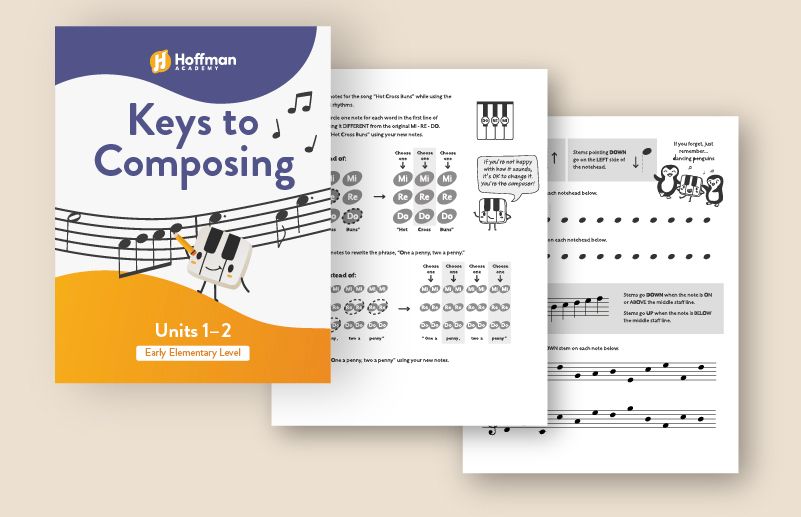
Composing offers a creative way to connect to melodic dictation exercises. Both focus on the building blocks of melodies. With Hoffman Academy’s Keys to Composing, you’ll develop the tools to put the music in your head onto paper. The guided activities help build confidence in writing down songs or arrangements. We hope you take some of these ideas and continue to use them in other ways.
Concluding tips for melodic dictation success
We hope you’ve enjoyed learning with Hoffman Academy! We recommend starting small with short and recognizable songs. To make it more fun, try our Hoffman Academy Premium Game Mystery Melodies.