Learn all about the Lydian mode in music, including its mood, how to use it, and examples
Listen to the theme from The Simpsons, by Danny Elfman:
This portion of the melody uses a scale called the Lydian mode. Now listen to the same theme using an ordinary major scale:
You don’t need any musical training to hear that something is off in the second recording. There’s one note that doesn’t sound quite right, especially if you’ve hummed this tune for years. Danny Elfman wanted a lighter, more airy quality for this theme, and he wrote it using the Lydian mode for that very reason. Now that you’ve heard the difference, let’s take a closer look at this mode, learn how it differs from the major scale, and find out how to compose with it.
Keep all the musical modes at your fingertips with our Piano Modes Quick Guide, a free download in the Hoffman Academy store!
Where does the name Lydian come from?
Lydian refers to an ancient people in western Anatolia (modern-day Turkey), whose kingdom enjoyed its height between about 800 and 550 BC. As with so many regions in and around ancient Greece – Aeolis, Doris, Ionia, Phrygia – the Lydian mode doesn’t have a particular association with musical practice in ancient Lydia. Medieval European music theorists tried to revive the spirit of the ancient Greco-Roman world, and arbitrarily named the scales after regions from those times: Aeolian, Dorian, Ionian, Phrygian, and so on. In fact, they even misapplied certain names. The Lydian mode as the ancient Greeks knew it was what we today call the major scale, while the Greek Dorian mode sounded more like our modern Phrygian.

How does the Lydian mode work? What is the formula for this mode?
The modern Lydian mode is an octave scale, very similar to the major and minor scales that have come to dominate tonal music. In fact, Lydian differs from a major scale in only one note: the fourth degree of the scale. As you can see below, take any major scale, raise the fourth note a half step, and you get this mode:

This changes the arrangement of whole steps and half steps. A major scale has its first half step between the third and fourth notes, or MI and FA in solfège. In the Lydian mode, the first half step can be found between the fourth and fifth notes. The solfège is modified to accommodate the raised fourth degree; FA becomes FI:

So the order of whole and half steps in a Lydian mode is W-W-W-H-W-W-H, whereas a major scale has the order W-W-H-W-W-W-H.
Is C Lydian the same as G major?
It is not! C Lydian and G major are relative scales, which means they do indeed use exactly the same notes. But their tonal centers are built on completely different tones. C Lydian has its tonic, or “home note,” on C, while G is the tonic of a G major scale:

This distinction is no different from relative major and minor scales. The A minor scale uses the same notes as its relative major scale, C major, but because its tonal center is A, this creates a completely different sequence of whole and half steps. This is the reason that music in the key of A minor sounds much more somber than in C major.
When should you use the Lydian mode?
Now we come to the fun part: the way Lydian sounds. Listen to the opening of John Rutter’s Te Deum, particularly when you hear the sopranos sing “All the world doth worship thee, the Father everlasting” at 0:23.
You can hear that raised fourth degree of the Lydian mode on the first “the,” as well as on the second syllable of “father.” This single difference from the major scale gives the phrase a much more lifted, floating quality, perfectly suited to the music’s religious exultation. This mode is therefore effective in music that calls for a luminous, optimistic feeling.
Let’s hear it again in Béla Bartók’s Romanian Folk Dance No. 6. Listen again for the raised fourth degree of the scale:
In the key of D Lydian, the raised fourth is G-sharp, and you can see it at the red arrows:
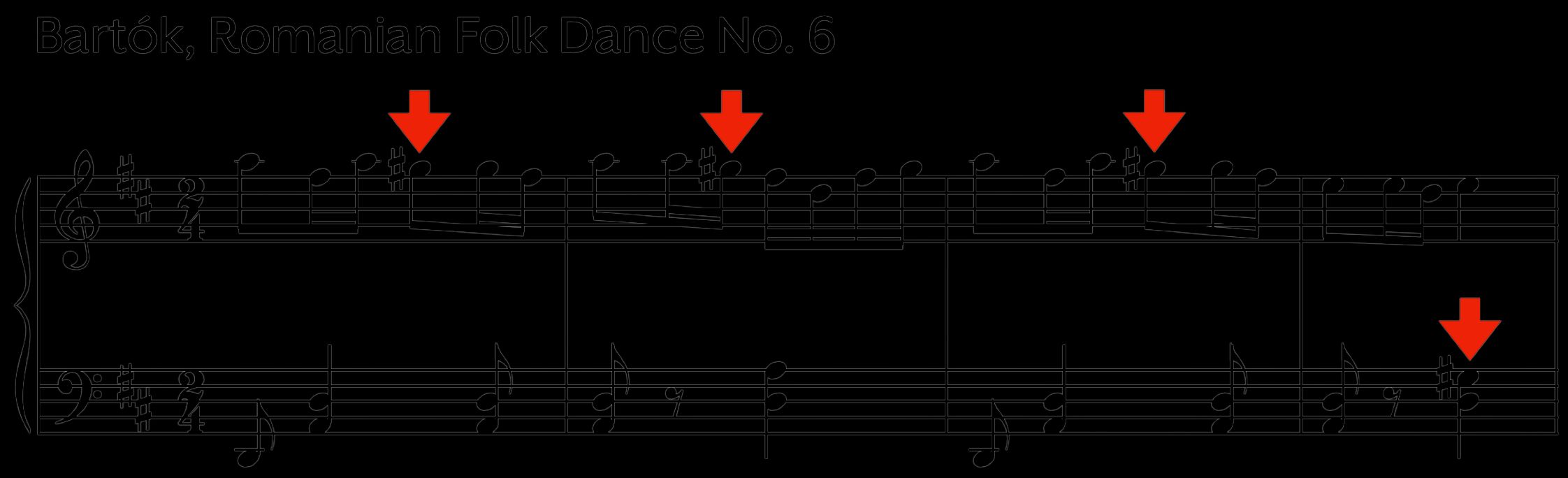
The D Lydian mode gives this passage a bright, elevated quality that the D major scale can’t quite match. It also destabilizes the tonic note, D, and makes the ear drift back and forth between D Lydian and the relative scale, A major. In fact, the bottom five notes of D Lydian, D – E – F-sharp – G-sharp – A, can easily sound like the top five notes of the A major scale. This is why Lydian gives the listener a deliberately vague sense of the piece’s tonality.
Modes were also typical of eastern European folk music, and Bartók’s extensive use of modes like Lydian were in part a reaction against the more strict major-minor tonality of western Europe. The jaunty folk character of the Lydian mode can be a refreshing liberation from the conventional scales of common-practice music.
Are there chords for the Lydian mode?
Chords can be built on the notes of this mode just as for major or minor scales. But because of the different sequence of whole and half steps, this mode produces different chords from what you’ll see in typical major and minor scale music:

Notice that, simply by raising that fourth degree a half step, we alter the II, IV, and VII chords from what they would be using a major scale. The minor ii triad becomes major, the major IV triad becomes diminished, and the diminished vii triad becomes minor. The raised fourth becomes a tendency tone in these chords, an unstable pitch that easily resolves upward. Listen to Alan Silvestri’s theme from Back to the Future starting at 0:28, and you’ll hear this tone as the tonic is followed by the major II chord. You’ll hear it again at 0:39.
Songs in Lydian mode
In the Hoffman Academy online store, you’ll find sheet music that showcases the Lydian mode. All of Béla Bartók’s Romanian Folk Dances are modal, which gives them their distinctive eastern European flavor. Two of these dances make use of Lydian:
Bartók’s Romanian Folk Dance No. 5
Bartók’s Romanian Folk Dance No. 6
You can also enjoy further examples in various musical genres. Remember to listen for the raised fourth note of the major scale, or FI in solfège.
In film music:
Michael Gore: Soundtrack to Defending Your Life
John Williams: Yoda’s Theme from Star Wars, The Empire Strikes Back
Trevor Jones: Soundtrack to Dark City, Ending
The Lydian mode is heard in the violins. After twenty seconds, the music switches to a major key, and FI goes back to FA.)
In pop music
R.E.M: Man On the Moon
The Beatles: I Want to Tell You
Pearl Jam: Oceans
In classical music
Gabriel Fauré, Lydia from Two Melodies, Op 4.
Charles-Valentin Alkan: Allegro barbaro, Étude Op. 35, No. 5
Frederic Chopin: Mazurka, Op. 24, No. 2 (Listen at 0:31 and 0:40).

Playing the Lydian mode on piano
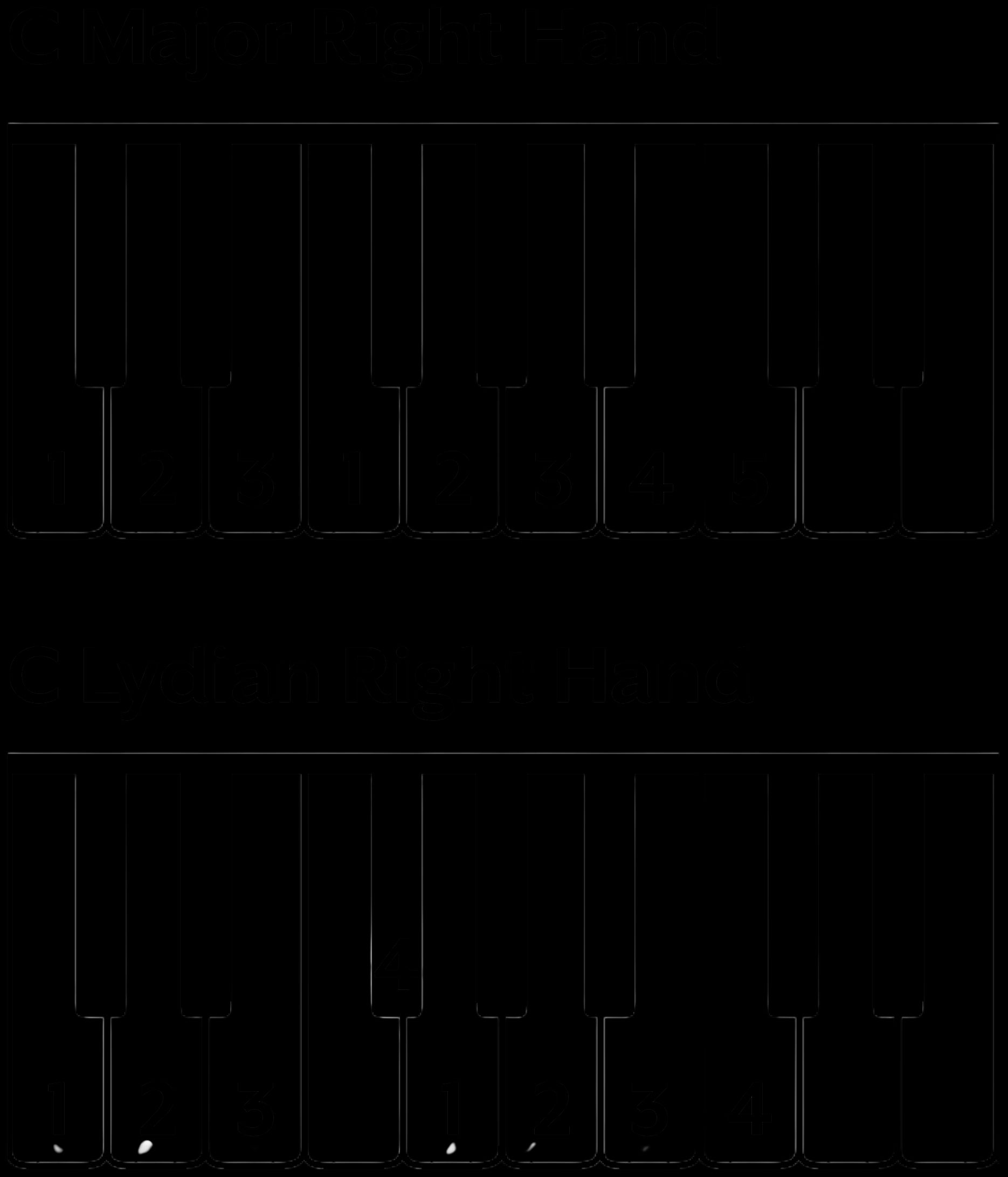
Playing this mode is easy on the piano! Simply take any major scale and raise the fourth note a half step. For the C major scale, F becomes F-sharp. Be advised that this may change the fingering for one or both of your hands. For C Lydian, the left hand fingering remains unchanged, but for the right we now need to pass the thumb under the fourth finger, instead of the third:
For a comprehensive guide to playing all the modes, try our Modes Packet in the Hoffman Academy store. You can also find fingerings for all the modes in our One Book of All Piano Scales. These resources will help you find the best way to play all the modes in every key!
Unlock new creative possibilities with the Lydian mode
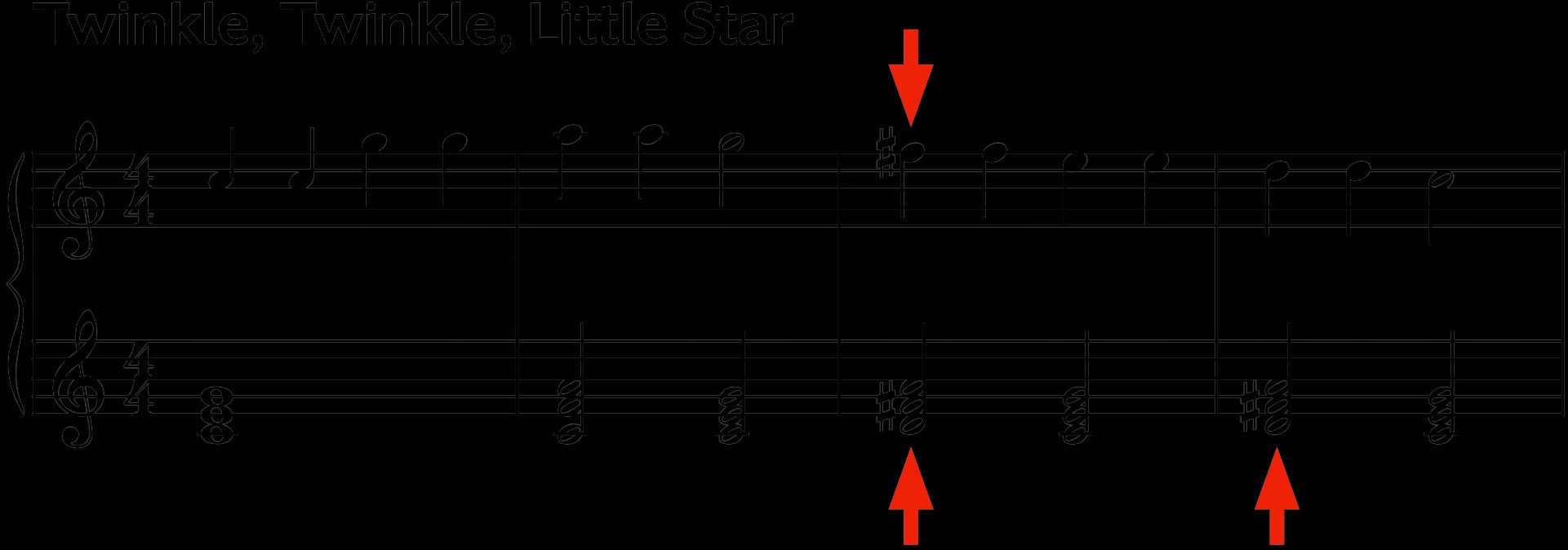
Even though this mode differs from the major scale by only one note, the effect is remarkable in real music. You can experiment by taking major-key music you already know how to play and raising the fourth note of the scale a half step. Listen for the difference; even simple music is transformed by a little touch of Lydian. Twinkle, Twinkle, Little Star reaches just a bit higher with it: