





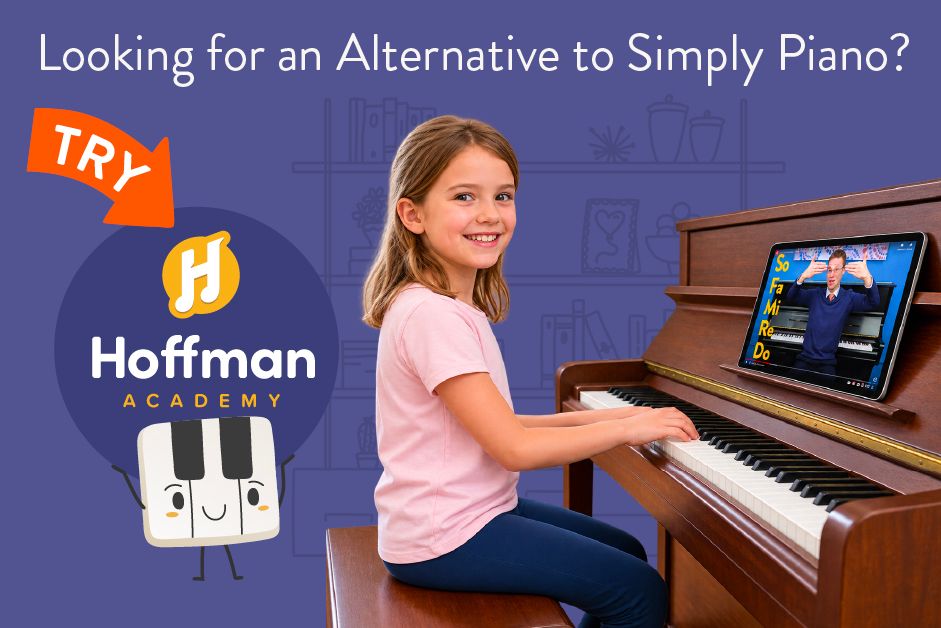
Hoffman Academy provides a complete music education program, the same kind of learning you’d get if you were taking lessons with a private instructor. Other piano apps can be heavily gamified, where playing the right notes on the keyboard is like pressing the right buttons on a game controller. There is so much more to playing music than hitting the right keys! Hoffman Academy focuses on technique, musicality, and the skills kids need to become lifelong musicians.
Why do people look for an alternative to Simply Piano?
Simply Piano has some limitations that might make it difficult for students to progress beyond a basic level of playing.
- No technique or posture guidance: Simply Piano does not teach proper hand posture, wrist movement, seating posture, or bench distance. Hoffman Academy covers these topics in the first few lessons and reviews them throughout the course.
- Forced linear progression: With the Simply Piano app, students can’t skip ahead if they already know the basics. They have to play certain songs correctly for the listening software in order to unlock higher levels. All Hoffman Academy lessons are free to access by anyone, anytime. The Hoffman Academy curriculum is carefully structured to introduce musical concepts and songs in a certain order to optimize learning, but students can choose to watch them in any order.
- Simplified song arrangements: Simply Piano boasts a library of thousands of songs, but many of these songs are heavily simplified. This doesn’t provide the sight reading or performance challenge piano students need to reach their full potential. Hoffman Academy’s sheet music library includes simplified piano pieces for beginners, complete original piano pieces for advanced players, and everything in between.
- High error tolerance: Simply Piano’s listening software can let players pass a level even if they hit several wrong notes. At Hoffman Academy, we teach students to listen to each piano piece they’re learning until they know how it’s supposed to sound, and how to listen for and correct their own mistakes. They’re not practicing to pass a test. They’re practicing to play their very best.
- Learning cap: Because Simply Piano doesn’t teach proper piano technique, traditional sight reading, or the original versions of classical piano pieces, students are unable to progress beyond a certain level. At Hoffman Academy, our lessons take students through intermediate level, to the point where they can become truly independent musicians, able to choose pieces to learn and play them successfully.
What are your options beyond Simply Piano?
Options beyond Simply Piano include Hoffman Academy, Piano Marvel, and Piano Maestro, each built around a distinct teaching approach.
Hoffman Academy offers free, structured video piano lessons similar to what an in-person piano teacher would give. The lessons cover technique, music reading, ear training, theory, and more. Parents can create accounts and track progress as their students grow from earliest beginner to independent, intermediate-level musicians. A subscription gives access to music theory games and an extensive library of sheet music, worksheets, and reference guides for all levels of piano learning. This is a top rated app for guiding young students to become strong, well-rounded musicians.
Piano Kids is more of a game than a complete piano course. It’s great for preschool and early elementary, and includes simple piano games, rhythm games, and musical activities.
Piano Maestro is popular with piano teachers to use in tandem with in-person lessons. It was originally designed for piano teachers, but can be used by a well-motivated child with parent support. It’s one of the most highly rated apps out there, but there are a few drawbacks. The app is best suited for early beginners, and some feel that the lessons don’t progress quickly enough. Some users also complain about technical bugs, especially with the listening software. Also, only the most basic Piano Maestro lessons are free. The rest require a subscription to access.
Skoove is another app popular with piano beginners. It’s fun and easy to use and goes beyond Simply Piano to provide useful instruction in music theory and finger exercises. However, it still gives very little guidance on hand posture and finger movement. Like many other piano learning apps, Skoove uses a scrolling music notation system and focuses on learning by rote, so students never get to practice the skills they need for real sight reading from ordinary sheet music.
Piano Marvel is a good option for adults that are serious about learning to read music. It develops actual piano score reading skills with a substantial, systematic curriculum. With a library of over 25,000 pieces, it can take a piano learner much farther than most beginner-oriented apps. The app features a sight reading assessment that scores students on the accuracy of their playing, which some users like but others found frustrating. It works best with an electric keyboard with MIDI interface as its note recognition software has a hard time hearing acoustic notes.
Flowkey is great for adults who want to learn to play their favorite music on the piano. It has a large song library and high-quality demonstration videos. However, for piano learners who want a comprehensive music education, Flowkey doesn’t cover music theory, chord construction, rhythm, technique, and fingering like you would expect from a traditional piano teacher.
Pianote is a good choice for an adult who wants to learn to play recognizable songs quickly. The video tutorials are of excellent quality, and students can also post videos of themselves playing to get feedback from an actual teacher. However, this app doesn’t teach sight reading skills, and is focused mostly on beginners. It’s also one of the more expensive options for online piano learning.
Playground Sessions is a top-rated piano learning app, combining real-time feedback with recognizable songs and structured instruction. Playground Sessions balances making piano practice feel like a game with quality video tutorials. It’s a good option for adults who don’t want to take traditional piano lessons with an in-person teacher. However, some users report that the curriculum is not well designed and while there are a lot of songs to learn this doesn’t necessarily promote steady progress and skill development.
Yousician is another popular gamified piano learning app. It features instant feedback that makes practice engaging, gets beginners playing quickly, and uses backing tracks to make practice time more fun and rewarding. One possible issue is that students can become dependent on following the screen rather than learning to read actual sheet music. Another is that piano technique and music theory aren’t emphasized. The options for piano music on this app are also more limited than other similar apps, possibly because Yousician teaches a variety of instruments in addition to piano.
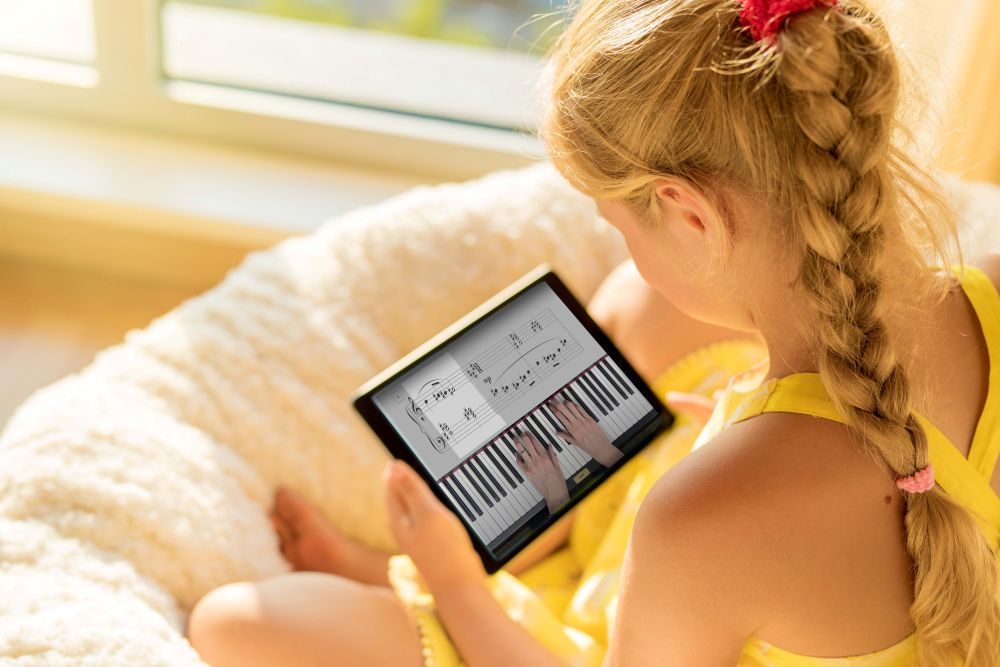
Gamified apps: more of the same problem?
Piano apps that make piano learning into a game can help motivate students to practice, but if playing piano with the app is too different from playing the piano with sheet music, then the learned skills won’t translate to real piano playing. Playing the piano should not be like typing or pressing buttons on a game controller. It’s about musical expression as well as hitting the right note.
Developing the technique to play with dynamics and articulation requires a good teacher that focuses on these skills. Gamified apps can’t measure musical sensitivity and so therefore they can’t reward it. It’s up to the student to listen to their own playing and, by comparing it with other piano performances they’ve heard, decide if they’re playing with emotion, telling a story with the music, and getting all the small details that make a polished performance. An in-person teacher or a well-structured series of video lessons will help a student learn to do this.
Method books: structured but no teacher
It is possible, though difficult, to learn piano on your own by working through a method book. This would require a lot of self-discipline and also some knowledge of how to learn and practice a musical instrument. Most piano method books, for example, won’t guide you when to do finger exercises. A method book may have some illustrations showing correct technique, but without watching someone actually play the piano it can be difficult to translate a flat illustration into 3-dimensional motion.
To get the most out of a piano method, find a teacher who can help guide you. There’s so much more to playing the piano than what you can learn from a printed book.
In-person lessons: effective but expensive
The best way to learn piano is with good-quality private instruction. With a good teacher, you’ll have someone to check in with at regular intervals, which can help motivate you to practice. You’ll also have someone who can give you a good example of playing. If you’re having difficulty understanding something, you can ask questions. You’ll also have someone who can watch your playing and help you avoid any bad habits in your technique.
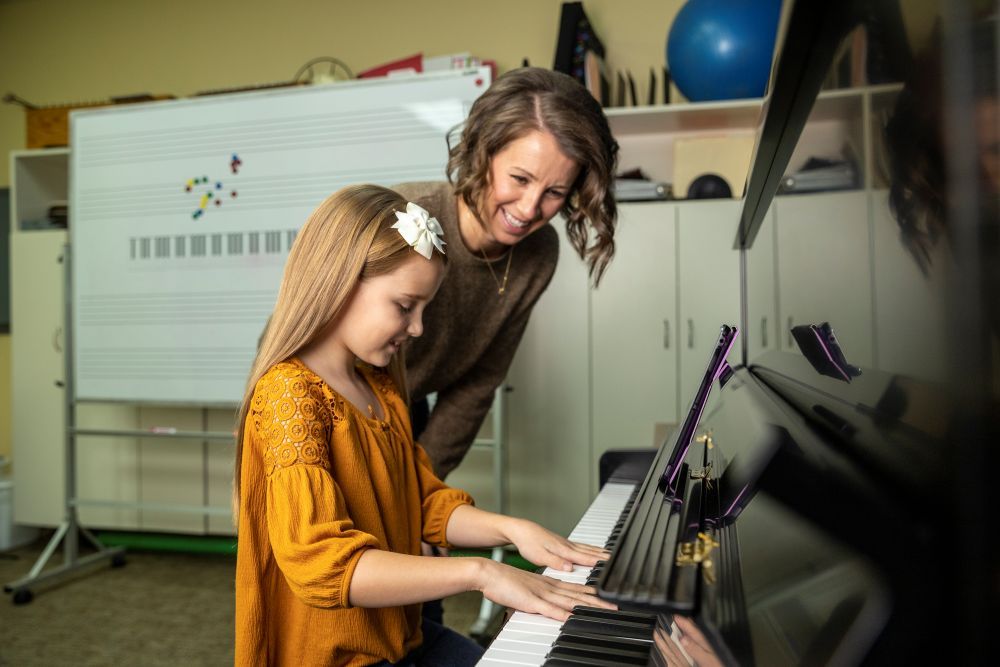
The main difficulty with private music lessons is the cost, starting at $30 USD for half-hour lessons and going up to $50 USD or more. Also, depending on where you live, it can be hard to find an excellent piano teacher in your area.
While Hoffman Academy is not intended to replace private piano lessons, it can give piano students who don’t live near a good piano teacher or who do not have the resources for traditional piano lessons a chance to get an excellent music education. In our video tutorials, Mr. Hoffman guides students through a piano method that is proven to build solid musical skills.
Teacher-led online lessons: the best of both worlds
With teacher-led online lessons, students can get much of the benefits of an in-person teacher at a fraction of the cost. By watching an expert teacher play the piano, students have a good example to follow. Because the lessons are recorded, there’s no limit to the number of students who can benefit from watching them.
The main drawback to teacher-led online lessons is that students don’t get feedback directly from the teacher. One way to get around this is having a parent or older sibling watch the lessons and compare the student’s playing to the teacher’s playing.
Hoffman Academy vs. Simply Piano: how they compare
Hoffman Academy and Simply Piano have the same basic objective. They help beginning musicians learn piano at home. However, they have very different approaches. Hoffman Academy is a structured piano curriculum students can experience online, making it a strong alternative to Simply Piano for students who want that kind of guided, teacher-led experience. Simply piano is an interactive piano-learning app that turns playing the right notes into a game.
Core experience: Hoffman Academy features teacher-led video lessons that are carefully structured to guide beginners step-by-step to becoming confident, independent musicians. Simply Piano is an interactive app that will listen as you play and score your accuracy, providing immediate feedback as you learn songs.
Best fit for: Hoffman Academy is perfect for kids or families who want a comprehensive music education. Simply Piano is best for beginners who want a highly accessible, game-like way to start playing the piano.
Teaching style: Mr. Hoffman explains, sings, and demonstrates playing each piece. He gives students tips and encouragement, and also asks them to pause and do things on their own during the lesson. The Simply Piano app offers short instructions followed by interactive note playing.
Feedback: At Hoffman Academy, students are taught to self-correct by listening to a piece of music before learning it so that they can hear when they make a mistake. Simply Piano listens to a student’s playing and lets them know if they are playing correctly or not.
Curriculum depth: For students who learn with Hoffman Academy, music theory is a strong and integrated part of the experience. Ear training, improvisation, creativity, and technique are explicitly taught. These principles of good musicianship are woven throughout the curriculum so that students grow in their ability and understanding. Simply Piano has a more streamlined approach to learning to play. Theory, playing by ear, improvisation, and technique take a back seat as students learn popular songs using feedback from the interactive app that listens as they play.
Cost: Both platforms have free content and subscription options. While Hoffman Academy offers all of its video lessons for free, students get the most out of the experience with a subscription that gives them access to printable sheet music, online games, and other features. Simply Piano offers its first course free, but additional Simply Piano content requires a subscription.
Is there a free alternative to Simply Piano?
Hoffman Academy’s video lessons are a free alternative to Simply Piano. With over 400 video lessons, which include both a core curriculum and a selection of popular songs, Hoffman Academy offers a remarkably generous amount of free educational content. Hoffman Academy helps students become real musicians, not just note players. Instead of following prompts from software, they can learn from an experienced piano teacher who demonstrates each piano piece and musical concept. Hoffman Academy is built with an understanding of the way kids learn best, with songs, stories, games, and short lessons for young attention spans.
Getting started with Hoffman Academy
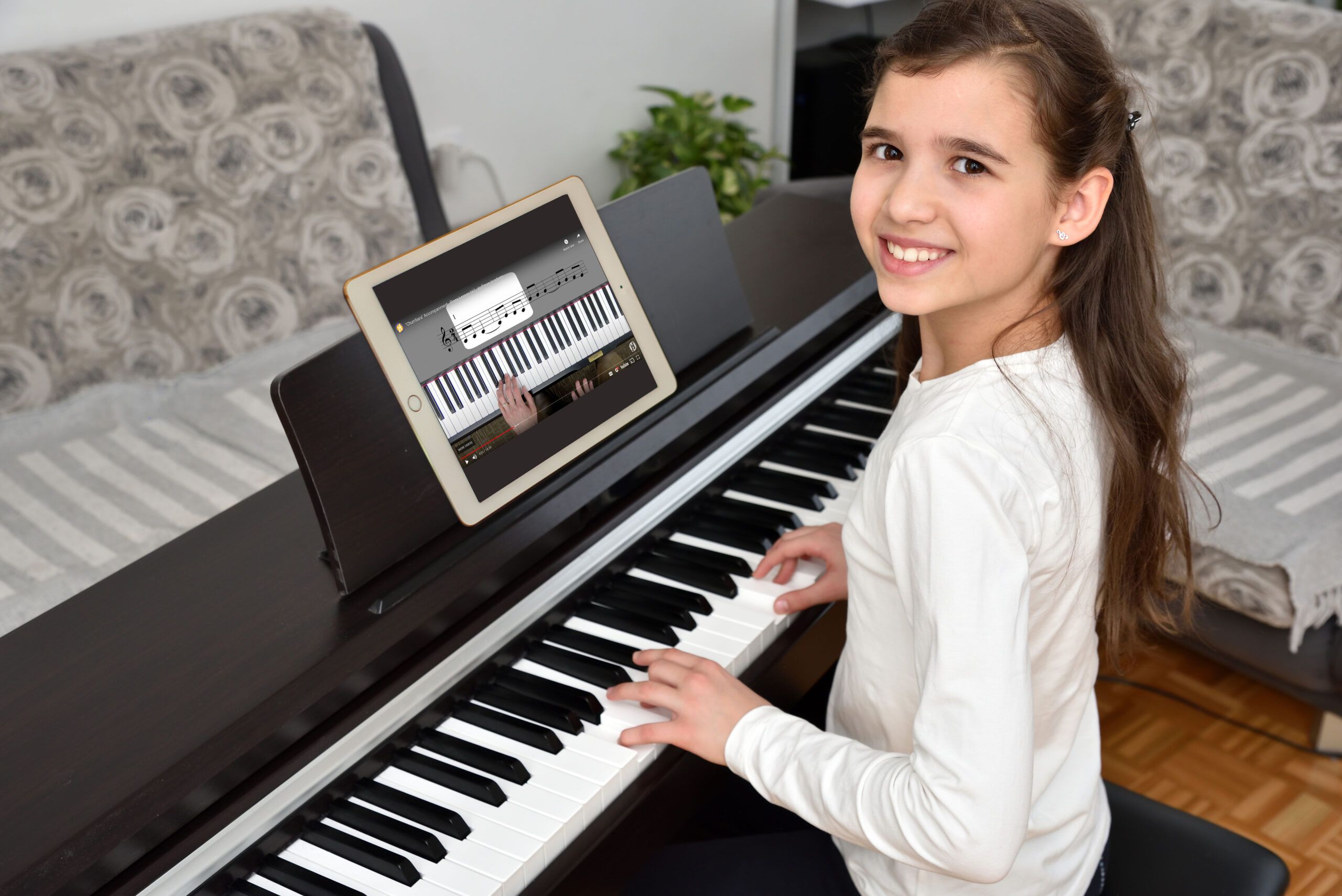
It’s easy to get started with Hoffman Academy! From our very first lesson, designed for absolute beginners, you’ll be making music and growing your piano skills. Set up your free account today.