


What are key signatures? Learn how they define a piece of music!
Key signatures tell you the key of a song, or the scale a song is based on. Written with either sharps or flats, they serve as a guide for pianists and indicate the primary scales used in the piece. Although recognizing the patterns of sharp and flat symbols for all keys with 24 musical scales might seem like a lot, Hoffman Academy’s resources below can help make this easier. We’ve included charts, flashcards, and memory aids, along with additional information about how key signatures relate to scales.
For more music theory knowledge, give Hoffman Academy Premium a try!
What are the key signatures? How many are there?
Wondering why there are 24 total major and minor keys and only 15 ways to write key signatures? Each key signature symbol is associated with both a major key and a minor key. The major and minor keys share the same sets of sharps or flats, so it makes sense to use the same key signature to indicate these relative scales. In the minor keys, a composer can also make adjustments to the fifth and seventh scale degrees for natural or harmonic minor.
But wait, half of 24 is 12, so if each key signature represents two keys, why are there 15 ways to write the key signatures instead of only 12? Here’s the answer. There are 3 pairs of enharmonically spelled keys. These enharmonic key signatures use the same pitches, but spell them with either all flats or all sharps. Enharmonic spellings are a way for composers to write a piece of music calling a black or white key by its enharmonic name. For example, the enharmonic scale of B major is C♭ major. D♭ major’s enharmonic pair is C♯ major, and G♭ major’s pair is F♯ major. Find the piano keys used for each enharmonic pair, and you’ll see the same keys are called by different names.
Download our free key signature chart, and you’ll be able to recognize the key signatures by sight.

No sharps or flats – C major or A minor
Sharps
1 sharp – G major or E minor
2 sharps – D major or B minor
3 sharps – A major or F♯ minor
4 sharps – E major or C♯ minor
5 sharps – B major or G♯ minor
Flats
1 flat – F major or D minor
2 flats – B♭ major or G minor
3 flats – E♭ major or C minor
4 flats – A♭ major or F minor
5 flats – D♭ major or B♭minor
Enharmonic pairs
6 flats or 6 sharps – G♭ major/F♯ major and E♭ minor/D♯ minor
7 flats – C♭ major/A♭ minor – more commonly written as B major/ G♯ minor
7 sharps C♯ major/ A♯ minor – more commonly written as D♭ major/ B♭ minor (5 flats)
How do you identify key signatures?
Start by looking at the positions of the sharps or flats to the right of the treble clef or bass clef.
Recognizing key signatures visually helps musicians sightread quickly and accurately. With practice, you will soon know which key signature a piece is in based on the number of flats or sharps. If you’re still working on memorization, you can use these tricks to figure out which key you are in.
For keys with sharps, look at the sharp farthest to the right, then go up a half step. That note is the name of your key signature. For a key signature with one sharp, the sharp symbol is on the F line. One half step up from F-sharp is the name of your major key, G major. In flat keys, find the second-to-last flat in order from left to right, and you’re done. If there are three flats in the key signature. the next-to-last flat will be E-flat, and that’s the name of the key: E-flat major. The only key this doesn’t work for is F major, so you’ll want to memorize that this is the key with one flat.
Next, you’ll need to determine if you are playing in the major key or its relative minor key. To do this, look at the starting or ending chord. Let’s return to our key signature with one sharp. If the piece of music starts or ends on a G major chord (G-B-D), we’re likely in G major. But if the starting or ending chord is E minor (E-G-B), then we’re in the relative minor key, E minor.
Is there a rule for key signatures?
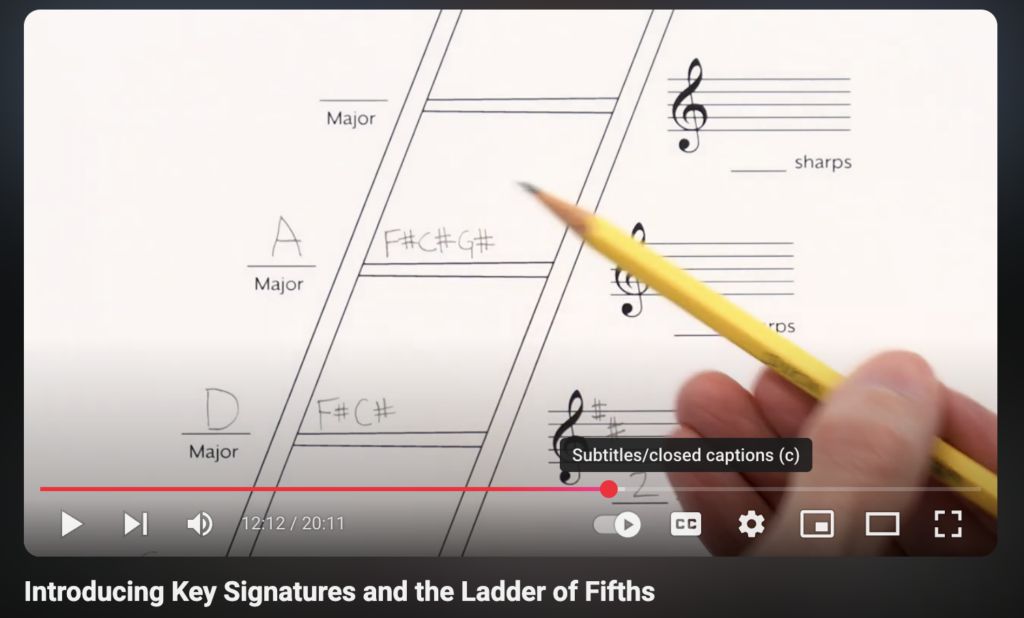
We recommend memorizing the visual patterns of the key signatures as you learn the Circle of Fifths. The Circle of Fifths helps organize the 15 spellings for the 24 major and minor keys into one chart. For sharp keys, you’ll climb up by fifths from C major (no sharps or flats) to G major (1 sharp) to D major (2 sharps) and so on! For flat keys, you’ll descend by fifths from C major to F major (1 flat) to B♭ Major (2 flats) and so on. This pattern exists because each time you begin a scale a perfect fifth higher than the previous one, you add a sharp, while beginning a scale a perfect fifth lower that the previous one adds a flat.
Download our free Circle of Fifths chart and check out our video about the Ladder of Fifths and Key Signatures below!
How do you memorize key signatures?
Our Key Signature Flashcards will help speed up your recognition of key signatures. Learning to instantly recognize the key by the number of sharps or flats improves student sight reading performance.
Although we recommend memorizing the visual patterns, there are also mnemonics you can use to help your memorization. College and high school students like to use mnemonic devices for subjects from music theory to anatomy. If you understand how to make a key signature and find it, the mnemonic can help jog your memory if you are stuck.
If you want to remember the order of sharps and flats, you can use the mnemonic Father Charles Goes Down And Ends Battle. The first sharp is on the F line and corresponds to G major. If there are three sharps, the third sharp is in the G space, and a half step above G-sharp is the name of the key, A major. For flats, the order reverses and becomes “Battle Ends And Down Goes Charles Father.” The first flat goes on the B line for F major. If you have three flats, the next-to-last flat goes in the E space, and you’re in E-flat major.
There are also mnemonic devices for the key signatures associated with the sharps. A mnemonic device for the number of sharps—from one sharps to seven sharps—is Good Dogs Always Eat Burgers For Christmas. In flat keys, you can use Fun Bugs Eat And Drink Good Cheese. You can make up your own mnemonic devices too!
Do key signatures apply to all notes?
Yes, key signatures apply to all the notes in a piece. For example, in A major, the key signature tells you that F, C, and G are sharp. That means every time you play an F, a C, or a G, they will be sharp.
In some longer pieces, there might be key changes. When this happens, you’ll see a double bar line and a new key signature, indicating the change. After the key change, the notes will follow the sharps or flats of the new key signature.
It can help to think of key signatures as guidelines that help us stay in a particular scale. Most Western music—from classical piano music to today’s pop hits—uses the notes of the diatonic scale for a particular key. The key signature applies to every note in the piece, serving as a reminder that we are staying in the correct key.
Sometimes a composer might want to borrow a sound or chord from a different scale. To do this, they can indicate a sharp, flat, or natural to change a note in a particular measure. These notes, called accidentals, indicate when a note is an exception to the key signature, meaning that it doesn’t belong to the scale that the key signature prescribes.

What are the different key signature symbols?
The different key signatures symbols are made up of sharps and flats. These symbols evolved over time as Western music notation developed.
A sharp symbol indicates that a particular note is raised a half step. While the sharp symbol looks like a hashtag (#), it’s a little different (♯)! If a particular key signature has a sharp, that note is raised a half step for the duration of the song. For example, in G major, the F sharp in the key signature means that the note F is raised to F♯ throughout.
Besides appearing in the key signature, sharps and flats can be used in a piece as accidentals. Accidentals allow composers to add extra spice by including notes that aren’t part of the key signature’s scale. Written to the left of a note in the song, an accidental changes a note for the duration of a measure. D natural would become D sharp, but only for one measure. In the next measure, the note would go back to D.
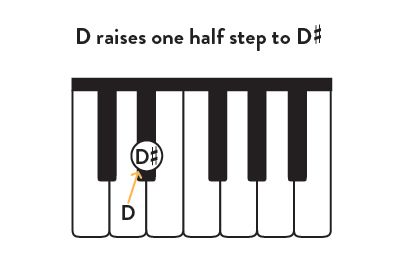
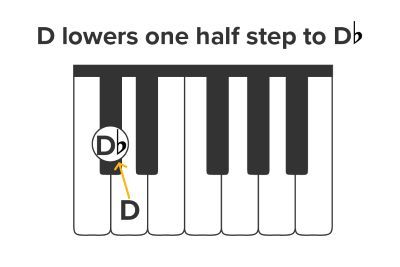
Flat symbols indicate that the tone is lowered a half step. As an example, D natural becomes D flat.
Singers and instrumentalists also use the terms sharp and flat to indicate tuning. If a note sounds sharp, the pitch of the singer or instrument is too high. Singing flat means the sound is lower than it should be.
What is the relationship between key signatures and scales?
You can think of key signatures as a way to represent scales. They allow composers to indicate that a piece of music uses a particular scale. By telling us which notes are either raised or lowered, the flats or sharps remind us which notes to play. In the key of F major and its relative key D minor, the note B is always flat, so you’ll always play B♭. In this way, key signatures help us stay in our scale.
Explore all major and minor scales and how to play them with our All Piano Scales Guide!
Put your knowledge of key signatures into practice
Hopefully, you’re now feeling more confident about identifying and understanding key signatures. We recommend using flashcards and charts to help you recognize them at a glance. As you become more familiar with identifying the key signature of a piece of music while practicing your scale patterns, you’ll find playing piano gets easier and easier!
For more music theory knowledge, give Hoffman Academy a try!