





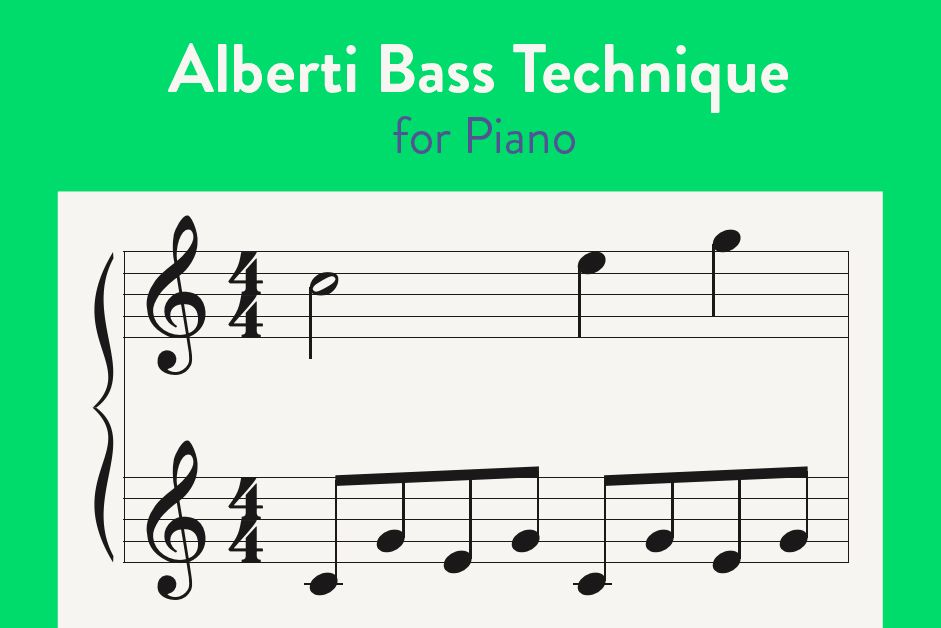
Learn about the Alberti bass in music, including playing tips and examples
The Alberti bass is an accompaniment pattern made from broken chords. Appearing in the early 18th Century, this technique was an outgrowth of Baroque figured bass, a shorthand notation that keyboard players used to improvise harmonies. Let’s explore this style that became a fixture of European keyboard music for nearly a century.
You can also watch Joseph Hoffman introduce this technique here!
When was the Alberti bass popular?
The Alberti Bass had its heyday in the Neoclassical and early Romantic Eras, a period roughly spanning 1740 to 1820. It was named after Domenico Alberti, an Italian singer, harpsichordist, and composer who lived in the first half of the 18th Century. During his short life, he became the Venetian ambassador to Spain, and composed operas, songs, and a variety of keyboard pieces. In his fourteen surviving keyboard sonatas, a distinctive accompaniment pattern is often found on the left hand. This pattern creates a flowing backdrop for the right hand’s melody, giving continuous movement where there would otherwise have been blocked chords:
Alberti, Keyboard Sonata in F Major
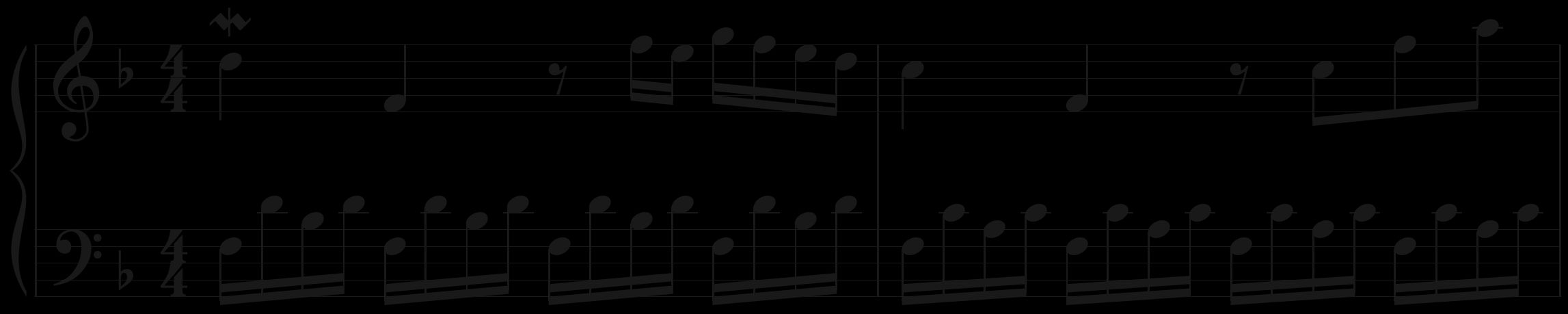
As often happens in music, a particular style gets named after its most famous practitioner, not its creator. Though Alberti was not the first to use this pattern, his name has forever been attached to it.
What is an Alberti bass chord?
A piano chord can be played two different ways: either harmonically, with all of its notes played at the same time, or melodically, meaning one note at a time. Below is the famous C Major Piano Sonata, K. 545 by Mozart. The music is first shown with the left hand chords blocked (all notes played simultaneously). The next excerpt shows the music as Mozart wrote it, with the chords broken up into a repeating melodic pattern:
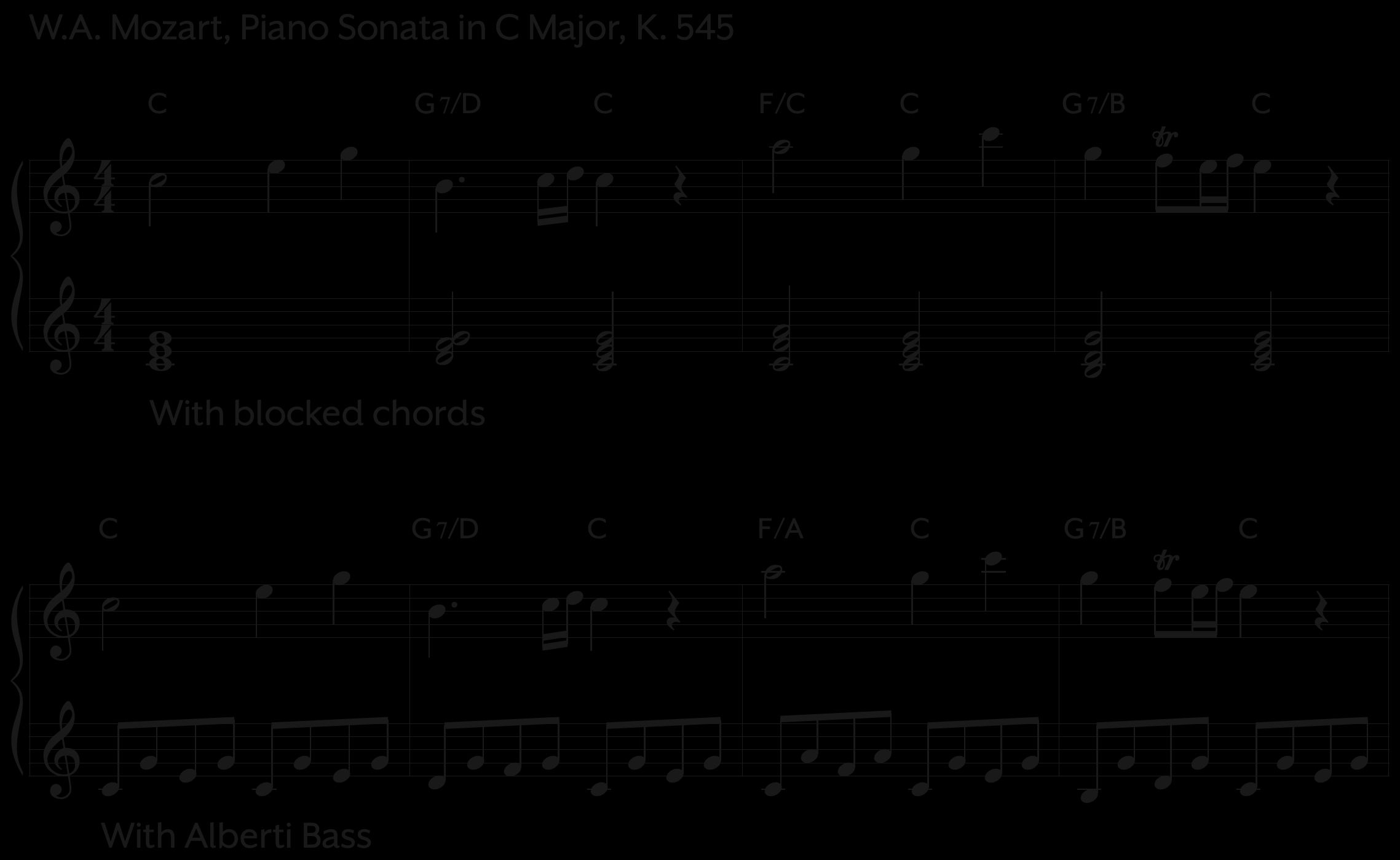
Notice that both versions have the same chord symbols above the music. The harmony remains unchanged, but the bottom version has its chords transformed into a flowing accompaniment. The pattern is created by having the chord notes appear in the following consecutive order: bottom-top-middle-top. Here are the primary chords in the key of C major: the I, IV, and V7 chords. First they are shown blocked, then broken up into the Alberti bass pattern:
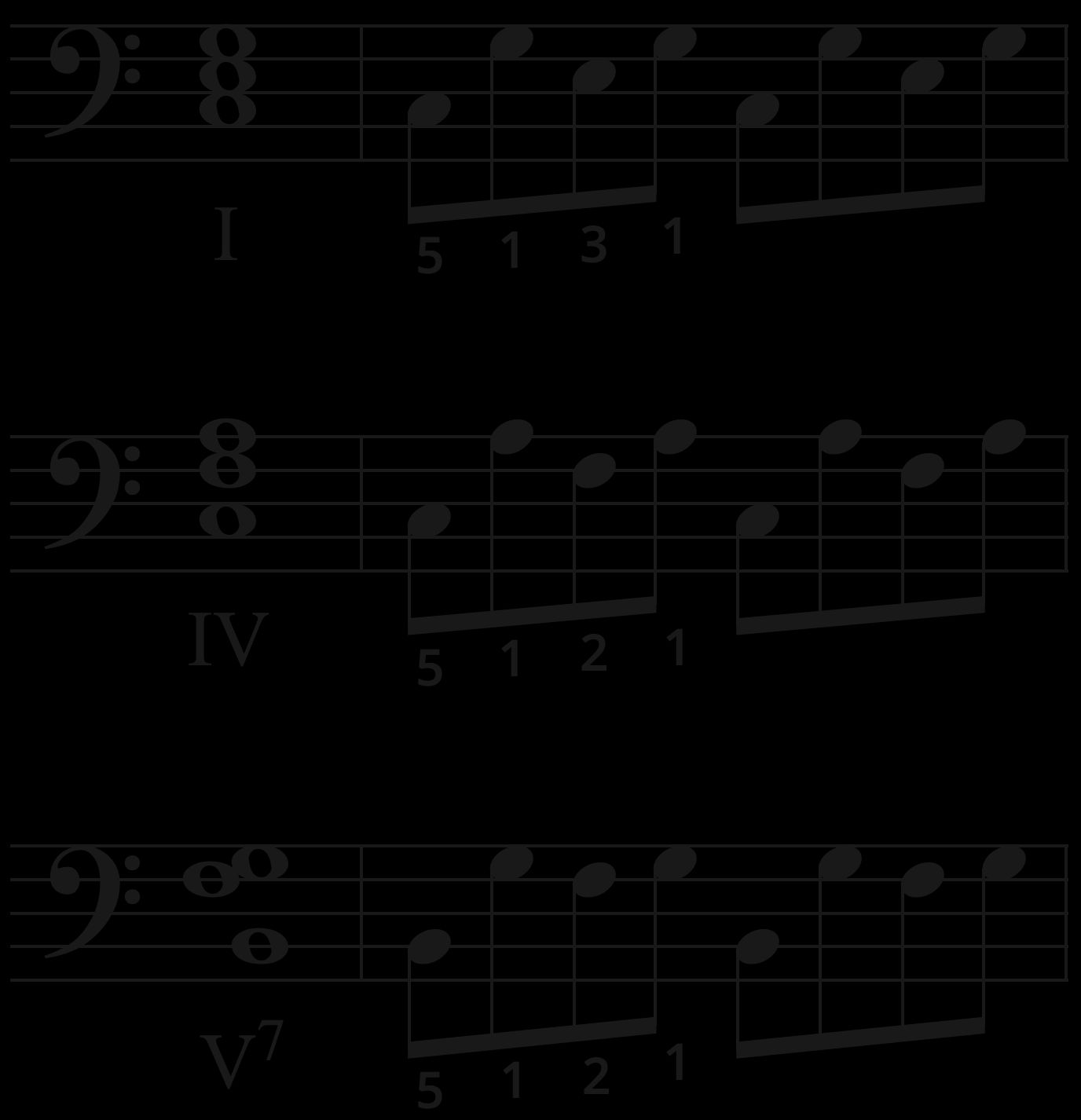
If you’ve had some piano training already, try practicing these patterns on your left hand. Play each chord a few times, then slowly play each note one at a time in the order shown: bottom-top-middle-top, then repeat. In time your left hand will become fluent at this pattern.
What is the difference between Alberti bass and walking bass?
Simply put, the Alberti bass is an accompaniment, while walking bass is a type of bass line.
The Alberti bass usually consists of faster note values that subdivide the beats, like eighth and sixteenth notes. These scurrying notes create a moving soundscape behind the melody. It is, in fact, a way to turn a chord progression into an accompaniment.
By contrast, a walking bass uses notes on the beat–typically quarter notes–that create a sense of regular, tramping footsteps. It can feature either passing tones, with stepwise motion, or arpeggios (broken chords), but it is used as the foundation of the musical texture, not as an accompaniment.
Here is the Mozart Sonata in C Major again, with melody, Alberti bass accompaniment, and an added walking bass line. The walking bass is like a riverbed, over which the faster notes of the Alberti bass rush:
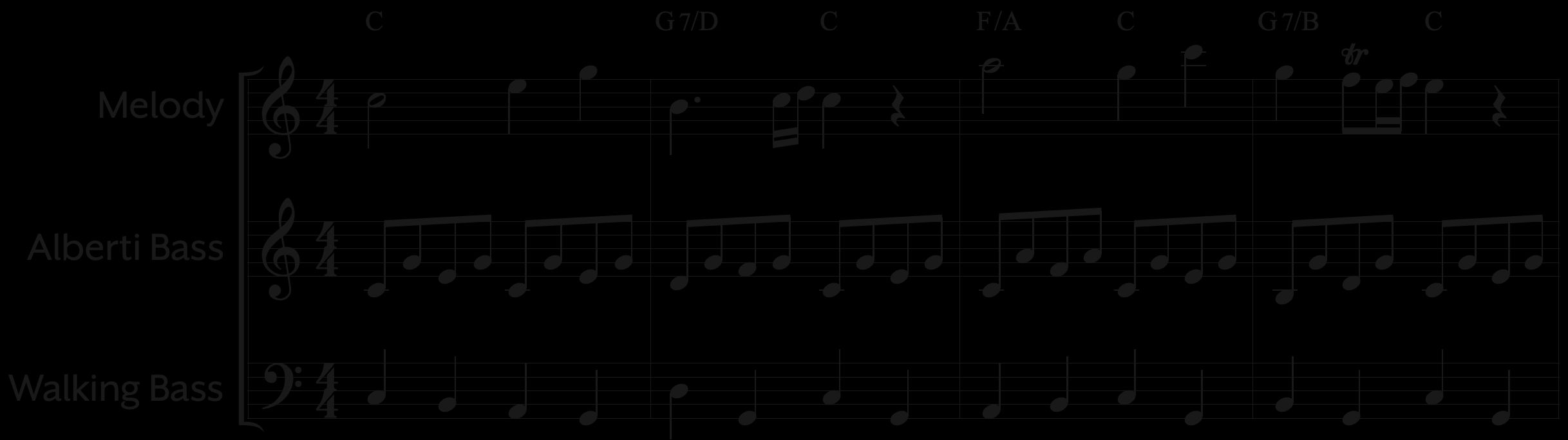
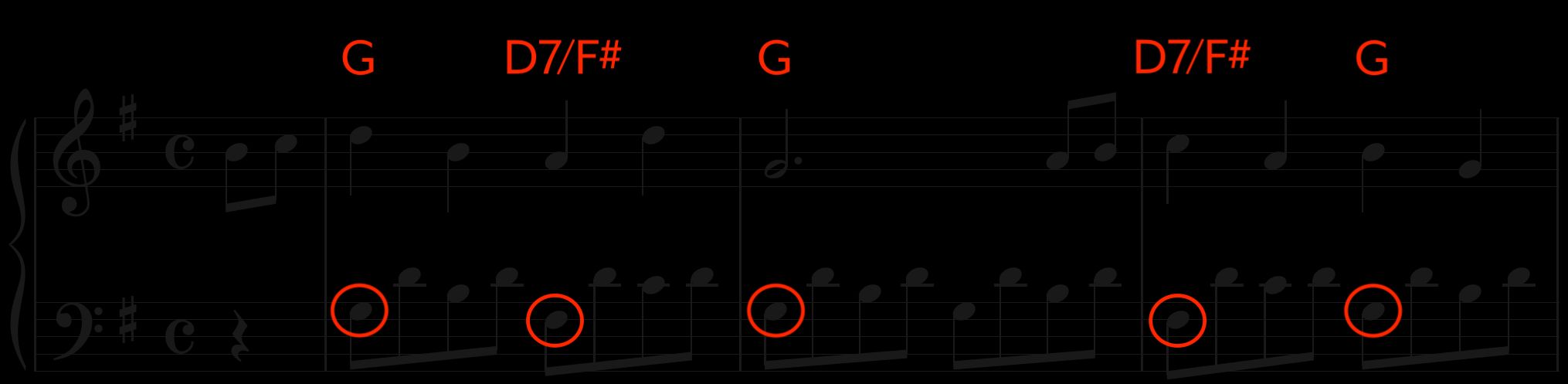
To be sure, a bass line can be extracted from an Alberti bass pattern. The first (and lowest) note in the pattern, which occurs on the beat, is the bass note of the chord at any given time. Below is Thomas Attwood’s Sonatina in G major, which features a left hand Alberti pattern. Notice that the bass notes for the above chord symbols are circled in the pattern. Taken together, these notes can constitute a bass line.
What are Alberti bass techniques for piano players?
Dynamic Balance
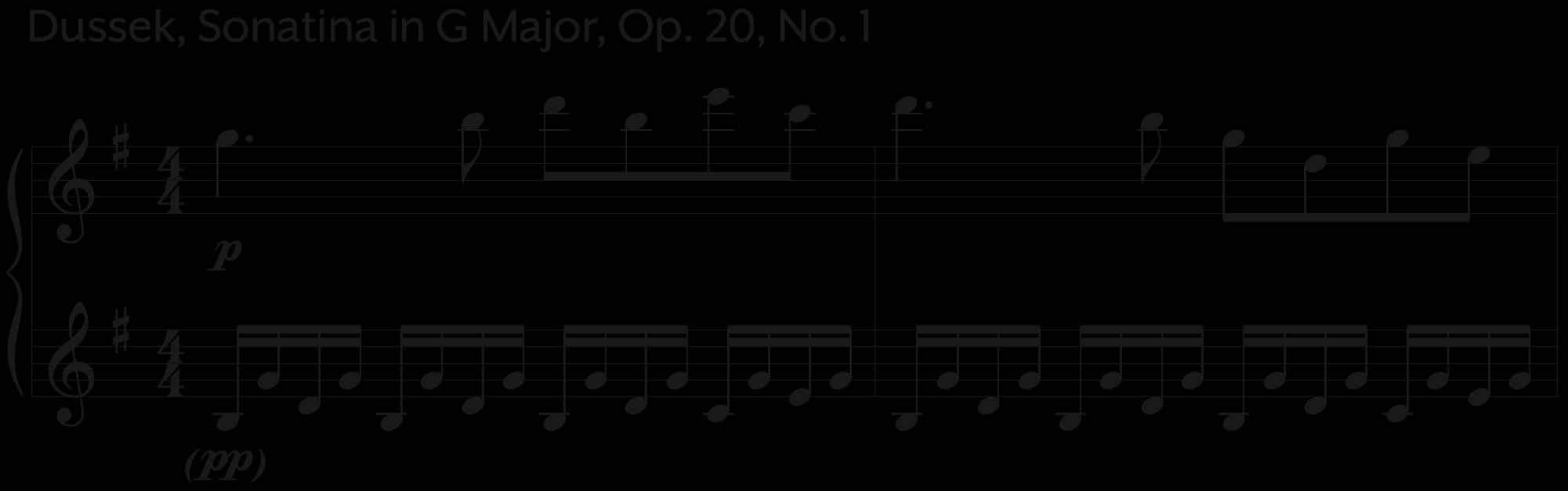
When performing keyboard music that uses an Alberti bass, it’s important to get the right balance between melody and accompaniment. If the notes of the Alberti bass are too loud, they can easily drown out the melody. Keeping the left hand in the background allows the right hand melody to sing out clearly. A great way to facilitate this balance is to look at the dynamic mark in the sheet music, play the right hand at that level, and play the Alberti bass one dynamic level quieter, as follows:
Playing the Alberti Bass on the right hand
The most straightforward way to perform piano music with the Alberti bass is to have it appear on the left hand, while the right hand plays the melody. Although this is the arrangement most frequently seen in classical music, the texture can certainly be flipped. A baritone melody can appear on the left hand beneath an Alberti pattern on the right, as in this excerpt from the third movement of Beethoven’s Moonlight Sonata:
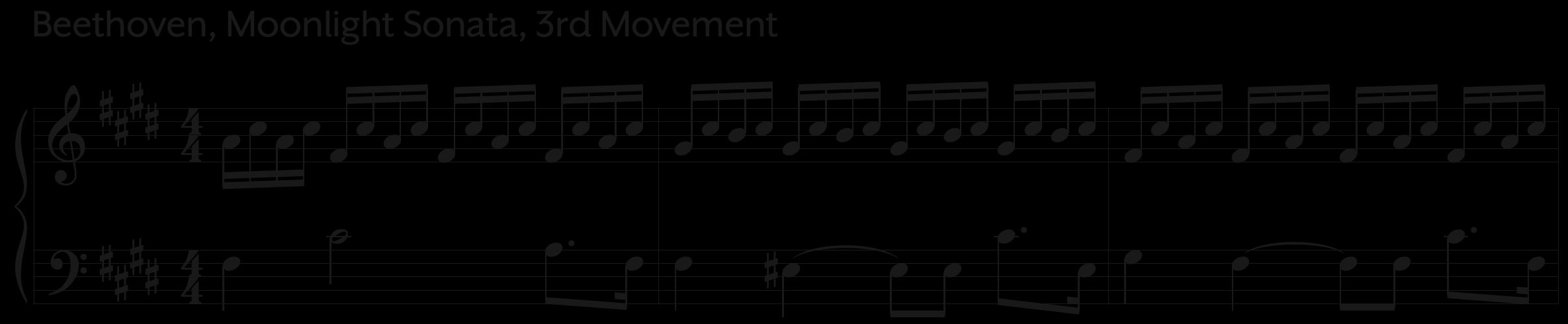
In this case, since the Alberti bass is above the melody, it’s now the left hand that you’ll want to play louder, while keeping the right hand in the background.
Variations of the Alberti Bass pattern
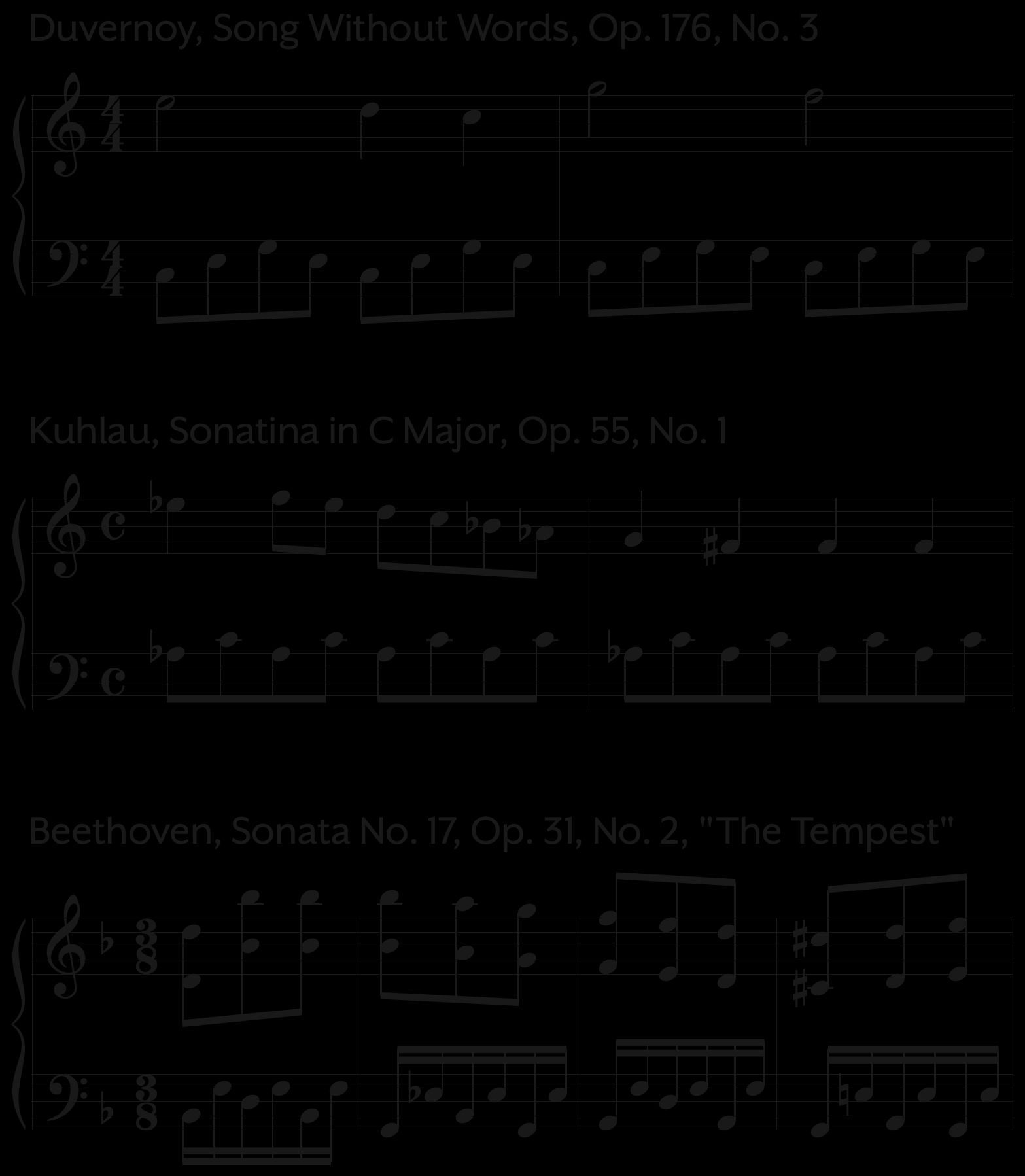
While the bottom-top-middle-top sequence of notes is most typical of the Alberti bass, other patterns can be considered variations of it. In the example below by Duvernoy, the pattern is bottom-middle-top-middle. In the Kuhlau sonatina, the pattern is simply missing an intervening note. And the sonatina by Beethoven shows the Alberti pattern adapted to include an extra beat in 3/8 time.
Popular examples
In the Hoffman Academy store, you can find many pieces of sheet music that give excellent practice with the Alberti bass. Here are some examples arranged by skill level. The Song Without Words by Duvernoy and the Clementi Sonatina offer variations on the Alberti pattern, while Scarborough Fair and the Kuhlau Sonatina have the pattern adapted for triple meter, like 3/8 and 3/4. Finally, Duvernoy’s Etude in C Major, Op. 176, No. 4 provides the Alberti bass on the right hand.
Early Intermediate Level Pieces
Thomas Attwood, Sonatina in G Major
Albert Biehl, Sonatina in C Major, Op. 57, No. 1
Jean-Baptiste Duvernoy, Song Without Words, Op. 176, No. 3
Francesca Lebrun, Rondo in Bb Major, Op. 1, No. 1
Felix Le Couppey, Sonatina in C Major
Intermediate Level Pieces
Ludwig van Beethoven, Sonatina in G Major, Anh 5, No. 1
Muzio Clementi, Sonatina in G Major, Op. 36, No. 2
Jean-Baptiste Duvernoy, Etude in C Major, Op. 176, No. 4
Scarborough Fair (Intermediate Version)
More Advanced Pieces
Jan Dussek, Sonatina in G Major, Op. 20, No. 1
Friedrich Kuhlau, Sonatina G Major
W.A. Mozart, Symphony No. 40 in G minor, K. 550
Tips for learning piano pieces with Alberti bass
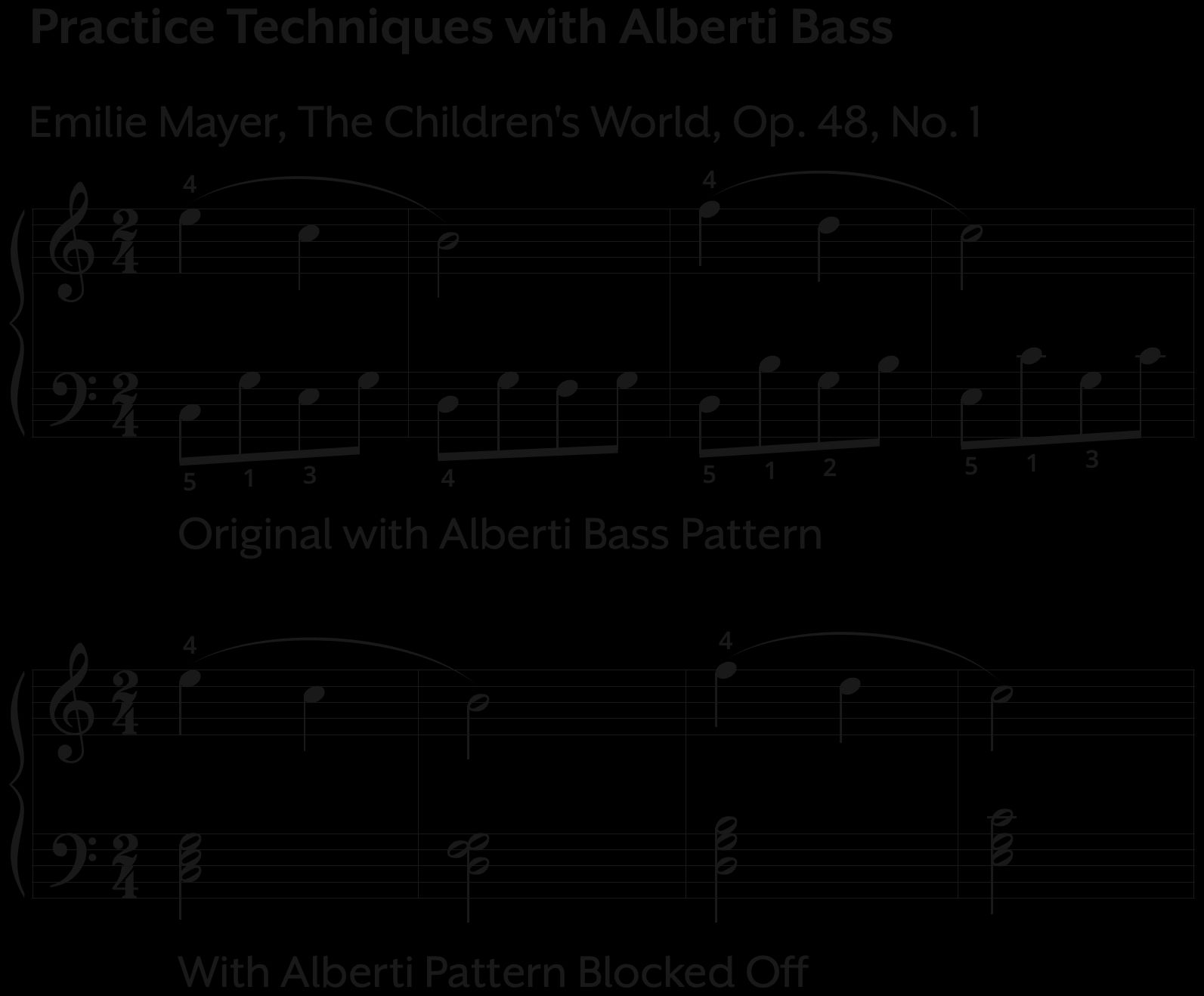
When learning a piano piece that uses the Alberti bass pattern, you’re dealing with a lot of notes! For this reason, it’s often helpful to “block off” the notes at first by playing them all at the same time. In this piece from Emilie Mayer’s The Children’s World, start by playing all the notes in each Alberti pattern simultaneously, as a chord, on the first beat of every measure. Try it this way when practicing hands together, then break up the notes and play as written when you feel ready. This is a very effective step toward mastering the Alberti bass in your favorite music!
Now that you’re familiar with the Alberti bass, see if you can identify when it shows up in classical pieces that you play and listen to. Enjoy the vibrant energy and flowing sound of this versatile accompaniment pattern.