


Why does music education matter?
Providing good quality music education to our youth is vital for the future of music. Teaching music allows creativity to thrive, fosters emotional development, cultivates a personal and lifelong passion for the arts, and ensures that musical knowledge will pass on to future generations. Good music education plays an important role in inspiring young people and providing them with opportunities and quality learning experiences. Schools that invest in music programs give students skills that last well beyond the classroom.
Not only important in public, private, and charter schools, music programs also benefit homeschoolers, microschoolers, and online learners. Students pursuing nontraditional schooling in some states can use specialized scholarships and funding options, including Education Savings Accounts (ESAs). Hoffman Academy is an ESA-approved online school for music, so you may be eligible to use these funds to purchase music lessons for your child with us.
Hoffman Academy makes it easy to supplement traditional or nontraditional education paths – try a Free account today and see how piano can light up your child’s curiosity!
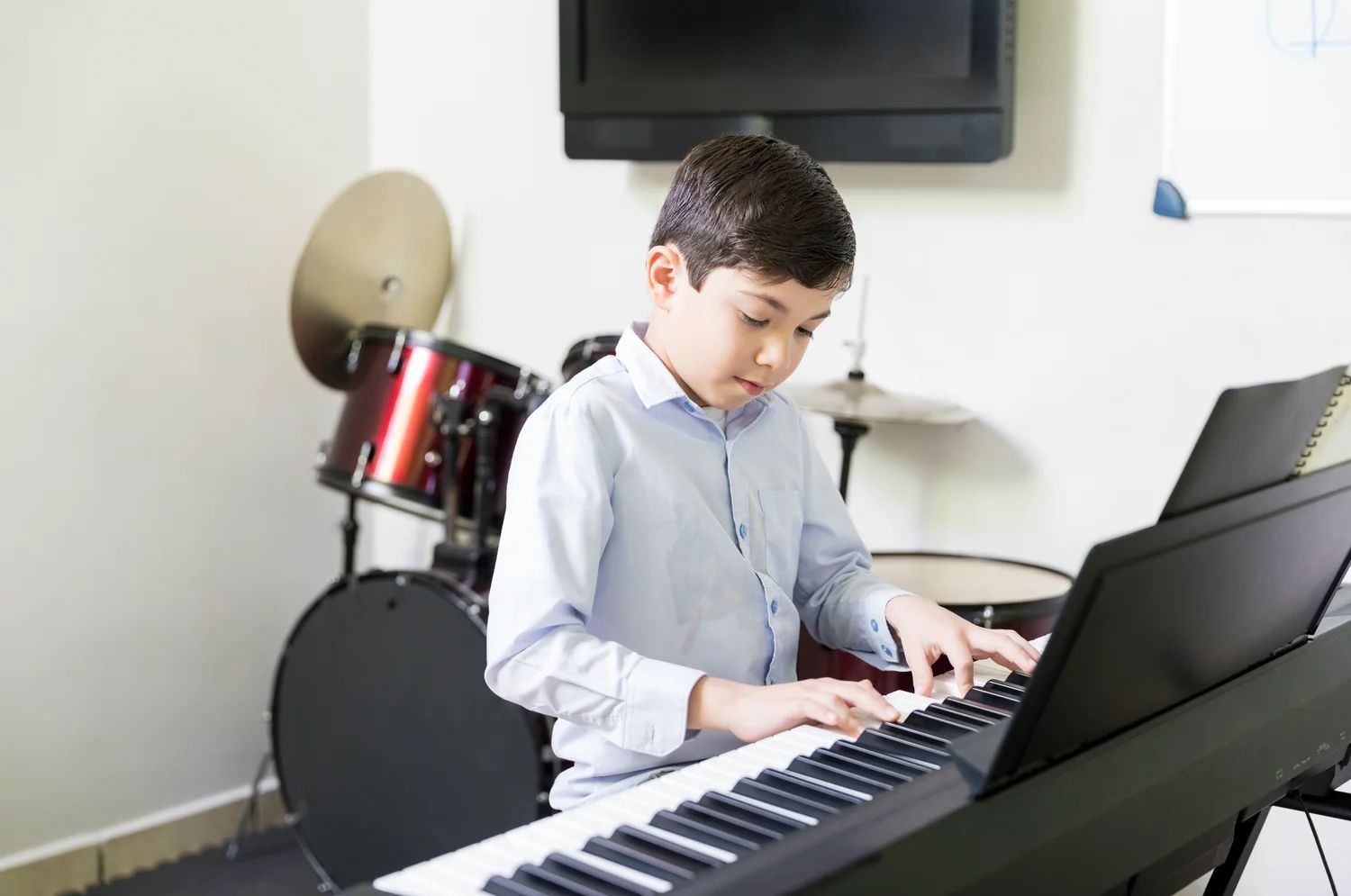
Why should schools invest in music programs? What are the benefits of music programs in schools?
Schools should invest in music programs because they provide proven academic advantages, foster crucial life skills such as memory and discipline, and support belonging and mental health.
Academic success
Students who study music learn skills such as leadership, personal responsibility, independence, and perseverance. These students also display higher grades, an improved literacy, and are more likely to graduate from high school.
Physical health
Musicians aren’t often thought of as athletes, but your body is truly your instrument. Playing an instrument uses muscles in your arms, core, back, and more.
Social success
Music exposes students to many different points of view and new experiences. It connects differing cultures, promotes inclusion, equity, and belonging, and also promotes teamwork and friendship building.
Mental health
Learning music is known to accelerate brain development in youth, which increases their brain power. Music study improves concentration, enhances executive function, fine motor skills, and sensory development. It also nurtures creativity, builds empathy, helps people manage emotions and anxiety more effectively, and helps reduce the risk of dementia and Alzheimer’s.
What does the research say about music education and academic performance?
Research on why schools should invest in music programs shows a consistent connection between music education and academic performance. Students who learn how to play an instrument in band, choir, orchestra, or as a soloist often perform better academically, and learning music engages skills such as listening, memory, attention, pattern recognition, and coordination. Some studies also show that music training improves language skills, reading, and cognitive skills.
However, music education is valuable in its own right—and the concentration, persistence, creativity, collaboration, and disciplined practice it develops can support the kinds of skills students use throughout their education.
In 2019, the Journal of Educational Psychology published a study that included more than 112,000 Canadian students and found that students who studied music performed significantly better on exams in other subjects, such as math, science, and English. Dr. Peter Gouzouasis, PhD of the University of British Columbia and author of this study was quoted saying, “Students who participated in music, who had higher achievement in music, and who were highly engaged in music had higher exam scores across all subjects.” He also was quoted saying, “Learning to play a musical instrument and playing in an ensemble is very demanding. A student has to learn to read music notation, develop eye-hand-mind coordination, develop keen listening skills, develop team skills for playing in an ensemble and develop discipline to practice. All those learning experiences play a role in enhancing children’s cognitive capacities and their self-efficacy.”
In 2022, a study by the Hungarian Academy of Sciences found that musical training played an important role in later academic achievement. This study took place over seven years and consisted of 76 students. The study concluded that musical training, especially early rhythm recognition and reproduction, are directly associated with the development of cognitive skills used in academic achievement later in life.
With the advent of online learning, homeschooled students and microschool or online learners can also have the benefits of a music education. According to the American Music Institute, music education can:
- strengthen academic performance
- build discipline and perseverance
- nurture creativity
- create social opportunities
- build a lifelong passion in music and art
Read more about the importance of music education and its impact on human academic development:
Key Research Insights on Music Education’s Impact
Why Music Education Matters Now More Than Ever
The Link Between Music Education and Academic Performance – Des Moines Symphony
What happens when schools cut music programs?
When schools cut music programs, it often leads to lower student engagement and a decrease in the students’ emotional well-being. This is due to the loss of a vital outlet for stress relief and self expression. This strongly impacts students from lower-income homes who may rely on school-based activities for emotional and social support.
The elimination or downsizing of music programs can cause lasting damage to the infrastructure of the school, which undermines the development of a well-rounded learning environment and limits opportunities for students to explore. In the long run, cutting music programs negatively affects students’ personal growth and their overall quality of education. Schools that invest in music programs avoid these losses and protect the learning environment for every student.
What types of schools typically offer music programs?
Public schools, private schools, and charter schools offer music programs. These programs usually include band, choir, and orchestra, with rare instances of piano classes. A student interested in playing the piano usually needs to find a qualified teacher for one-on-one lessons.
How can schools fund music programs?
There are funding options available for music programs in public schools, private schools – and even for homeschoolers! Music programs in public schools are funded by tax dollars while music programs in private/charter schools are often supported by fundraisers.
Music programs in homeschools can be supported by state grants and ESA funding. More and more families are choosing non-traditional school options like homeschool, charter schools, online schools, or microschools. Some states offer families who opt out of the public school system the option to use the tax dollars allocated to their student at their school of choice through Education Savings Accounts (ESAs). This is a way parents can direct their tax dollars to fund their child’s homeschool education. Music classes with Hoffman Academy are a smart, eligible way to provide a music program.
Are there grants available for school music programs?
There are grants available for public and private school music programs, such as Chorus America, NAfME, Save the Music Foundation, National Endowment for the Arts, and The Mockingbird Foundation.
For homeschoolers, there are state ESAs (Education Savings Account) and Scholarships. ESAs can effectively work like a personal music education grant for homeschooled students to support their music learning. This is a way for families to fund their children’s alternative education in a homeschool or private school. Some states might call these an Education Freedom Account, or a grant or scholarship. This type of ESA enables families who homeschool to utilize the public tax dollars they contributed towards their child’s homeschool or private school education.
Can ESA funds be used to pay for music education?
ESA funds can be used to pay for music education within the United States, but it depends on the ESA and the state that it’s located within. Education Savings Accounts, Education Freedom Accounts, or State Scholarships for Homeschoolers cover a variety of learning options for students. These programs are designed to fund qualifying educational services for students who are not attending public schools. With more states developing programs every year, ESA homeschooling funding may help pay for your child’s music program with Hoffman Academy.
ESA coverage of music curriculum and educational software programs as eligible expenses varies from state to state. Many states with ESA funding recognize that homeschooled students may not have access to music lessons. For states that cover music lesson costs, ESA funding can be a great way to support your child’s music education and enrichment.
Hoffman Academy provides an ESA-approved online piano curriculum for students attending online schools, charter schools, and more. We are an approved provider in 10 states and we are working on expanding to more states. See the full list of states for which Hoffman Academy is ESA approved.

How can parents advocate for music programs in their child’s school?
The National Association for Music Education or NAfME gives the following suggestions as ways that parents can advocate for music education in their child’s school.
- Volunteer in and get involved with the school
- Build a dialogue with the school administration before problems develop
- Involve musicians within the community
- Reach out to local media, such as writing a letter to the editor in your local newspaper to tell people what music means to you and your child
- Invite school board members, county/district supervisors, state/national lawmakers to your child’s concerts.
What can families do if their school doesn’t have a music program?
Some schools don’t have music programs and some families may choose alternative schooling options, such as arts charters or magnet schools.
Hoffman Academy is now an option for homeschoolers. We provide a complete and holistic music education online.
A good homeschool music curriculum teaches songs and exercises to guide students through learning music theory and how to play an instrument. Our structured curriculum uses theory pages, scales and exercises, and songs and tutorials to teach fundamentals including rhythm and ear training. From sightreading sheet music to playing by ear and improvising, homeschoolers become confident piano players and well-rounded musicians with the Hoffman Method.
Let Hoffman Academy’s exceptionally designed curriculum simplify your homeschool music experience. The Hoffman Method teaches music skills sequentially by introducing songs that make it easy and fun to learn the elements of music. Students discover music theory concepts including rhythm and note identification as they learn to play the song in each lesson.
Music education is worth the investment
It’s up to all of us to make sure that the future of music education is secure, whether we are parents, teachers, students, or someone who enjoys music. There are many ways to advocate for and support good quality music education, so please do your part to get involved. If you are a parent and you’re interested in providing your student with good quality music lessons, check out our website to learn more!