


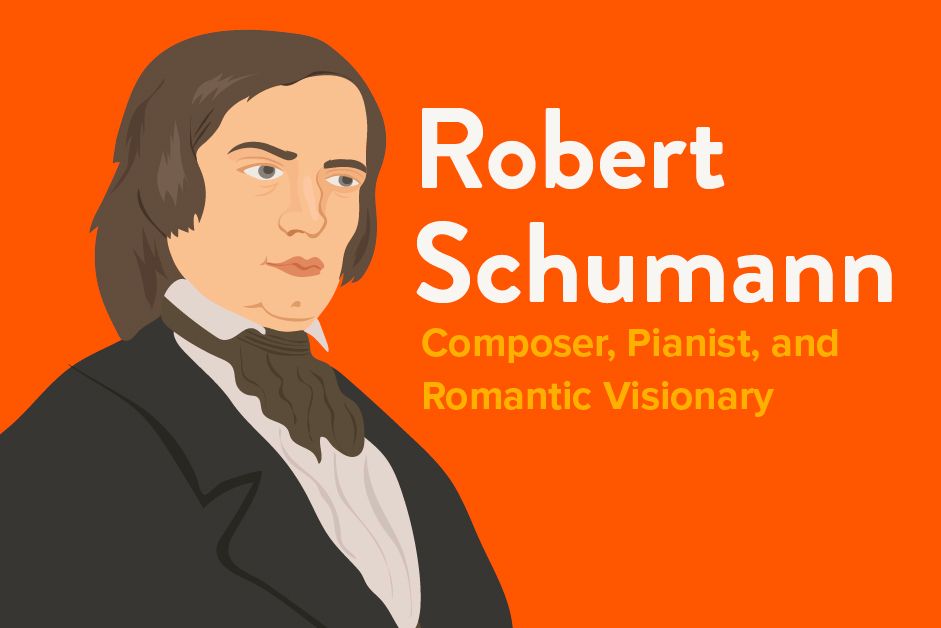
Robert Schumann embodies the spirit and times of the Romantic Era perhaps more than any other composer. A person who had a deep and loving relationship with his wife Clara, had friendships with great composers such as Brahms and Liszt, battled tragic health problems, and composed complex and emotional music, he is certainly a composer with whom everyone should familiarize themselves with. Read on to learn more!
Learn classical music with Hoffman Academy! Discover your piano potential at Hoffman Academy with the world’s best piano learning system.
German pianist and composer Robert Schumann was born in the Kingdom of Saxony, now located in the modern-day German state of Sachsen, on June 8th, 1810 in the town of Zwickau. He passed away on July 29th, 1856 in Bonn, Prussia, which is now located in the modern-day German state of Nordrhein-Westfalen.
What is Robert Schumann best known for?
Along with Franz Schubert, Johannes Brahms, and Hugo Wolf, Robert Schumann is considered one of the greatest composers of Lieder (German-language art songs). During his lifetime he composed over 300 Lieder, which are known for their emotional depth and lyrical beauty. He is also well known for his chamber music, piano works, symphonies, and his turbulent life, which included a famous love life with pianist/composer Clara Wieck.
A short biography of Robert Schumann
Robert was born into a middle-class family and was the youngest of five children. His parents were August and Christiane (née Schnabel) Schumann. August worked as a bookseller, author, and publisher, which fostered young Robert’s lifelong interest in poetry and literature. Robert began music lessons at the age of seven, studying piano, flute, and cello. His interest in poetry inspired him to produce many small compositions, including many Lieder.
August was supportive of his son’s musical pursuits and tried to coordinate lessons for Robert with famous composer Carl Maria von Weber, but was unsuccessful. After August passed away in 1826, Christiane encouraged Robert to study law instead of music, so he studied at Leipzig University for a year before transferring to the University of Heidelberg. While still in Leipzig, he began studying piano with Leipzig’s leading piano teacher, Friedrich Wieck, who became an important figure in his life. In 1830, Schumann wrote a letter to his mother and announced his intention to become a professional musician. With Wieck’s support, he left the university to pursue his performance career. Not long after that, due to a growing paralysis in his right hand. he shifted his focus to a career in composition, music criticism, and music editing.
Together with Wieck, Robert co-founded the Neue Zeitschrift für Musik in 1834. This new music magazine became a prestigious and influential voice in Germany’s music scene, and in 1835 Robert became its sole editor.
Around this time, Schumann began falling in love with Wieck’s daughter Clara, who was a fabulous virtuoso pianist and her father’s best student. After discovering that Clara reciprocated his feelings, Robert asked her father for his consent to marry her. Wieck refused due to his fear that Robert could not provide for Clara. After four years of many legal actions, Robert was able to obtain a court ruling that allowed Clara and himself to marry without Wieck’s consent. They finally married on September 12th, 1840. Clara became one of the most distinguished virtuoso pianists of the Romantic era. She served as Robert’s greatest muse, inspiring him to compose many of his musical works. This included the incredibly famous song cycle Frauenliebe und -leben which was written in the year of their marriage. She also premiered and performed many of his piano works. Together, Clara and Robert had seven children.
What changed the trajectory of Schumann’s playing?
Schumann had a desire to become a great concert pianist, but this path was altered after a hand injury caused him to turn mostly to composition. There are many myths surrounding this hand injury, including one claiming that he had designed a contraption to strengthen the muscles in his hand, which ended up destroying his tendons and rendering him unable to play.
The truth of Schumann’s hand injury was a growing paralysis that affected at least one finger on his right hand. The cause is still unknown, but he first began experiencing symptoms from the paralysis while he was a student in Heidelberg. He experimented with many different treatments, none of which cured the problem. Realizing that he could no longer play the piano at the level required to become a virtuoso pianist, he turned his focus to composition.
Robert Schumann and Clara Wieck
Schumann’s relationship with his wife Clara Wieck is well known today for having been one of deep admiration and turmoil. If you are interested in an in-depth look at their relationship, I recommend The Marriage Diaries, which is a wonderful book of compiled letters that Clara and Robert wrote for each other.
Schumann’s musical style and experience as a critic
Born at the same time as other pivotal Romantic-era composers, such as Felix Mendelssohn (born in 1809), Frédéric Chopin (born in 1810), Franz Liszt (born in 1811), and Richard Wagner (born in 1813), Robert Schumann’s compositional voice is often described as “quintessentially Romantic.” During Schumann’s young life as a student and composer, composers were particularly interested in nature, the supernatural and spiritual, writing for large orchestras, developing new structures that incorporate elements from literature (such as the song cycle), experimenting with more elaborate harmonies, and continuing the innovations of Beethoven, which helped to define the sound of the Romantic era.
What is Robert Schumann’s most famous composition?
One of Schumann’s most famous compositions is his song cycle Dichterliebe, which along with Franz Schubert’s Winterreise and Die schöne Müllerin are considered three of the most influential song cycles ever written. Dichterliebe (translated to the “Love of a Poet”) is a setting of 16 interconnected poems by Heinrich Heine, which together tell the story of a poet who falls in love with someone and is then rejected by them.
Listen to this song cycle below:
Dichterliebe, Op. 48 (1840)
Another famous composition by Schumann is his Piano Concerto in A Minor, Op. 54. This piece is one of the most widely performed piano concerti and is famous for its accessibility. It is often the first piano concerto learned by young pianists, but it is also known for its emotional depth and melodic beauty. Due to their structural and harmonic similarities, Edvard Grieg’s Piano Concerto in A minor, Op. 16 (1868) is frequently paired with Schumann’s concerto. Both of these pieces inspired Sergei Rachmaninoff’s Piano Concerto No. 1 in F-sharp minor, Op. 1, which also carries many similarities to Schumann and Grieg’s concerti.
Listen to this piano concerto below:
Piano Concerto in A minor, Op. 54 (1845)
What are popular compositions by Robert Schumann?
Some of Robert Schumann’s most famous compositions include movements from his educational Album for the Young. These pieces are accessible for intermediate pianists and their sheet music is included in our store. Some of the most exciting pieces included are: Melody, Knecht Rupert, The Wild Horseman, and The Happy Farmer. Click on these previous links to access the sheet music and click on this link for more options.
Other great compositions by Robert Schumann include more advanced piano compositions, such as his Piano Sonata No. 1 in F-sharp minor, Op. 11 (1835), Fantasie in C Major, Op. 17 (1836), and the quirky Kinderszenen, Op.15 (1838). His ghostly song “Waldesgespräch” from the Eichendorff Liederkreis, Op. 39 (1840) and the song cycle Frauenliebe und -leben, Op. 42 (1840) are also beloved works.
What are other interesting facts about Robert Schumann?
- Both Robert and Clara Schumann were very close friends with Johannes Brahms and supported the younger composer as he was beginning to make a name for himself. In his music magazine Neue Zeitschrift für Musik, Robert said that Brahms was “fated to give expression to the times in the highest and most ideal manner” and hailed him as Beethoven’s true compositional successor, which placed a great deal of pressure on the shoulders of the young perfectionist composer.
- Schumann was known by friends and acquaintances as a quiet person who preferred to sit in silence over engaging in small talk.
- He was also known as a very loving father who truly enjoyed playing with his kids. He kept a diary of big moments for his children, which included things as small as discovering bird nests.
Schumann’s legacy and final years
In his last few years, Schumann suffered from terrible hallucinations and mental health complications. He was admitted to a mental hospital in 1854 where he lived until his death, which was attributed to pneumonia and occurred on on July 29th, 1856. Before he was admitted to the hospital, he composed his final work: a composition for solo piano entitled Geistervariationen in E-flat Major, WoO 24, known in English as the Ghost Variations.
You can hear this work here:
Geistervariationen in E-flat Major, WoO 24 (1854)
Robert Schumann’s music lives on
Schumann made a lasting impact on culture and music through his compositions, musical reviews, and his support of “modern” music. He had an innovative approach to composition which blended emotion, literature, and musical form which helped define the Romantic era. Despite his troubled final years, he was a master in crafting deeply expressive piano works, symphonies, and Lieder, which left their mark on music history and continue to inspire composers and performers today.