





Discover how playing famous classical pieces can strengthen your skills and inspire your piano journey
Playing classical music on the piano is a wonderful way to strengthen your musical skills. Learning classical music can seem intimidating, but there are so many delightful classical pieces that can be learned in the early years of piano studies. With a variety of styles of classical music, and hundreds or thousands of pieces within each style, your choices are nearly endless. Read on to learn about some of our favorite classical pieces for piano learners to explore!
Learn classical music with Hoffman Academy! Discover your piano potential at Hoffman Academy with the world’s best piano learning system.
What is the easiest classical piano piece to play?
It’s difficult to say what the easiest classical piano piece is due to the large quantity of classical piano music, but here are four of the easiest classical pieces to learn in the Hoffman Method. Each of these songs are only about a page long and simplify many of the same techniques that more challenging classical pieces use.
I recommend beginning with Spinning Song by Ferdinand Beyer. This piece uses the C major pentascale and starts introducing a simple left hand part. Not all music uses chords and instead uses single notes in an alternate melody, which is called counterpoint. This piece is a simple example of music written with counterpoint.
Another great beginning classical piece is Vivace by Cornelius Gurlitt, which again uses the C major pentascale, but provides the learner a lot of practice with the I and V chords. It’s also fast and exciting to play!
A slightly more challenging beginning piece is Musette in D Major, which was composed by an anonymous acquaintance of J.S. Bach. This piece introduces even more hand independence. In the first two measures the left hand must play even eighth notes (ti-tis) in a bouncy staccato fashion while the right hand plays completely different notes and rhythms. This takes some slow practice to confidently coordinate the hands, but once these difficult measures are mastered, the student is rewarded with two measures where both hands play exactly the same notes and rhythms.
Out of all four of these beginning examples, Dance by Cornelius Gurlitt is the most challenging piece. In this piece, the student must work slowly and patiently for both hands to feel confident and well-coordinated enough to play together. It’s important to note that patience is well rewarded when the student enjoys playing this fascinating piece.
Famous classical pieces for beginners
Many of the classical pieces that people get excited about playing are intermediate or advanced level pieces, but there are still lots of fun and easy classical pieces that you can learn that will prepare you to play your favorites!
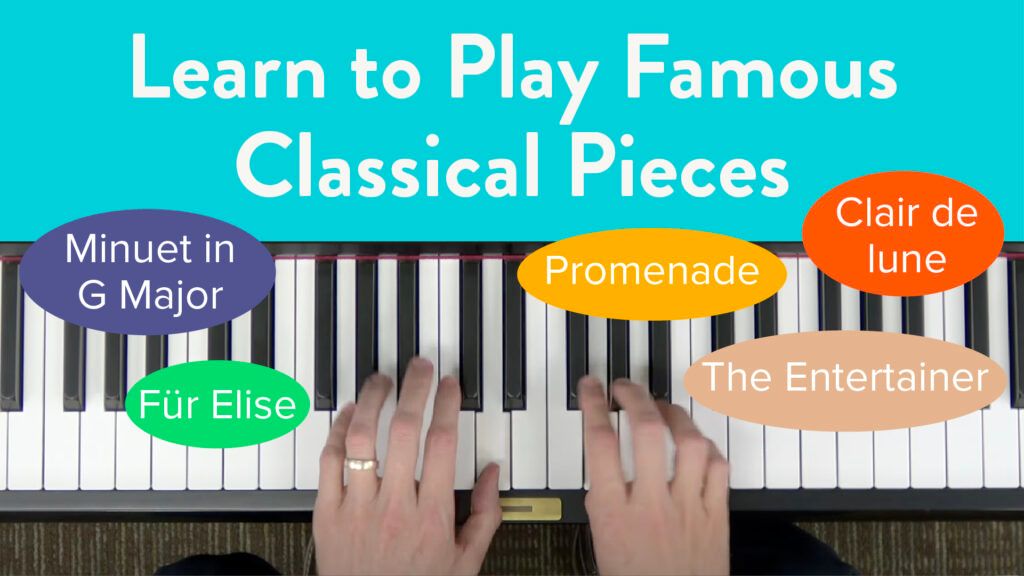
One of the most popular classical pieces for beginners is the Minuet in G Major. For hundreds of years it was misattributed to Johann Sebastian Bach, but recently, music historians have discovered that it was composed by a composer friend of his from Dresden named Christian Petzold.

Other great pieces to learn include Minuet in C Major by Jean-Philippe Rameau, Melody for Left Hand by Ludvig Schytte, Etude in C Major by Albert Biehl, Promenade by Alexander Reinagle, and Morning Salute by Cornelius Gurlitt.
At Hoffman Academy, we’ve created video lessons that simplify and teach certain favorite classical pieces to students at their level. Examples include an early elementary level version and a late elementary level version of Für Elise by Ludwig van Beethoven.
Famous classical pieces for intermediate piano
The team at Hoffman Academy has also created video tutorials of your favorite intermediate classical pieces, such as the original Für Elise (video links included below) and the first movement of the Moonlight Sonata (late intermediate level).

Some simplified versions of more challenging classical pieces include our arrangement of Moonlight Sonata (early intermediate level), Clair de Lune (intermediate level) by Claude Debussy, and The Entertainer by Scott Joplin.
Famous classical pieces for advanced piano
Hoffman Academy’s store provides sheet music for over 100 popular classical pieces for advanced pianists. These include Clair de lune by Claude Debussy (sheet music), Rondo alla turca by W.A. Mozart (sheet music), and The Entertainer by Scott Joplin (sheet music).

How can playing classical music improve my piano skills?
Playing classical music incorporates a variety of challenging technical elements. Many of the piano exercises that students traditionally learn are designed to prepare them to perform classical music. In classical music, you will encounter scales, chord progressions, arpeggios, inversions, and so many other technical skills. The best way for a student to get better at classical music is to take these ideas that they’ve learned in their daily drills and use them in performance.
Let classical music inspire your ongoing piano practice
If you are interested in discovering more piano tutorials for classical piano pieces, Hoffman Academy’s has quite a few video tutorials that you can check out! Discover more sheet music from our store. Remember that the video tutorials are free, and signing up with our Premium Membership includes the sheet music to all of the over 500 popular classical pieces in our store. Have fun discovering classical music and happy playing!