



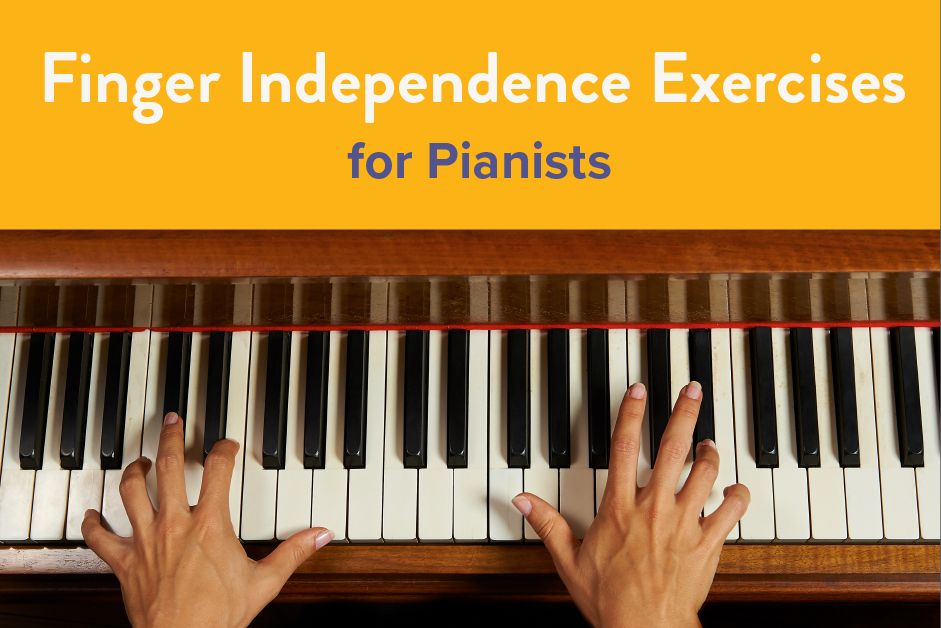
Learn about finger independence exercises, including examples you can practice without a piano
Are finger independence exercises important? How can I get started? Are there exercises I can do away from the piano? In this article we’ll address the answers to these questions and provide examples of exercises and resources so that you can practice even when you don’t have an instrument nearby. Read on to learn more!
Build your finger independence with Hoffman Academy! Our hundreds of free video tutorials include exercises for speed and strength so you’ll be able to tackle any piano piece. For access to the world’s best piano learning system, including all of our piano learning resources, such as games, listening tracks, practice plans, and over 800 printable sheet music and theory worksheet downloads, start Hoffman Academy Premium today.
Do finger exercises work for piano?
Yes, finger exercises can improve your strength, dexterity, and overall finger independence as a pianist. Practicing finger exercises regularly allows you to navigate the keyboard easily, increase your speed, and develop better control overall. By including finger exercises with your regular practice routine you can also promote better hand posture and reduce tension, making performing a more comfortable and enjoyable experience.
Watch Mr. Hoffman demonstrate some finger exercises you can do even without a piano!
How to train your fingers to move independently on piano
Practicing simple finger exercises that focus on dexterity and coordination, such as five-finger scale exercises (pentascales) are a great way to begin to train your fingers to move independently at the piano. Consistent and patient practice of these finger independence exercises builds muscle strength and memory, and increases the ease with which you play. As you become more confident and comfortable with these exercises you can gradually incorporate more complex exercises into your routine, such as octave scales, arpeggios, and Hanon exercises.
How do you improve finger dexterity for piano?
Through a combination of consistent practice and specific exercises, you can improve your finger dexterity. It’s best to begin with simple finger exercises, such as arpeggios and scales. While doing this, you should focus on playing slowly and deliberately. It’s important to play clearly and be precise. Also, consider practicing with a metronome to increase your speed and maintain accuracy.
Wrist and finger stretches can be really helpful in improving your dexterity as well. Keep reading for guidance through some of these stretches.
How do you strengthen your fingers for playing piano? Can you do this without a piano?
The following stretches and exercises can strengthen your fingers. Some of these are even possible to practice without a piano nearby, allowing you to improve your skills anytime, anywhere.
- Finger and Wrist Stretches
- As with any physical activity, playing can be demanding on our body, so it’s important to stretch the muscles in your fingers and wrists. Here are some stretches that you can do on your own!
- Let’s begin with spreading your hands and fingers wide. Use your hand’s own strength only – don’t use anything else to help spread your fingers because this can cause a sprain. Do this for one hand and then switch to the other.
- Now we will stretch the fingers backwards. For this stretch, feel free to use the palm of your other hand to gently move the fingers. Again, to keep from straining your muscles or tendons, stretch a group of your fingers at the same time, not one at a time. After you’ve stretched the fingers of one hand, switch to doing the same for the other.
- Next, take the palm of your left hand and press it against the fleshy part of your right hand just below the thumb. This is called a backward thumb stretch. Switch hands and repeat.
- For this stretch, straighten your left arm and put up your hand as if saying “stop”. Take the right hand’s palm and gently push it against the fleshy part of the fingers of the left hand. This will cause your wrist to experience a gentle backwards stretch. Repeat for the other wrist.
- The last stretch can be slightly modified to stretch the wrist forwards. First, straighten your left arm and point your fingers and wrist down. Take the right hand’s palm and gently push it against the back part of your left hand. This will cause your wrist to experience a gentle forward stretch. Repeat for the other wrist.
- Slowly, roll your wrist in a circular motion one way and then the other.
- Roll your neck and head slowly one way and then the other.
- Finally, roll your shoulders slowly one way and then the other.
- As with any physical activity, playing can be demanding on our body, so it’s important to stretch the muscles in your fingers and wrists. Here are some stretches that you can do on your own!
- Finger Independence Exercises
- Here are some simple finger independence exercises that you can do anywhere! All you need is a flat surface like a desk or table. It might also be useful to have a pencil/pen and piece of paper handy to help organize your thoughts as you practice.
- First, let’s create some patterns that you can practice. Choose a random order of the numbers 1-5 (your finger numbers) and remember this order, or write it down if you like. Play that pattern on the flat surface with each hand one at a time. Once you feel confident with each hand, try putting the hands together.
- Try mixing the numbers up again into a different random order. It can be fun to even add a metronome to this exercise!
- Next, place all of the fingers of one hand onto the flat surface. Slowly tap each finger individually without moving the others. You might find that the 4th (ring) finger is the most difficult to move on its own, but with some practice, it will become easier!
- Here are some simple finger independence exercises that you can do anywhere! All you need is a flat surface like a desk or table. It might also be useful to have a pencil/pen and piece of paper handy to help organize your thoughts as you practice.
- Rhythm Exercises
- Place all of your fingers on the flat surface and tap each finger individually starting with the thumb and ending with the pinky as if you were playing C to G.
- To create an accented rhythm, tap every finger, but accent the tap of every other finger. Tap from your thumb to your pinky and back to your thumb. Keep the accented taps going and see how fast you can cleanly tap.
- Choose a different pattern to tap, such as every fourth tap or create one of your own patterns.
- Add a metronome to practice this exercise with.
- Practice doing this with both hands separately and even both hands together. When putting the hands together, tap in the same direction or try tapping in opposite directions.
It can be really helpful to use a metronome to increase your speed. If you don’t have a metronome, there are lots of free metronome apps that you can download onto your cell phone or tablet. You can find a list of free metronome apps in our blog article Keeping Beat at the Piano: Metronome Options.
Hoffman Academy offers many resources for strengthening your fingers for playing the piano, including the Finger Power blog article. Within this article are a variety of exercises that are designed to strengthen and enhance finger dexterity. You can also find more information about beginning piano exercises by reading our article Piano Exercises for Beginners and become familiar with the Hanon Exercises in the Benefits of Hanon Exercises, Hanon Jr Exercises 1-10, and Hanon Exercises 1-20.
Piano exercise resources from Hoffman Academy
Developing finger independence is crucial for pianists who desire to enhance their musicianship and playing technique. Through the incorporation of finger independence exercises into your daily practice you can improve your strength, control, and dexterity. As we’ve seen earlier in this article, you can even strengthen your fingers when you’re away from the piano! Check out Hoffman Academy’s resources, such as our instructional videos, to make it easier than ever to enhance your skills and musical enjoyment.