


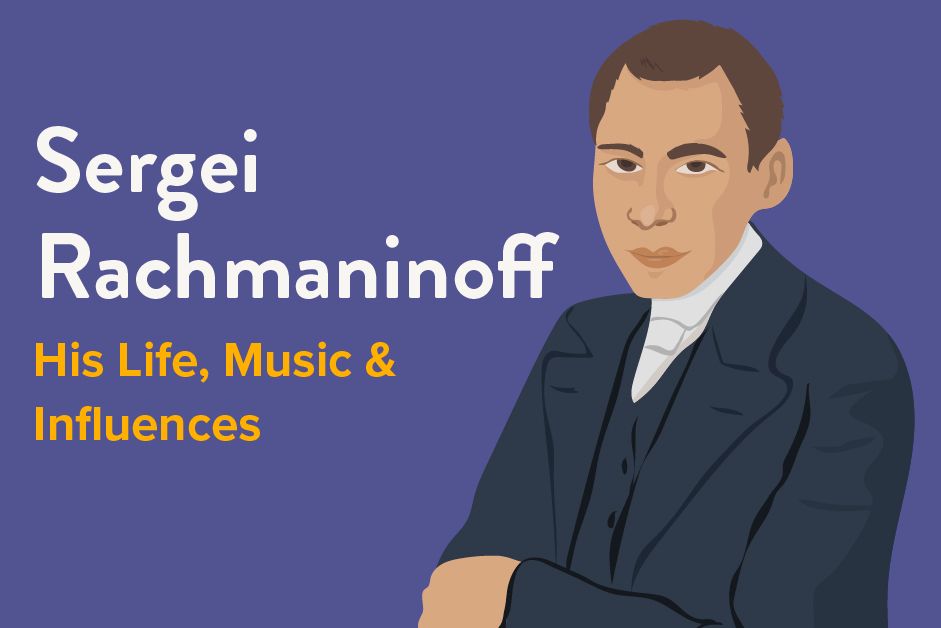
The beginning of the 20th century saw an explosion of new sounds! Blues and jazz were gaining public attention in the western world, eventually influencing the development of rock-and-roll, R&B, popular music, and other genres. In classical music, it was a time when many composers were experimenting with new sounds and developing modernist compositional styles, such as Arnold Schoenberg’s twelve-tone system, the famous riot-inducing ballets of Igor Stravinsky in his “primitive” style, and Edgard Varèse who produced innovative rhythmic and percussive works. Sergei Rachmaninoff stood out as one of the last Romantic composers, continuing to write rich, lyrical works well into the 20th century.
Russian virtuoso pianist, composer, conductor, and teacher Sergei Vasilyevich Rachmaninoff (Серге́й Васи́льевич Рахма́нинов – click here to learn the correct Russian pronunciation) was born in the Russian Empire on April 1st, 1873 in the town of Staraya Russa. During his lifetime, Rachmaninoff witnessed a lot of change, including many technological advancements, both world wars, and the collapse of the Russian Empire, which caused him to flee to the United States. During this time, he developed his own style that was firmly rooted in tradition while still fostering a unique and personal voice. He passed away on March 28th, 1943 in Beverly Hills, California, USA. Today, he is still considered one of the most influential musicians of the late 20th century and his music is regularly performed in concert halls across the world.
A short biography of Sergei Vasilyevich Rachmaninoff
Rachmaninoff was born into an aristocratic Russian family who claimed to have descended from Stephen III of Moldavia. His father was a retired army officer and his mother was the daughter of a wealthy general. At the time of their marriage, Rachmaninoff’s mother inherited five estates, including the one that young Sergei was born on and called his childhood home. All five of these estates had to be sold off during Sergei’s childhood due to family financial struggles. He had a rather large family with two brothers and three sisters and this coupled with the family’s financial struggles meant that his father could not afford the expensive military training that he had intended for young Sergei. The family was forced to move into a small apartment in Saint Petersburg.
The young Rachmaninoff’s piano teacher, who was impressed with his hard work and talent, arranged for him to enter the Saint Petersburg Conservatory at the age of 10. At this time, his 13-year-old sister Sofia passed away from diphtheria and his grandmother stepped in to help his parents financially and with raising their children. His grandmother was an ardent and faithful member of the Russian Orthodox Church, who regularly took him with her to services. This is where he became enthralled by Russian Orthodox liturgical music. The music of Pyotr Ilyich Tchaikovsky was introduced to him and his family by his older sister Yelena, who passed away in 1885 at the age of 18. This devastated Rachmaninoff. He flunked out of Saint Petersburg Conservatory, but the music of Tchaikovsky remained a big influence on him for the rest of his life.
After flunking out of St. Petersburg Conservatory, Rachmaninoff applied to and was accepted into Moscow Conservatory where he studied piano with Alexander Siloti (a student of Tchaikovsky), composition with Anton Arensky (a student of Nikolai Rimsky-Korsakov), and counterpoint with Sergei Taneyev (also a student of Tchaikovsky). During his time at the Moscow Conservatory, Rachmaninoff composed his Piano Concerto No. 1 in F# minor, Op. 1, his single movement Youth Symphony, a symphonic poem entitled Prince Rostislav, a piano trio Trio élégiaque No. 1 in G Minor, and the opera Aleko. He graduated from Moscow Conservatory in 1892 with highest honors in both piano and composition.
Listen to his Piano Concerto No. 1 in F# minor, Op. 1 here:
Rachmaninoff then went on to compose numerous works in many different genres and to perform and conduct across the world. His world was radically changed in 1917 at the onset of the Russian Revolution. Soon the Russian Revolution gave way to the Russian Civil War, which caused the Russian Empire to collapse and be replaced by the Soviet Union. After his home was seized by the new government he became fearful for his life and his family’s (he was married and had two daughters by this time) so he escaped through Scandinavia to the United States.
What is Sergei Rachmaninoff famous for?
Sergei Rachmaninoff composed over a hundred works in different genres during his 69 years of life. Some of the most famous works he composed include five piano concerti, piano preludes and etudes, two piano sonatas, choral works, four symphonies, operas, and symphonic poems.
What is Rachmaninoff’s most famous piece?
Rachmaninoff’s most famous composition is his Prelude in C-sharp Minor, Op. 3 No. 2, which he composed in 1892 after he graduated from Moscow Conservatory at the young age of 19! This composition was so popular during his lifetime that everywhere he performed, he was always asked to play it. He grew so tired of playing this piece that he purportedly told people that he dreaded being asked to perform it. It’s still his most popular solo piano work today.
This prelude was published as the second work in a set of five pieces called Morceaux de fantasie (“Fantasy Pieces”) and was nicknamed “The Bells of Moscow” since the beginning is said to resemble the chiming of the Kremlin’s carillon. It has been a tradition since Bach for many classical composers to compose 24 preludes in every key. While it was not Rachmaninoff’s intention to do this at the time he composed this prelude, he later did compose preludes for each one of the other 23 keys. Below, you can hear Rachmaninoff himself perform this famous prelude:
For a more recent interpretation, here is a recording of Evgeny Kissin performing the prelude:
Other popular compositions by Sergei Rachmaninoff:
Another incredibly popular composition of Rachmaninoff’s was his Piano Concerto No. 2 in C Minor, Op. 18. This was composed three years (1901) after the premiere of his First Symphony (1897) which, due to the orchestra’s poor preparation and other issues, was poorly received. The premiere of that symphony caused Rachmaninoff to enter a deep depression which he came out of after three years when he finally put pen to paper again and composed this work. It became an instant success. Below is a performance with the composer himself at the piano:
Here is a recent performance with Yuja Wang at the piano:
Considered one of the most challenging piano concerti ever composed, Rachmaninoff’s Piano Concerto No. 3 in D Minor, Op. 30 was written in the summer of 1909. The work was dedicated to Polish pianist Josef Hofmann (no, not Hoffman Academy’s Joseph Hoffman) who refused to play it due to its complexity. Instead, it was premiered in New York City by the New York Symphony Orchestra, the composer himself at the piano, and Walter Damrosch conducting (the same conductor who premiered Gershwin’s Piano Concerto in F and American in Paris).
Piano Concerto No. 3 in D Minor, Op. 30:
Not only was Rachmaninoff a master at the piano and with orchestras, but he composed several masterpieces for choir, including the beautiful All-Night Vigil, Op. 37 which was composed in January and February of 1915. This is an hour long work that was written for a large choir and meant to be sung a capella, which means to sing without any instrumental accompaniment. As an ardent member of the Russian Orthodox faith, Rachmaninoff grew up in a grand tradition of a capella choir music, which certainly influenced his choral compositions.
All-Night Vigil, Op. 37:
Who influenced Rachmaninoff?
The compositions of the great Russian composers, such as Pyotr Ilyich Tchaikovsky and Nikolai Rimsky-Korsakov were great influences on Rachmaninoff and his compositional style. He also gained a lot of inspiration from the Russian Orthodox liturgical music of his childhood.
What was Rachmaninoff’s favorite piece?
Rachmaninoff is said to have had two favorite compositions: his choral symphony The Bells, Op. 35 (composed in 1913) and the All-Night Vigil, Op. 37 mentioned above. He requested that the fifth movement (“Nunc dimittis”) of the All-Night Vigil be performed at his own funeral.
What was the last major work Rachmaninoff wrote?
The last major work composed by Rachmaninoff was his Symphonic Dances, Op. 45, which was finished in 1940.
Who is the last surviving pupil of Rachmaninoff?
Rachmaninoff’s last surviving pupil is still alive and turned 101 on January 15th, 2026. Ruth Slenczynska was born on January 15th, 1925 in Sacramento, California. During her lifetime, she studied with several famous teachers including of course Rachmaninoff, Austrian pianist Artur Schnabel, French pianist Alfred Cortot, Dutch pianist Egon Petri, and Polish pianist Josef Hofmann (again, not our Mr. Hoffman). Ruth had her debut performance in Berlin at the age of six and had her orchestral debut as the featured pianist in Paris at age seven.
Watch this video to hear her speak and listen to her play:
More interesting facts about Sergei Rachmaninoff
- He had enormous hands and could easily reach a 12th! That’s an octave plus a fifth. To visualize that, place your right hand’s thumb on middle C and try to reach up to the G a fifth above treble C.
Here’s a video that shows how far that reach is.
- Irish composer John Field was the personal piano teacher of Rachmaninoff’s paternal grandfather. John Field invented the nocturne and was one of Chopin’s greatest compositional influences.
- Rachmaninoff was renowned for his extraordinary talent to listen to a piece of music just once and then reproduce it flawlessly, even if a year had passed between hearing and performing it.
Sergei Rachmaninoff’s lasting impact on music and culture
Rachmaninoff made a lasting impact on culture and music, continuing to inspire young composers and pianists with his musical lyricism and late-Romanticism. His reputation as one of the greatest pianists of the 20th century and the composer of technically demanding piano compositions cement his masterful and enduring legacy. His deeply expressive music remains a cornerstone in classical music today and continues to inspire young generations of musicians around the world.