





Learn how beat and rhythm work together
Beat and rhythm are the backbone of music. Both beat and rhythm are what make a song memorable, catchy, and interesting. The beat acts as a framework, giving music a sense of timing and consistency, while rhythm weaves through the beat, creating patterns of sound and silence. In this article, we’ll explain the difference between beat and rhythm, ways to practice counting rhythm, and how to teach beat vs rhythm to students.
What is the difference between beat and rhythm?
Imagine you’re listening to a rock song. The music is so irresistibly catchy, you can’t help but tap your foot or nod your head while listening. More than likely, you are tapping along to the beat and feeling the unchanging pulse of the song. Beats in music are steady and consistent, similar to our heart beat. Sometimes our heart beats faster while running. Sometimes our heart beats slower when we’re sleeping. But no matter what, our heart beat is steady, predictable, and consistent. Just like beats in music.
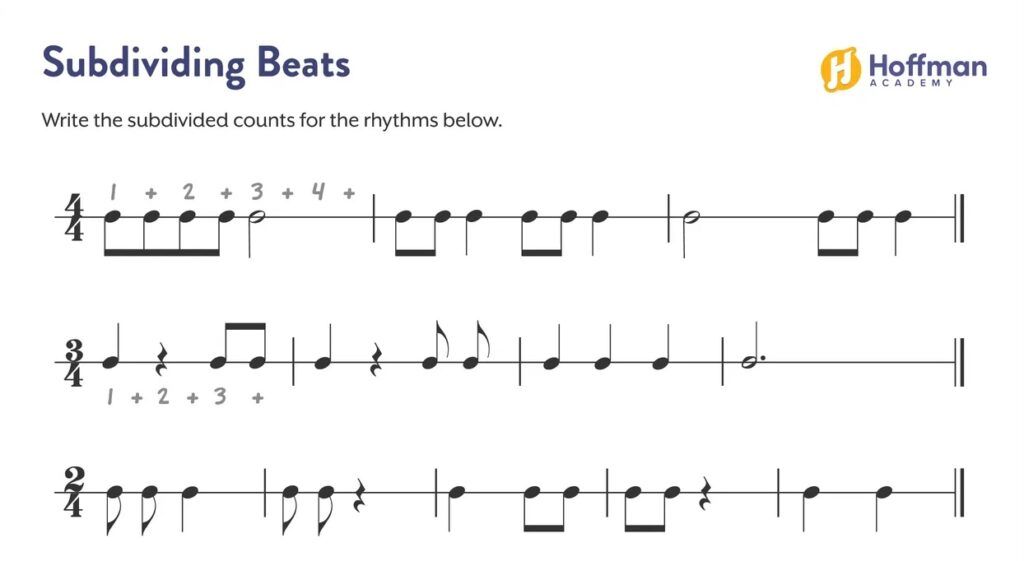
Rhythms are patterns of sound and silence. It’s what makes music groove and move. If you are listening to a song you love and singing along with the performer, you’re singing in rhythm. Rhythm provides a sense of structure and is created by patterns of varying lengths and accents of sounds. Learning how to count rhythm is a crucial for a musician. Practice counting rhythm with our Subdividing Beats Worksheet.
Is the rhythm of a song the beat?
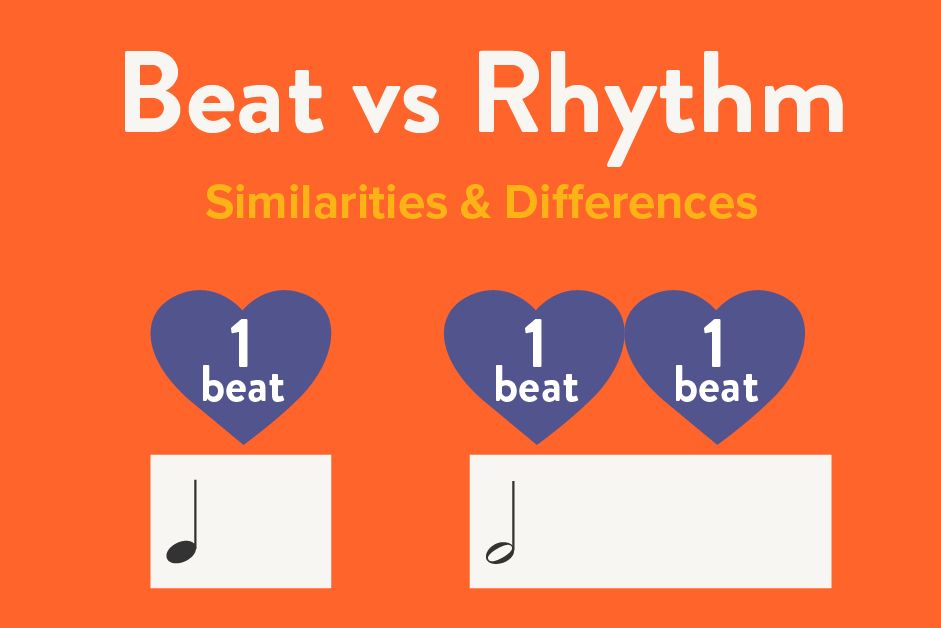
Nope! Rhythms are organized within the beat, but rhythm and beat are not the same. Beats are predictable and create a foundation for rhythms. Rhythms are the catchy patterns that lay on top of the beat.
In the video below, Mr. Hoffman shows how to count the beat of a song. Counting beats helps musicians keep a steady tempo and have an awareness of where they are in the song. In the video, notice how some rhythms take up more space on the heartbeat mat than others. Longer rhythms like whole notes take up 4 hearts on the mat whereas shorter rhythms like quarter notes cover only one heart. With a little bit of practice, it’s easy to count the beat!
Can you have rhythm without a beat?
You can absolutely have rhythm without a beat! Even though rhythm and beat are closely linked, rhythm can exist freely without a pulse. There are many styles of music that have rhythm with no beat. In Indian classical music, ragas are rhythmically free and don’t always have a clearly defined beat.
Listen to this morning raga by Ravi Shankar and notice the way he freely plays with rhythm.
Many plainchants are free of a clearly defined beat. Plainchants are monophonic sacred songs used in Christian services. Vocalists follow the natural flow of syllables rather than rely on a beat. The emphasis is on the text and flow of the melody and words. Beats in plainchant are often unpredictable and irregular.
Experimental artists also freely play with rhythm. “Philomel” by Milton Babbit pioneered the use of electronic music in live performance. Created in 1964, “Philomel” combines a synthesizer and soprano voice with irregular beat and rhythm.
The use of rubato is another way musicians feel rhythm without beat. Rubato is a musical technique where the performer slightly speeds up or slows down the tempo. The timing becomes more flexible and the emphasis is placed on expression rather than precise rhythm and beat. Rubato is used heavily in Romantic and Impressionist music. “Clair de Lune” by Claude Debussy is a beautiful example of how rubato can be used.
How many beats is a rhythm?
It’s not that rhythm is made up of a specific number of beats, but rather that rhythm involves how beats are organized within time. To figure out the beats in a rhythm, learn how to read basic musical notation and time signatures. Our free Simple Meter Rhythm Chart shows all the rhythms you’ll need to know to play music in the most common time signatures. Check out our free Compound Meter Guide to understand how to read musical notation in 6/8, 9/8, or 12/8.
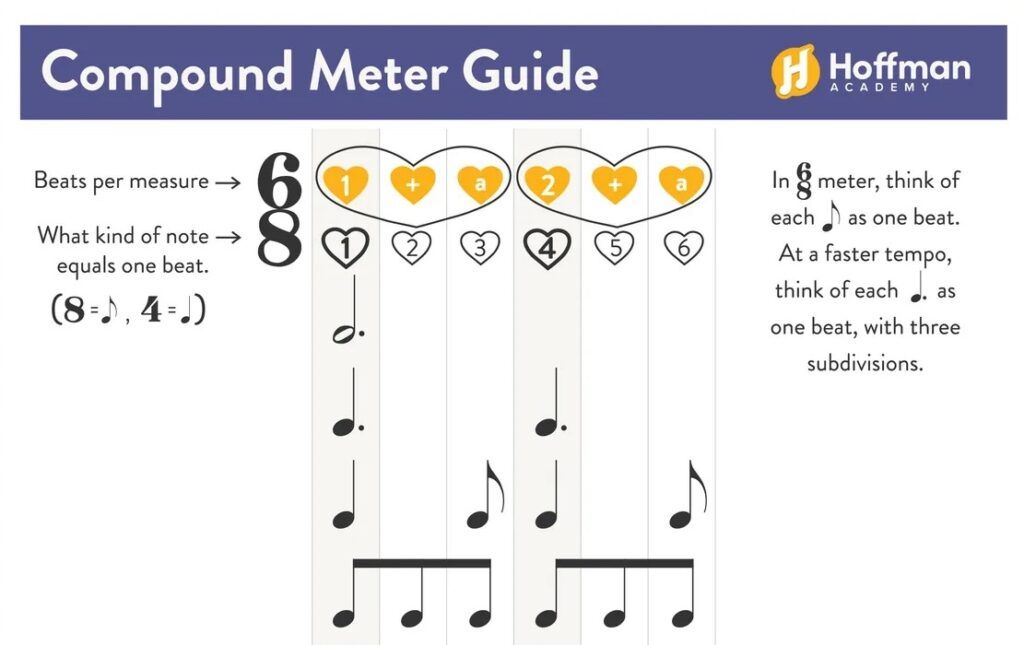
To best understand rhythm, a musician needs to know how to read time signatures. Time signatures give musicians information on how to play a piece. In a time signature, the top number is the number of beats in a measure. The bottom number shows what note gets the beat. For example, if a piece is marked with a ¾ time signature, the musician knows that there are three beats in a measure and the quarter note gets one beat. If a piece is composed in 2/2, the musician knows that there are two beats in a measure with the half note getting one beat. The time signature will inform how the piece feels rhythmically and how the beats fall within a measure.
How do you teach beat vs rhythm?
One of the most effective ways to teach beat vs rhythm is with the heartbeat mat. Beat and rhythm can often be difficult for young students to grasp. For many traditional piano methods, beat and rhythm are taught by rote, through students memorizing abstract symbols and understanding the meaning before they play them. Instead of teaching beat vs rhythm by rote, bring students to the heartbeat mat. The heartbeat mat gives students the chance to experience and experiment with beat and rhythm. This tactile activity helps students physically feel the steady beat of the song and see how rhythms interact with the beat.

Take a simple song like Hot Cross Buns and sing the song while you and your music student tap the beats on the heartbeat mat. Then, show them one rhythm of the song and demonstrate how it fits into the piece. Have students guess where else they can find the rhythm in the piece by singing and tapping the next few beats. This is a great method for introducing new rhythms and developing a student’s ear. The video below explains how to guide a student through the heartbeat mat.
The heartbeat mat is also fantastic for showing more complex syncopated rhythms like in the piece Kye Kye Kule. In the video below, Mr. Hoffman explains syncopation through the heartbeat mat.
Beat vs rhythm: The heart of music
Beat and rhythm are inseparable from music. They create the foundation for musical expression and exploration. We hope you found new ways to think about beat and rhythm in this article. Happy piano playing!