





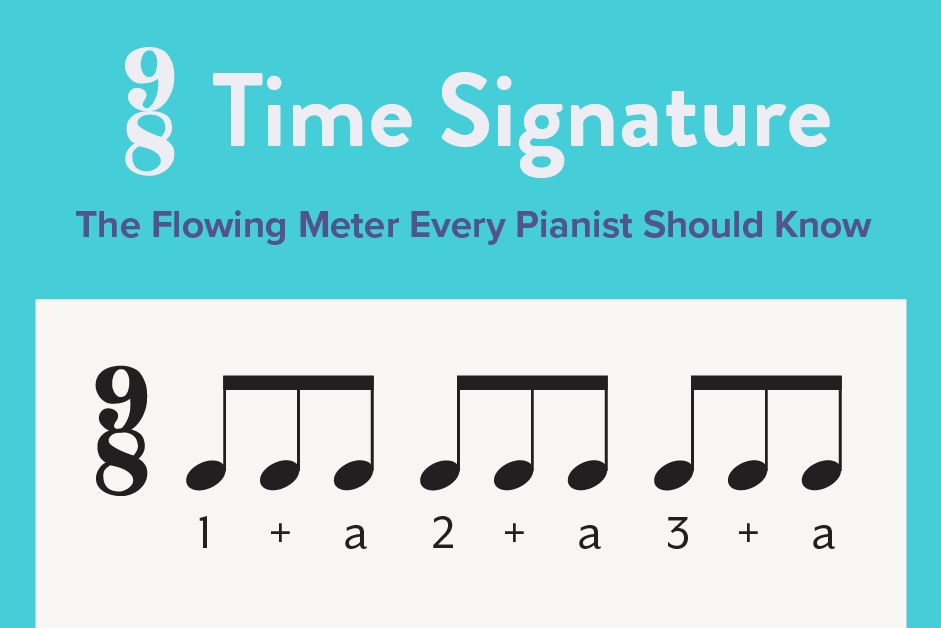
The 9/8 time signature is found in rock, jazz, soul, classical, and traditional folk music. 9/8 contains 9 eighth-note beats per measure, and musicians all over the world interpret these 9 eighth-note beats in different ways. 9/8 can be slow and meandering or unpredictable and experimental. The feel of 9/8 depends on the musical genre and the culture of the musician. Read on to learn how musicians around the world interpret 9/8 and how to play music written in this time signature.
What does the 9/8 time signature mean?
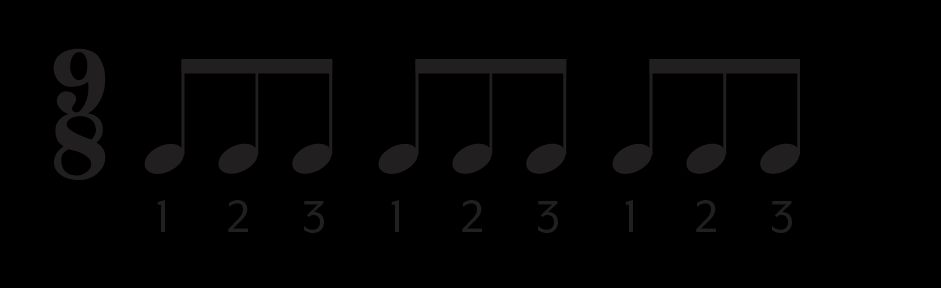
In the 9/8 time signature, there are 9 eighth-note beats per measure. However, 9/8 isn’t felt with nine distinct beats in a measure. Instead, these 9 eighth notes are grouped together in various ways, based on the style of music and how the composer wants the music to feel. In Western music, 9/8 is often perceived with 3 beats per measure. Each beat is a group of 3 eighth notes. In traditional Balkan music, 9/8 is commonly felt with three groups of two eighth notes and one group of 3 eighth notes, making 9/8 an irregular time signature in this context.
How do you count in 9/8 time?
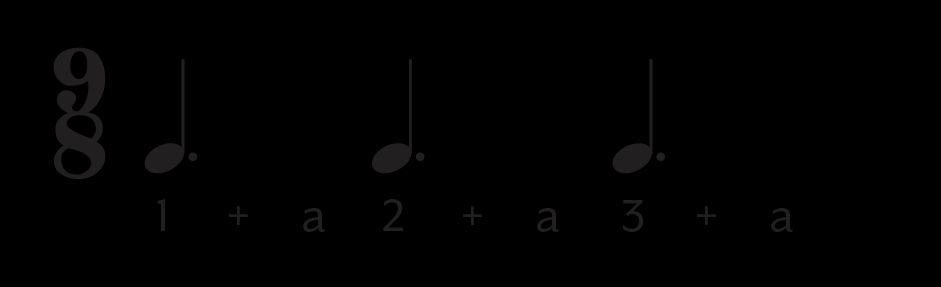
The 9/8 time signature can be counted in three groups of three eighth notes, often spoken as “1-and-a, 2-and-a, 3-and-a.” This time signature is a compound triple meter time signature which means each beat can be divided into three equal parts. The following illustrations show two different ways to count eighth notes in 9/8. 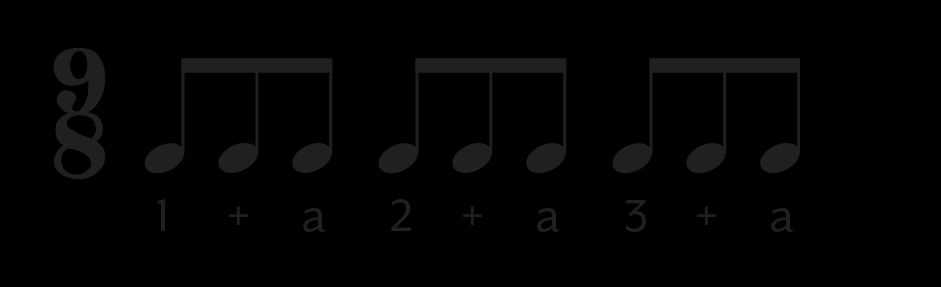
What are some examples of the 9/8 time signature?
Perhaps one of the most famous pieces written in the 9/8 time signature is “Clair de Lune” by Claude Debussy. “Clair de Lune” is an interesting example because it’s difficult to feel the clear, distinct pulse of 9/8. This piece is famously played with rubato, a style of playing that freely pushes and pulls the tempo. This piece is an example of the ways that the tempo within 9/8 can be pushed and pulled to create emotional depth and unpredictability.
While the original composition is advanced, our intermediate arrangement of “Clair de Lune” is great for those wanting to explore 9/8. Tap on the thumbnail below to watch our video tutorial.
Another famous example is “Ride of the Valkyries” by Richard Wagner. With this piece, it’s easier to feel the pulse of 9/8. See if you can tap to the beat of the piece. Notice how three quick eighth-note beats can fit into one tap.
Other examples of 9/8 in classical music include “Notturno,” Op. 54, No. 4 by Edvard Grieg and “Song Without Words,” Op. 62 No. 4 by Felix Mendelssohn.
What is the feel of the 9/8 time signature?
9/8 can feel different depending on whether it’s written as a traditional compound time signature or odd time signature. Listen to The Impressions’ “Fool For You” and notice the swaying, swinging feel of the piece. 9/8 feels easy going and relaxed in this context as a traditional compound time signature.
Listen to “The Crunge” by Led Zeppelin. The song feels unpredictable and chaotic based on the way the eighth notes are grouped. This is an example of how 9/8 feels written in an odd time signature.
In “Jesu, Joy of Man’s Desiring” by Johann Sebastian Bach, 9/8 feels steady and predictable. Notice how three eighth notes clearly fit into each beat. This piece is another excellent example of 9/8 as a traditional compound time signature.
What are some popular songs in 9/8 time?
Here are a few of our favorite popular examples in 9/8 from a variety of genres:
- Fool for You – The Impressions
- Anyone Who Had a Heart – Dionne Warwick
- Morning Has Broken – Yusuf/Cat Stevens
- I Hung My Head – Sting
- Gaia – King Gizzard and the Lizard Wizard
- Prelude to the Afternoon of a Faun – Claude Debussy
What are common note groupings in 9/8 time?
In Western classical music, the 9/8 time signature is traditionally felt with 3 beats per measure, each beat containing 3 eighth notes. In soul music, 9/8 is often felt in dotted quarter note groupings which can be counted with “1-and-a, 2-and-a, 3-and-a,” as seen in the image below.
Traditional Balkan music feels the 9/8 time in three eighth note groupings of 2 and one grouping of three. In the video below, a man dances The Zeibekiko, a traditional improvised Greek dance. Notice how the music is grouped into beats of 2, 2, 2, and 3.
A fascinating fusion of both Balkan groupings and Western groupings of 9/8 is “Blue Rondo à la Turk” by the Dave Brubeck Quartet. The piece is structured with three bars of 2+2+2+3 eighth notes per measure followed by one measure of 3+3+3 eighth notes. The illustration below shows how the notes are grouped together in this piece. Listen to “Blue Rondo à la Turk” and see if you can hear both the Balkan and Western groupings. 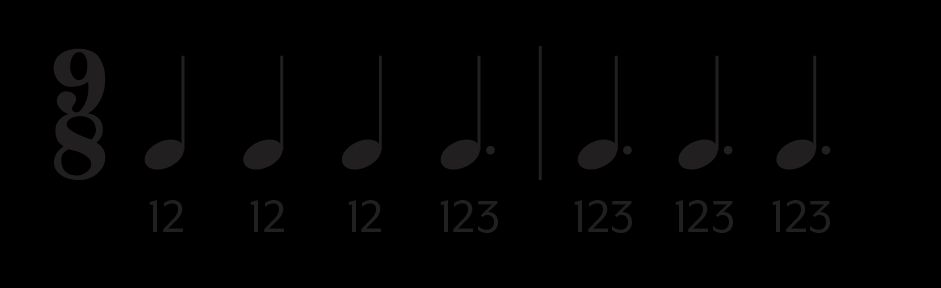
What are some tips for playing piano in 9/8 time?
One of the best ways to learn how to play piano in 9/8 time is to listen to music in 9/8! Because 9/8 can be interpreted in various ways, there are also various ways to play 9/8. Each genre of music interprets music differently so familiarize yourself with 9/8 in classical, jazz, folk, and rock. Once you’ve become familiar with the feel of 9/8, choose a piece of music written in 9/8 to learn!
What is the difference between 9/4 and 9/8 time?
The key difference between 9/4 and 9/8 is the note that gets one beat. In 9/4, the quarter note receives one beat. The 4 in the time signature indicates that the quarter note receives one beat. In 9/8, the 8 indicates that the eighth note receives one beat.
Why every pianist should explore the 9/8 time signature
The 9/8 time signature is incredibly versatile. Understanding 9/8 can open a whole new world of composition and musical understanding. Take some time to listen to music written in 9/8 and figure out what 9/8 pieces resonate with you the most!