


Some of the links in this article are affiliate links, which allow us to earn a commission when you use them to make a purchase. This helps us continue to create fun music learning experiences for everyone to enjoy.
Learn how to read piano sheet music below, including a video tutorial
Are you interested in learning how to read piano sheet music? Like learning a foreign language, learning how to read piano sheet music takes time and practice. Depending on the level of fluency that you are looking for, it may take years to accomplish this task. In this article, we will give you an introduction to reading piano sheet music, present you with tips on how to read sheet music, and list some references for you to check out!
Do I need to be able to read sheet music to play piano?
Reading sheet music is an incredibly helpful and useful skill for pianists. While not all pianists learn to read sheet music, a piano player who does not read sheet music can only play music that they’ve heard and memorized or that they improvise on the spot. Some people have a natural talent for this and can even become professional musicians. It was said that the great American songwriter Irving Berlin never learned to read sheet music well, and could only play in the key of F sharp. However, learning piano without reading music can be very difficult. While most people can learn to pick out simple melodies they’ve heard on the piano, learning to play both melody and accompaniment without ever learning to read music is very challenging and few students have the patience for it.
A pianist who can read music will be able to learn and play any written music, whether they’ve heard it before or not. When a pianist can sight read music fluently, they’ll be able to play far more music than they could ever keep memorized in their own head. They’ll be better able to accompany choirs, vocalists, and other instrumentalists, and play with a band or orchestra.
How do you read piano sheet music for beginners?
Beginners learn to read piano sheet music by breaking this complex task into smaller steps. First, to start reading piano sheet music, you must understand the musical alphabet. The musical alphabet is exactly the same as the English alphabet, but only uses the first seven letters: ABCDEFG. Once you get to G, it begins over at A again.
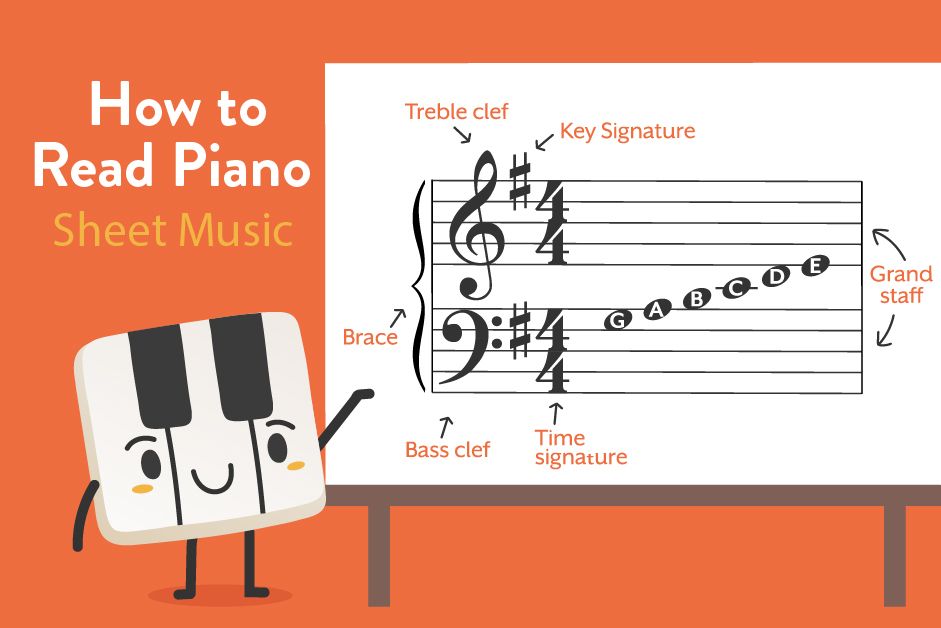
On sheet music, you will notice two sets of five lines. Each set of five lines is called a staff. Once two staffs are joined by a brace, they create a grand staff. Download our free Grand Staff Guide for a handy reference to help you learn the notes on the grand staff!
Since music is read from left to right, just like English, the grand staff normally has a treble clef at the left side of the top staff and a bass clef at the left side of the bottom staff. The treble clef tells the musician that the right hand will mostly be playing above middle C and the bass clef tells the musician that the left hand will mostly be playing below middle C. Following the clefs, you may notice a group of sharps or flats. This is called the key signature, which tells you which key you will be playing in: G major (one sharp), F major (one flat), C major (no sharps/flats), etc.
The staff is designed to correspond to the musical alphabet. If the notes on the staff are stepping up, the names of the notes are moving forward in alphabetical order. If the notes of the staff are stepping down, the note names are moving backwards in reverse alphabetical order.

Memorizing guide notes speeds up your sheet music reading. When you do this, it becomes easier to figure out new notes too! Below is a diagram of important guide notes. I recommend starting by memorizing the placement of middle C, treble G, and bass F, because these notes are easy to identify! Once you know these notes, you can count up or down from the closest guide note to identify other notes that you are unsure about. Remember: the alphabet goes forward as you step up and backwards as you step down! It’s important to count both lines and spaces, otherwise you will likely end up on the wrong note!

When reading piano sheet music, it’s important to practice the rhythm first. You can practice saying the rhythm out loud, clapping the rhythm, and/or tapping the rhythm on a table top. Next, use guide notes to help you identify the notes on the page. Lastly, as you move from one note to the next, figure out if the notes are stepping, skipping, or making leaps! This will help you figure out how to play the notes on the piano.
How to read piano sheet music: What do the two numbers mean in sheet music?
The numbers indicate the time signature of the piece. Following either the clefs or the key signature, you will notice two numbers stacked on top of each other, such as 4/4, 3/4, or 2/4. These numbers are called the time signature, which tells you how many beats are in each measure and what kind of note equals a single beat. For a visual representation of these concepts, see the illustration below:
For example, the 4/4 time signature tells you that there will be four beats in every measure and that the quarter note (represented by the bottom 4) equals the beat.
How do you memorize piano notes fast?
Memorize piano notes fast by focusing on a few notes at a time, experiencing the notes and their symbols in many different ways, and working in frequent, short, repeated sessions. Start by learning the letter names of the notes, and then learn to find them on the staff, rather than trying to learn everything at once.
For example, a beginner could start by learning the notes C, D, and E. Find these notes on your piano keyboard by looking for a set of two black keys. The note directly to the left of the two black keys is always C, the note in the middle is always D, and the note directly to the right is always E. Play each note while saying its letter name out loud. Find another set of two black keys on the piano and play C, D, and E again. Try finding all the C’s on the piano, all the D’s, and all the E’s. Then step away for a few minutes, come back, and try it again. Once you feel confident with C, D, and E, then add F and G. Focus on those two notes for a while, then go back and review the first three you learned. Last, add A and B. Learning the notes in small groups is much more effective than trying to memorize the letter names of all the notes at once.
To learn notes on the staff, flash cards can be very helpful. Choose only a few notes at a time to work on. Try saying the note name aloud when you see the note. Then, try playing the note on the piano when you see the note. Practice writing the notes on blank staff paper while saying the note name aloud as you write. Take a piece of sheet music and circle all the C’s, or whatever note you’re working on. Use as many different ways you can think of to connect the letter name, the note on the staff, and the key on the piano.
When memorizing anything, it works best to practice for a few minutes, then do something else for a while, and then practice again. This signals our brain that the information we’re trying to learn is important to remember, since it keeps coming back!
Hoffman Academy has created some fun games to help pianists learn how to read piano sheet music, like Staff Crawler, Sea Turtle Shuffle, and Piano Street. Get access to these games, along with all of our sheet music and music learning resources, with a Hoffman Academy Premium membership.
Reading piano sheet music is easier with these references
If you are looking for some free beginner piano sheet music, you can find some exciting music here on the Hoffman Academy website!
Are you looking to get better at sight reading piano sheet music, learning sheet music, and playing the piano? Check out the following blog articles and resources:
- Music Learning Resources
- What is the Musical Alphabet?
- Seven Steps for Super Sight Reading
- How to Learn a New Song on Piano
- How to Read and Play Piano Chords
What is the fastest way to get better at reading piano sheet music?
The fastest way to get better at reading sheet music is to practice a piece slowly in small, simple chunks! Reading piano sheet music is so much easier once you’ve learned to read music fluently. There is no shortcut to being able to read sheet music, so take your time and practice consistently.
One good way to strengthen your sight reading is to practice reading super simple sheet music, pieces that are much easier than the ones you could learn to perform. Then as you become comfortable, gradually increase in difficulty! We make this easy for you with our series of Sight Reading Trainers! Starting with a simple, one-line staff, these trainers will guide you all the way to reading pieces written for both hands on the full grand staff, including ledger lines! The Hoffman Academy Sight Reading Trainers are a free download for Premium members or can be purchased separately from our store. You can also order our Sight Reading Trainer Book 1 on Amazon!
Be patient and you will be surprised at how much you can accomplish! It’s also important to have fun when learning how to read sheet music! Remember that learning music doesn’t have to be difficult or boring. Find music that excites you and you will learn much quicker because you will be engaged in the music that you are learning.
We hope you have a better understanding of how to read piano sheet music. Try Hoffman Academy today and see how fun and easy learning the piano can be!