





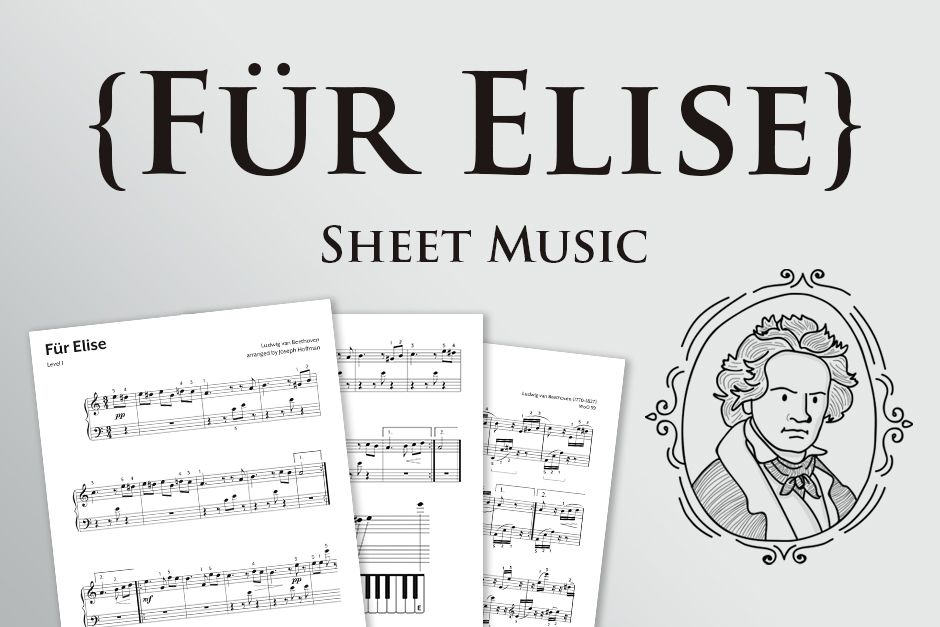
Learn to play “Für Elise” with Mr. Hoffman! Premium Members may print “Für Elise” sheet music for various levels of difficulty. Not a Premium Member? You can purchase sheet music and download it from our store.
Für Elise, Early Elementary Version
Für Elise, Elementary Version
Für Elise, Intermediate Version
Für Elise, Complete Version
Learn to play “Für Elise” with Hoffman Academy Video Lessons
Watch Mr. Hoffman play “Für Elise”
Discover the fascinating history behind this iconic classical piece in our All About “Für Elise” article!
Is “Für Elise” beginner friendly?
The original “Für Elise” is considered to be an intermediate piano piece, so a beginner would have a hard time learning the full version. Although there are parts of the piece that are easy, the music requires finger independence, hand coordination, and changes in tempo that can be challenging for a beginner pianist.
Despite the challenges, “Für Elise” is a popular piece to learn because the melody is so familiar. The recognizable theme repeats throughout the entire piece and the opening section of the piece is easier to learn because the right hand doesn’t require large stretches or complex hand movements. The middle section of “Für Elise” is faster and requires complex hand movements, which is why many pianists start with learning only the main theme.
What key is “Für Elise” in?
“Für Elise” is primarily composed in A minor, which brings a somber, introspective quality to the theme. The middle section modulates to the relative major key of C major, providing a contrast in mood and tonality. This key change brings a brighter and more lyrical tone to the piece before returning to the familiar A minor theme.
How long is “Für Elise” sheet music?
The length of “Für Elise” will depend on which arrangement you play. In our Hoffman Academy store, we have four different versions of “Für Elise” sheet music for pianists of varying levels! For young pianists just learning how to read notes, we have a one-page early elementary arrangement that shows the correct hand position and names of notes. This simple arrangement showcases the famous motif that is the universally recognizable part of the song.
For beginner pianists who can read notes, our elementary version, arranged by Joseph Hoffman, will be at the right difficulty level for them. This version is two pages and is a simplified arrangement of the main theme. For intermediate students who can comfortably navigate quick hand position changes, our one-page intermediate arrangement is the original version of the main theme. For more advanced students, we also have the complete composition of “Für Elise,” which is 5 pages long.
Is “Für Elise” homophonic?
Yes! “Für Elise” is primarily homophonic because there is one distinct melodic voice with accompaniment. The piece begins monophonic for the first two measures because there is one voice in the right hand and no accompaniment. Then, in the third measure, we hear the left hand accompaniment alongside the melody and the song becomes homophonic. The right hand typically plays the main melody, which is characterized by its flowing and recognizable motif. The left hand plays an arpeggiated accompaniment that supports the melody.
Is “Für Elise” the hardest piano song?
While the original “Für Elise” can be challenging to learn, it is not considered the hardest piano piece to play. “Für Elise” is an achievable piano goal to work towards and there are many arrangements of “Für Elise” that can fit your skill level.
What are the notes of “Für Elise?”
Let’s look at the main notes for this famous theme! Here we will show how to play the melody in the Early Elementary version of Für Elise. Although “Für Elise” is written in A minor, there are important accidentals that we will need to know how to play. An accidental is a symbol, like a sharp or flat, that tells the musician to raise or lower a note by a half step. In this melody, we’ll encounter D# and a G#.
For this arrangement, the melody is split between the left hand and the right hand and uses 9 notes: Middle C, E, G#, A, B, C, D, D#, and E. Middle C is the lowest note of the melody and treble E is the highest note of the melody. The rhythm is composed almost entirely of eighth notes (“titi” – two eighth notes fit into one beat). It also uses dotted quarter notes (equal to a beat and a half) and half notes (equal to two beats) at the ends of phrases.
Here are the main notes of the melody and how the notes are split between the two hands:
RH: E, D#, E, D#, E, B, D, C, A
LH: C, E, A RH: B
LH: E RH: G#, B, C
LH: E RH: E, D#, E, D#, E, B, D, C, A
LH: C, E RH: A, B
LH: E RH: C, B, A
To learn the hand position and fingering for each note, check out our Early Elementary “Für Elise” sheet music here!
What tempo is “Für Elise?”
The exact tempo of “Für Elise” can often vary depending on the performer and interpretation of the piece. The piece is marked “Poco moto” which is an Italian music term for “a little motion/movement.” This is used to indicate that the piece should be played not too fast and not too slow. It often implies the use of rubato, another Italian music term that refers to the practice of deviating from the strict tempo to allow for greater phrasing and musical expression.
The B section of “Für Elise” is a stark contrast to the A section. It is played with a slight increase in tempo with a sense of urgency and agitation. The C section has more chords and feels march-like. The tempo is steady with less rubato than the previous sections.
What are the dynamics in “Für Elise?”
The dynamics of “Für Elise” play a crucial role in the character and emotion of the piece. The opening theme is primarily played pianissimo (pp), with an occasional crescendo to mezzo forte (mf) or diminuendo. The B section is slightly louder but is still soft, marked with the dynamic piano (p). The C section is the first instance of forte (f) and here we hear the most dynamic range with crescendos, diminuendos, and pianissimo. Lastly, the final return to the A section is played pianissimo and is marked with a ritardando in the last few measures of the piece. The ritardando indicates a gradual slowing down in the final notes of the piece.
Some famous performances of “Für Elise”
Here are some of our favorite performances of “Für Elise!”
We hope these performances inspire you to start your own “Für Elise” journey. Happy playing!